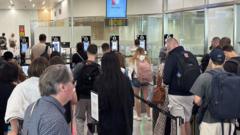
Airport executives love a good scapegoat. Every time summer approaches, the aviation lobby dusts off the exact same press release, swaps out the dates, and warns the public about "unbearable" border delays. The current target of their wrath is the European Union's automated Entry/Exit System. They claim biometric registration will ground tourism to a halt, destroy the travel economy, and leave millions of passengers trapped in sweat-drenched queues.
It is a masterful piece of misdirection.
The frantic warnings coming from airline and airport trade bodies are not born out of concern for your vacation. They are born out of a desperate desire to protect a broken business model. For decades, the aviation industry has treated passport control as an externalized externality—a government function they can blame whenever operational friction exposes their own systemic understaffing and outdated infrastructure.
The truth is uncomfortable. The impending border friction is not an administrative failure. It is an intentional, structural shift toward data-driven security, and the airport industry is screaming simply because they refuse to pay for the operational adaptations required to handle it.
The Myth of the Seamless Journey
Aviation marketing has spent twenty years selling a lie called the frictionless journey. They want you to believe that international travel across borders should feel exactly like boarding a domestic bus. It shouldn't, and logically, it cannot.
When airport bosses scream that a 90-second biometric registration per passenger will break the system, they are admitting that their operations run on a margin of error so razor-thin that a minor variation in processing time collapses the entire house of cards. That is not a border problem. That is a capacity management problem.
Consider the mechanics of the modern terminal. Airports are no longer transportation hubs; they are high-margin shopping malls with runways attached. In a standard European hub, non-aeronautical revenue—duty-free alcohol, luxury boutiques, overpriced coffee, and predatory parking fees—accounts for up to 40% to 50% of total income.
Every minute a passenger spends standing in a border queue is a minute they are not spending money at a retail terminal. That is the real source of the panic. The airport lobby does not care if you miss your flight; they care that you did not have time to buy a designer perfume before boarding. They want governments to flood the borders with border guards to speed up the line, effectively subsidizing the airport's retail foot traffic with taxpayer money.
The Math Behind the Lines
Let's look at the actual operational math that the industry refuses to discuss publicly.
When a new system requires fingerprint scans and facial recognition for non-EU travelers, processing times will inevitably rise during the initial enrollment phase. Industry consultants predict that transaction times at the booth will increase from an average of 45 seconds to roughly two minutes per person.
To an amateur observer, a 75-second increase sounds catastrophic when multiplied by a wide-body aircraft carrying 300 passengers. But this assume airports are passive victims of time. They are not. They control the flow of passengers long before those passengers ever reach a border booth.
Imagine a scenario where a terminal handles 5,000 arriving international passengers per hour. If your processing time increases by 150%, a competent logistics operation responds by doing three things:
- De-peaking flight arrivals to smooth out the waves of passengers hitting the hall at the exact same moment.
- Repurposing underutilized floor space from high-end retail boutiques back into queuing and processing zones.
- Investing heavily in pre-enrollment mobile technology so passengers upload their data before they even leave their house.
Instead of executing these steps, airports have spent the last three years lobbying for delays, exemptions, and extensions. They wanted the status quo because the status quo lets them maximize gate utilization and flight density during peak morning and evening banks, completely ignoring the physical limitations of the processing space below.
Why Automated Friction is Good for Security
The aviation lobby wants you to think that passport control is just a bureaucratic rubber-stamping exercise that should be done as quickly as possible. This view is dangerously naive.
The global security environment is fundamentally changing. Transnational crime, identity fraud, and irregular migration require physical verification systems that go beyond a human border guard glancing at a blurry passport photo for three seconds. The manual passport stamp—a 19th-century technology that is shockingly easy to forge, manipulate, or misread—is a massive vulnerability.
Automated biometric tracking shuts down identity fraud instantly. It ensures that an individual entering the Schengen zone under one name cannot exit under another. Yes, this requires a heavy front-loaded investment in time during the first registration. But once that data is captured, subsequent crossings become significantly faster than traditional manual checks.
The industry's insistence on delaying these systems is an insistence on maintaining a less secure border purely for the convenience of airline scheduling. We saw the exact same complaints when liquid bans were introduced after 2006, and again when advanced imaging scanners were rolled out. The industry claimed those security measures would kill air travel. They didn't. Travelers adapted, the technology matured, and the system adjusted.
The Cost of Cheap Labor Dependency
For decades, both airlines and airports have relied on a pool of cheap, flexible, seasonal labor to handle peak summer traffic. When the travel market collapsed during the pandemic, these companies laid off tens of thousands of experienced ground handlers, security screeners, and check-in staff to protect their balance sheets.
When travel bounced back, they discovered that workers were not willing to return to low-wage, high-stress split shifts in expensive airport locations. The resulting chaos of lost bags and canceled flights was entirely self-inflicted.
Now, facing a technological upgrade at the border, the aviation sector is making the same mistake. Instead of training their own staff to assist passengers with pre-enrollment kiosks and managing flows upstream, they are demanding that government agencies hire thousands of extra border guards to bail them out.
I have spent years analyzing transportation networks, and the pattern is always the same: private operators privatize the profits during boom times and socialize the operational headaches when things get tight. Border control agencies have fixed budgets and strict training requirements. You cannot simply hire a border guard off the street and put them in a uniform by July. The airport executives know this, yet they continue to use the threat of summer queues to pressure governments into softening security protocols.
Stop Asking the Wrong Questions
The media continuously echoes the industry's favorite question: How can governments prevent border queues from ruining the summer holiday season?
This is the wrong question. The real question we should be asking is: Why have major international airports failed to upgrade their terminal layouts and passenger flow strategies despite knowing about these regulatory changes for nearly a decade?
The EU Entry/Exit System was not invented yesterday. It has been debated, legislated, and delayed repeatedly since 2017. Every major airport operator in Europe has had ample time to redesign their arrival halls, install pre-registration kiosks, and work with airlines to adjust schedules.
They chose not to because doing so would require capital expenditure that does not yield an immediate retail return. They gambled that if they waited long enough, they could scare the public and pressure politicians into stalling the implementation. They lost that gamble, and now they are panicking.
The Reality of the Transition
Let’s be brutally honest about what will happen. There will be queues. There will be delays. Some passengers will miss connections.
But this friction is a necessary tax on transitioning from an obsolete, paper-and-ink border regime to a digital infrastructure built for the next fifty years. It is a classic operational bottleneck issue. When you upgrade a core database or a physical pipeline, throughput drops temporarily while the new architecture initializes.
The airports that will survive this transition smoothly are not the ones crying to the press. They are the hubs that are actively shrinking their duty-free footprints to build massive, climate-controlled pre-enrollment zones. They are the operators telling airlines that if they cannot space out their arrivals, they will lose their slots.
The Final Reckoning for Aviation Lobbyists
The era of hyper-cheap, frictionless international mass transit is colliding with the realities of national security and data sovereignty. If an airport cannot handle a two-minute processing time per international passenger without its entire operation collapsing into chaos, then that airport is poorly managed, structurally deficient, and fundamentally unsafe from an operational perspective.
Stop buying into the corporate hysteria. The border isn't broken. The airports are just lazy.