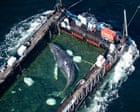
The conservation world is currently clutching its collective pearls over the "catastrophic" rescue attempt of Timmy the whale. The narrative is already set in stone: the tracker failed, the technology was deficient, and we sent a magnificent creature back into the deep with a broken GPS. It is a neat, tidy story that allows us to blame a microchip instead of our own fundamental misunderstanding of marine biology.
The tracker didn’t fail the whale. Our arrogance did. Expanding on this idea, you can find more in: The Missing Person Industrial Complex Why Our Grief Obsession Fails the Vulnerable.
Critics are lining up to scream about "deficient" tracking units and "all-round catastrophes." They are wrong. They are focused on the hardware because hardware is easy to criticize. It has a serial number. It has a warranty. You can point at a flat battery or a snapped antenna and say, "There. That is why the mission failed." But the obsession with real-time data is a crutch for a rescue industry that has forgotten how to actually read an animal.
The Myth of the Perfect Pinger
For decades, I have watched marine response teams pour six-figure budgets into satellite tags while their on-the-ground biological assessments remain stuck in the 1990s. We have become data-drunk. We believe that if we can see a blue dot on a screen, the animal is "safe." Analysts at TIME have shared their thoughts on this trend.
This is a dangerous fallacy.
Satellite tags on cetaceans fail at a rate that would bankrupt any other tech sector. We are trying to bolt electronics onto a living, breathing, high-pressure diving machine that spends 90% of its life in corrosive saltwater. The salt destroys the casing; the pressure crushes the sensors; the animal’s own skin rejects the attachment site. Expecting a tracker to survive the breach of a humpback is like expecting a smartphone to survive being fired out of a cannon into a coral reef.
The "deficiency" cited in the Timmy case isn't a manufacturing flaw. It is a biological reality. Tags fall off. They stop transmitting when the animal dives deep—which is exactly what a healthy whale should be doing.
We Are Tracking Death, Not Life
Here is the hard truth that nobody in the nonprofit sector wants to admit: If you need a tracker to tell you if a rescue was successful, the rescue probably wasn't a success.
A truly rehabilitated whale doesn't need a babysitter. If Timmy was fit for release, he should have been able to navigate, hunt, and socialize without a plastic box tethered to his dorsal fin. By making the tracker the metric of success, we have turned "rescue" into "surveillance."
When the tag goes dark, the experts panic. They call it a catastrophe. Why? Because they can no longer prove to their donors that the whale is alive. The panic isn't about the whale’s heartbeat; it’s about the signal. We have reached a point where a whale that is alive but untraceable is considered a "failure," while a whale that is dying but transmitting perfect coordinates is a "data success."
The High Cost of Tech-First Conservation
Every dollar spent on high-end telemetry is a dollar taken away from habitat preservation and acoustic pollution mitigation. We are obsessed with the individual—the "Timmy" of the week—because individuals make for great social media content and tear-jerking fundraising emails.
But biology is a game of populations, not individuals.
From an industry insider perspective, the "catastrophe" isn't that a tracker stopped working. The catastrophe is that we have built an entire response infrastructure that depends on these trackers to justify its own existence. We are treating the ocean like a smart home where every resident needs to be "connected."
Think about the physical trauma of the attachment. We are chasing an already stressed, recovering animal with boats, getting close enough to fire a dart or bolt a clamp into its flesh. We do this in the name of "monitoring." Imagine being discharged from a hospital after a traumatic injury, only for the doctors to chase you down the street and staple a GPS to your ear "for your own safety."
The stress of the tagging process itself can be the tipping point that leads to a post-release mortality. We are literally killing them with our need to know where they are.
The Data Gap Nobody Talks About
The "experts" quoted in the recent outrage are likely referring to Argos-system limitations or battery life cycles. Let's talk about the physics they are ignoring.
- The Saltwater Switch: Most tags only transmit when the salt-water switch clears the surface. If a whale is swimming shallowly or in heavy swells, the signal is fragmented.
- The Satellite Window: You need a bird overhead. If the whale surfaces when the satellite is over the horizon, the data is lost.
- The Bio-fouling: Within days, algae and barnacles begin to grow on the sensor.
To call the Timmy incident a "deficient tracker" issue is to display a profound ignorance of how the ocean works. The hardware performed within the known parameters of marine telemetry. The failure was the expectation that the hardware could compensate for a shaky release decision.
Stop Asking "Where is He?" Start Asking "Why?"
The public asks: "Where is Timmy?"
The "experts" ask: "Why did the tag stop?"
Both are the wrong questions. The right question is: Why did we think a tracker would change the outcome?
If the whale was healthy, he's out there doing whale things, invisible and free. If he wasn't healthy, a functional tracker would have just given us a front-row seat to his demise. Neither of those outcomes is changed by a better battery or a stronger antenna.
We have substituted gadgetry for craftsmanship. A seasoned mariner can look at the blow pattern, the fluke arch, and the skin tension of a whale and tell you more about its survival chances than a $5,000 tag ever will. But you can't put a "seasoned mariner's gut feeling" in a quarterly impact report. You can't chart it on a spreadsheet for the board of directors.
The Professional Cowardice of the "Deficient" Label
By blaming the technology, the rescue teams get a free pass. If it's a "hardware failure," then the humans did everything right. The veterinarians are blameless. The logistics team is blameless. The "catastrophe" is moved from the realm of human judgment to the realm of mechanical error.
It is a convenient lie. It protects the brand. It keeps the donations flowing because the solution is simple: "We just need more money for better trackers next time."
It’s time to stop the tech-worship. If we can't save a whale without tagging it, we aren't saving it; we’re just studying its disappearance. The most successful rescue is the one where the animal swims away and we never, ever see it again.
The tracker didn't fail. It did exactly what it was supposed to do: it showed us that we're obsessed with the wrong things.
Get rid of the tags. Watch the water. Accept the silence.