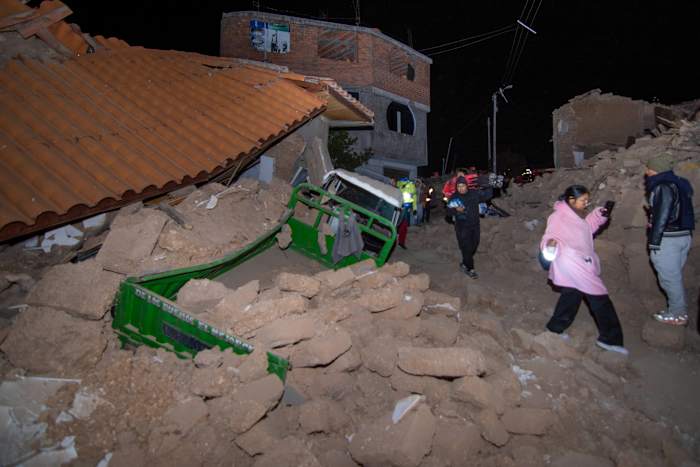
The mainstream media has a predictable, lazy formula for reporting natural disasters. A 5.5 magnitude earthquake strikes Peru’s Andes region. Five people tragically lose their lives. The headlines immediately point to the sky, or rather the fault lines, blaming the raw, unstoppable fury of Mother Nature. They treat a 5.5 magnitude event as an unavoidable cataclysm.
They are wrong. A 5.5 magnitude earthquake is not a monster. It is a geological hiccup.
If a 5.5 earthquake happens in California or Japan, people look up from their coffee, wait ten seconds, and go back to work. When it happens in the Andes, buildings collapse and families are buried. The disaster here is not seismological. It is structural, political, and entirely human-made. By focusing on the seismic reading instead of the failure of local infrastructure, the media shields the real culprits: corrupt local governance, ignored building codes, and the weaponization of poverty.
The Myth of the "Powerful" 5.5 Magnitude Event
Let’s correct the science immediately. The Richter scale, and the modern Moment Magnitude scale, are logarithmic. A magnitude 7.0 earthquake doesn't just feel a little stronger than a 5.0; it releases roughly 1,000 times more energy.
A 5.5 magnitude event is classified by seismologists as a "moderate" earthquake. The earth shakes, yes. But modern engineering cracked the code on surviving moderate shaking nearly a century ago.
- What kills people in an earthquake: Falling concrete, collapsing roofs, and unreinforced masonry.
- What does not kill people: The actual movement of the ground.
When the media reports on the Andes casualties as if they were the inevitable casualty of a planetary tantrum, they miss the entire point. I have spent years reviewing structural failures in post-disaster zones, watching billions of dollars in international aid pour into regions after the fact, while the glaring, pre-existing structural flaws are ignored for decades. We are funding funerals instead of funding concrete reinforcement.
The Adobe Trap: Traditionalism vs. Survival
The Andes region relies heavily on adobe—sun-dried earth bricks—for housing. It is cheap, thermally efficient, and culturally rooted. It is also a death trap in a seismic zone.
Adobe has virtually zero tensile strength. When the ground moves horizontally, adobe walls crack instantly and heavy mud roofs come crashing down on the occupants. This isn't a secret. The Pontifical Catholic University of Peru (PUCP) has spent decades researching low-cost seismic reinforcements for adobe homes, such as using geomesh plastics or wire mesh to bind the walls together.
The cost to reinforce an existing adobe home? A few hundred dollars.
Yet, these interventions remain academic case studies rather than widespread public policy. Why? Because local governments find it easier to hand out plastic tarps and emergency rations after a disaster than to enforce building regulations beforehand. It is a cynical cycle of reactive governance. Surviving a 5.5 magnitude earthquake should be the bare minimum standard for any dwelling in the 21st century, regardless of the region's GDP.
Why "People Also Ask" About Earthquakes Is Flawed
Look at any search engine data following an Andean earthquake, and you will see the same naive questions trending:
- Can we predict when the next Peru earthquake will happen?
- Is the Andes region overdue for a major earthquake?
These questions are fundamentally flawed because they seek a chronological scapegoat. Predictability is a red herring. We already know the Andes is an active subduction zone where the Nazca Plate dives beneath the South American Plate. We know with 100% certainty that earthquakes will happen. Trying to predict the exact Tuesday a fault line slips is a waste of scientific capital when we aren’t even preparing for the inevitable.
The question people should be asking is: Why did a house built in 2024 collapse under forces that a 1970s Tokyo apartment complex would ignore?
The brutal answer is informal construction. In rural and peri-urban Peru, upwards of 70% of residential structures are built without an engineer, an architect, or a municipal permit. It is self-construction driven by economic necessity. But poverty cannot be used as a blanket excuse for structural negligence when the solutions for basic seismic resistance are incredibly low-tech.
The Counter-Intuitive Truth About Foreign Aid
Here is the bitter pill that international donors hate to swallow: unrestricted post-disaster humanitarian aid often perpetuates the vulnerability of these communities.
When a localized disaster hits, millions of dollars stream in from international NGOs. This money builds temporary shelters, provides food, and sets up medical tents. Then, after three months, the cameras leave. The local population uses whatever materials are left over to rebuild the exact same unreinforced structures on the exact same unstable hillsides.
If we actually want to stop the body count from rising during moderate seismic events, the entire funding model must be flipped.
- Withhold reconstruction funds from municipalities that refuse to enforce basic seismic zoning laws.
- Subsidize building materials like rebar and cement instead of sending processed food rations.
- Mandate structural auditing for public buildings, especially schools and clinics, in high-risk rural corridors.
This approach is harsh. It requires confronting local political machines and disrupting the comforting narrative of pure, unadulterated charity. But continuing to treat these preventable structural failures as unpredictable tragedies is a form of passive complicity.
Stop looking at the magnitude numbers on the news. The ground shook in the Andes, but it was the systemic failure of human infrastructure that killed five people. If we don't change how we build, the next moderate tremor will do the exact same thing, and the blame will lie squarely on us, not the earth.