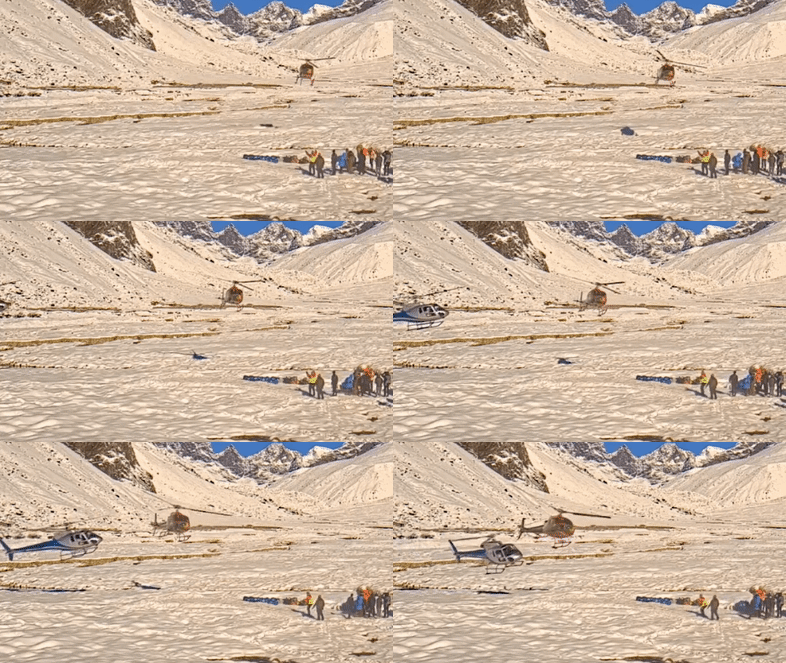
Every time grainier-than-usual footage of a rotorcraft clipping a ridge or slamming into a helipad on Mount Everest goes viral, the mainstream media runs the exact same script. They point at the jagged peaks. They talk dramatically about "thin air," "unpredictable mountain weather," and the "death zone." They frame every twisted wreck in the Khumbu region as an inevitable tax paid to Mother Nature by brave pilots and adventurous trekkers.
That narrative is lazy. Worse, it is a convenient lie that shields the people actually responsible for turning the world’s highest mountain into an unregulated, high-altitude demolition derby.
If you look closely at the viral crash footage coming out of Nepal—including the infamous multi-helicopter collisions at Lukla and the endless string of hard landings near Everest Base Camp—the culprit isn't the altitude. Aerodynamics do not change overnight. Pilots know the math of density altitude before they ever turn the key. The real killer in the Himalayas is a toxic cocktail of commercial greed, regulatory capture, and a tourism model that treats single-engine light helicopters like city taxicabs.
The Physics Excuse Is a Distraction
Let’s get the technical reality out of the way first, because aviation bureaucrats love hiding behind jargon when metal bends.
Yes, flying at 14,000 to 20,000 feet is unforgiving. At those altitudes, air density drops precipitously. To understand why helicopters struggle there, you have to understand density altitude—the altitude at which the airframe "feels" like it is flying, corrected for non-standard temperature and pressure. On a warm afternoon in the Khumbu Valley, a helipad sitting at 14,000 feet can easily present a density altitude closer to 17,000 feet.
At that level, three distinct aerodynamic penalties hit the aircraft simultaneously:
- Reduced Rotor Efficiency: Helicopter blades generate lift by pushing air downward. Fewer air molecules mean the main rotor has to spin at maximum pitch just to maintain a hover, eating up almost all available engine power.
- Tail Rotor Authority Loss: Because the main rotor is working harder, torque increases. The tail rotor—which prevents the fuselage from spinning out of control—is also starved of air. A sudden gust from the wrong direction can overwhelm the tail rotor, leading to a catastrophic loss of tail-rotor effectiveness (LTE).
- Zero Margin for Vortex Ring State: If a pilot descends too quickly into their own downwash while trying to hit a tight landing zone, the helicopter drops like a stone. Recovering requires altitude and excess power—two things you do not have at Gorak Shep or Pheriche.
Here is the catch: none of this is a secret.
Every commercial pilot flying an Airbus H125 (the AS350 B3e, the undisputed workhorse of the Himalayas) knows the performance charts inside and out. The machine is an engineering marvel, capable of hovering out of ground effect at staggering elevations—provided it is flown within its weight limits and strictly according to protocol.
When a helicopter collides with another aircraft on a tarmac or clips a rock face on approach, it is rarely because the laws of physics suddenly betrayed the pilot. It is because human beings decided to ignore the margins those laws demand.
Follow the Money in the Khumbu Valley
I have spent years analyzing commercial aviation risk in developing markets, and I have watched operators burn through millions of dollars in hull losses by pretending that "local conditions" excuse reckless dispatch practices. In Nepal, the problem isn't a lack of skill; it is a broken incentive structure.
A decade ago, Everest expeditions relied almost exclusively on yaks and human porters to move gear from Lukla to Base Camp. Helicopters were reserved for genuine life-or-death medical evacuations.
Today, the helicopter is a luxury shuttle, a cargo mule, and an insurance-scam ATM all rolled into one.
The "Fake Rescue" Industrial Complex
If you want to understand why the skies over Everest are dangerously congested, look at the travel insurance racket that exploded in Kathmandu. For years, unscrupulous trekking agencies, helicopter operators, and private hospitals colluded in a multi-million-dollar scheme:
- Guides would intentionally feed trekkers contaminated food or push them up the trail too fast to induce acute mountain sickness (AMS).
- Once a client felt nauseous or dizzy, the guide would pressure them into calling for a helicopter evacuation, assuring them their travel insurance would cover the $4,000 to $6,000 flight.
- The helicopter company would bill the insurer, kick back a commission to the trekking agency, and drop the tourist at an overpriced Kathmandu hospital for unnecessary tests.
Even after international insurers cracked down and demanded pre-authorization, the infrastructure—dozens of newly financed helicopters bought on steep loans—remained. Those loans still have to be paid every month. When the fraudulent rescue money dried up, operators pivoted to high-volume, razor-thin-margin shuttles: flying VIP clients directly to Base Camp for breakfast, ferrying climbers back down to Namche Bazaar for hot showers between rotations, and running non-stop cargo slings to bypass the Khumbu Icefall.
The Tyranny of the "Window"
In the Himalayas, weather closes in fast. By 10:00 AM or 11:00 AM, thermal winds roar up the valleys and thick clouds swallow the landing zones. That gives operators a brutal three-to-four-hour window every morning to make their entire day’s revenue.
Imagine a scenario where ten different companies are all trying to cram forty flights into a single narrow canyon before the clouds roll in, landing on postage-stamp helipads with zero air traffic control.
Pilots are pressured—sometimes explicitly, always implicitly—to fly overweight, skip thorough pre-flight weight-and-balance checks, and take off into marginal visibility. If Pilot A refuses a flight because the tailwind is too strong or the payload is 50 kilograms over the chart limit, the dispatcher simply hands the contract to Pilot B across the ramp. In an industry where saying "no" gets you blacklisted, safety checklists become fiction.
The Infrastructure Illusion
Watch the viral crash footage again. Notice where many of the collisions happen. They aren't happening in blinding blizzards at 25,000 feet. They are happening on the ground, or ten feet above it, at busy hubs like Tenzing-Hillary Airport in Lukla or the overcrowded pads at Base Camp.
Nepal’s aviation infrastructure was never built for the sheer volume of rotary-wing traffic it currently handles.
- No Radar, No Separation: Outside of Kathmandu, separation between aircraft relies almost entirely on pilots announcing their positions over a shared radio frequency—a system that breaks down instantly when a dozen helicopters are talking over each other in a steep valley that blocks line-of-sight VHF signals.
- Tight, Unsecured Landing Zones: At peak season, helicopters land within feet of parked aircraft, fuel drums, and crowds of tourists holding smartphones. Downwash from a heavy AS350 can kick up gravel, knock bystanders off their feet, and violently rock adjacent parked helicopters whose rotors are still spinning down.
- Fatigue Masquerading as Experience: During the spring climbing window (April and May), a single pilot might fly eight to ten sorties a day, cycling repeatedly between 9,000 feet and 18,000 feet. The physiological toll of rapid altitude transitions combined with extreme cognitive load degrades reaction times. A pilot on their ninth run of the morning is not operating at peak sharpness, no matter how many thousands of hours sit in their logbook.
The European Union has banned all Nepali airlines from flying into EU airspace since 2013 for a reason. The Civil Aviation Authority of Nepal (CAAN) acts as both the regulator and the service provider—a textbook conflict of interest flagged repeatedly by the International Civil Aviation Organization (ICAO). When the referee is also selling tickets to the game, nobody gets ejected for fouling.
Dismantling the Myths Travelers Believe
When tourists book a helicopter tour of Everest or buy a high-end expedition package that promises "helicopter support," they operate on dangerous assumptions. Let’s tear those down.
"Are helicopters safe to take to Everest Base Camp?"
The conventional answer: "Yes, modern helicopters are specially equipped for high altitude and flown by experienced mountain pilots."
The brutal truth: No commercial helicopter operation in the Khumbu Valley meets the safety standards you would expect in the Swiss Alps, the Canadian Rockies, or Alaska. You are flying in single-engine aircraft over hostile terrain with zero emergency landing options, managed by operators facing immense financial pressure, under a regulator that has failed international safety audits for over a decade. It works—until the exact second a minor mechanical hiccup or a sudden wind shift removes your last inch of margin.
"Why don't they just use bigger, twin-engine helicopters?"
The conventional answer: "Light helicopters are more agile in narrow mountain valleys."
The brutal truth: Weight is the enemy of altitude. Twin-engine helicopters carry the massive dead weight of a second turbine and heavier transmission systems. Above 15,000 feet, most twin-engine civilian helicopters cannot hover safely with a useful payload; their power-to-weight ratio collapses. Operators use single-engine light helicopters because they are the only machines light enough to carry paying passengers up there—which means if that single engine flames out, you are riding a brick straight into the granite.
"Doesn't the Nepalese government enforce strict rules after every crash?"
The conventional answer: "Authorities have introduced new weight limits and single-pilot restrictions to improve safety."
The brutal truth: CAAN issues reactionary bans every time a crash makes international headlines—temporarily outlawing commercial sightseeing flights or banning sling loads—only to quietly roll them back weeks later after intense lobbying from the Airline Operators Association of Nepal. Paper regulations mean nothing without ramp inspections and grounded fleets.
The Uncomfortable Trade-Off Nobody Wants to Admit
To be completely fair, banning or heavily restricting helicopters in the Everest region carries a massive human cost that armchair critics in the West routinely ignore.
If you ground the fleet tomorrow, people will die on the mountain who otherwise would have lived.
Before helicopters became ubiquitous in the Khumbu, a climber suffering from High Altitude Cerebral Edema (HACE) at Camp II or a Sherpa injured in the Khumbu Icefall faced a brutal, multi-day carry down to Lukla—a journey many did not survive. Today, a skilled pilot can pluck an injured climber off the Western Cwm at nearly 20,000 feet and have them in a hyperbaric chamber in Kathmandu in under an hour. That capability has saved hundreds of lives.
Furthermore, sling-loading equipment directly to Camp I reduces the number of times Sherpas have to haul heavy loads through the Khumbu Icefall—statistically the most lethal stretch of terrain on the mountain, where shifting seracs crush climbers without warning.
So the answer isn't a blanket ban. The answer is separating essential utility from vanity tourism.
How to Actually Fix High-Altitude Aviation on Everest
If regulators and expedition operators actually cared about stopping the carnage instead of protecting quarterly cash flow, four non-negotiable changes would happen before the next climbing season begins:
- Ban Pure Sightseeing Flights Above Namche Bazaar: There is zero justification for clogging high-altitude airspace so tourists can snap a five-minute selfie at Kala Patthar. Limit flights above 12,000 feet strictly to verified medical evacuations, essential expedition logistics, and scientific/government missions.
- Mandate Real-Time Satellite Tracking and ADS-B: Every rotorcraft operating in the Sagarmatha National Park must carry active, tamper-proof satellite telemetry monitored by an independent dispatch center, eliminating blind-spot mid-air conflicts and automatically flagging overweight takeoffs via torque-sensor data.
- Enforce Hard Daily Flight-Time Caps: Cap high-altitude pilots at four sorties per day above 14,000 feet. Fatigue is a silent killer; no amount of "mountain toughness" overrides human physiology.
- Break Up the Regulator: Strip CAAN of its airport management and commercial revenue functions so it exists solely as an independent safety watchdog with the authority to permanently revoke Air Operator Certificates (AOCs) without political interference.
Stop Watching the Wreckage and Start Watching the Wallet
The next time you see horrifying video of a helicopter spinning out of control on the side of Everest, resist the urge to marvel at the "ruthless power of nature." Nature didn't overload that cabin. Nature didn't build three helipads ten yards apart without a control tower. Nature didn't turn a life-saving rescue machine into an airborne Uber for impatient influencers.
If you are planning a trek or an expedition to the Himalayas, look past the glossy brochures and ask the only question that actually keeps you alive: Does my operator pay their pilots when they refuse to fly?
If the answer is no, stay off the chopper and walk.