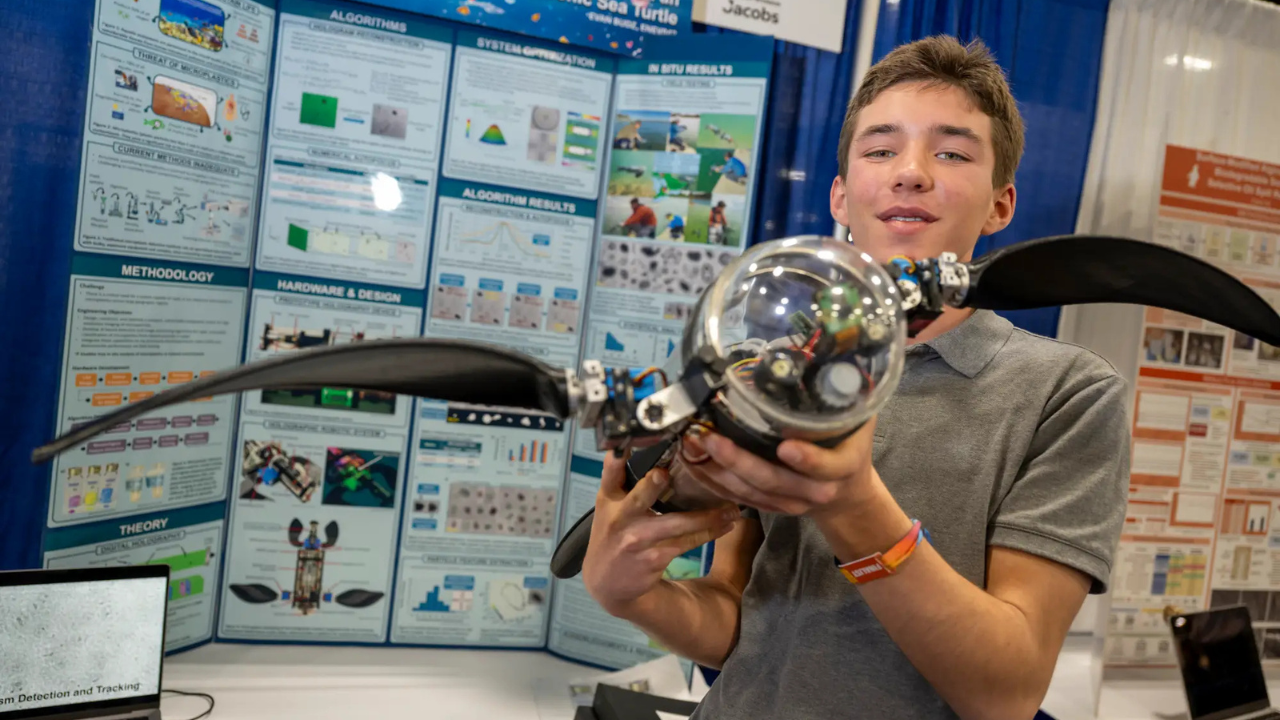
Tech media loves a feel-good story. A sixteen-year-old student builds a flippered robot inspired by snapping turtles, equips it with digital holography and a Raspberry Pi running custom machine learning models, and claims 94% accuracy in spotting microplastics in a swimming pool. The science fair judges shower it with awards, the headlines write themselves, and the tech community nods approvingly at another triumph of youth innovation.
It is brilliant tinkering. It is also an expensive distraction from how oceanography, fluid dynamics, and environmental policy actually work. You might also find this connected coverage insightful: Why Wall Street Is Completely Blind To The Real Robotaxi Math.
The tech industry is addicted to diagnostic gadgets that look impressive on camera while doing almost nothing to fix the actual catastrophe. We are building hyper-complex, fragile, autonomous toys to count individual microscopic particles in an ocean containing tens of trillions of them.
It is time to stop applauding high-tech monitoring theatre and talk about the brutal realities of ocean sensor engineering. As discussed in recent coverage by MIT Technology Review, the implications are notable.
The Diagnostics Trap: Why 94% Accuracy in a Swimming Pool Means Nothing
The core thesis behind autonomous environmental monitoring platforms like BURT is simple: if we can collect hyper-localized, real-time data on microplastics, we can better target mitigation efforts.
This sounds reasonable until you run the numbers on ocean volumes.
The ocean holds roughly 1.3 billion cubic kilometers of water. Microplastics are not distributed uniformly like dye in a sink. They exist across variable depths, stratified by density, salinity, solar degradation, biofouling, and thermal currents. Polyethylene (PE) floats near the surface; Polyethylene Terephthalate (PET) sinks; micro-fibers get suspended in deep oceanic pycnoclines.
I have seen venture-backed ocean startups sink millions of dollars into deploying autonomous surface vessels and micro-drones designed to map marine debris. Almost every single one hit the exact same wall: the ocean is too vast for localized point-source counting.
Imagine a scenario where a city's air pollution is so thick that residents can barely breathe. Instead of filtering industrial smokestacks or halting toxic emissions, municipal engineers deploy thousands of tiny robotic hummingbirds to count microscopic soot particles mid-air with 94% precision. You now have a very accurate map of where people are choking. You have solved zero percent of the pollution.
Data collection is not remediation. We already know the oceans are saturated with degraded synthetic polymers. We know where the major river gyres discharge them. Adding an autonomous turtle to count 10-micron particles in a localized patch of water does not alter the ecological outcome by a single fraction of a percent. It simply generates higher-resolution charts of an existing disaster.
Flippers Look Cute. In Marine Engineering, They Are a Mechanical Nightmare
The appeal of biomimicry is obvious. Nature evolved turtles over tens of millions of years to achieve incredible hydrodynamics and energy economy. So, the logic goes, building a robot that flaps four flippers must be superior to traditional underwater propellers.
This completely misunderstands mechanical physics.
Biological sea turtles possess flexible, multi-jointed cartilage, self-healing tissue, dynamic muscle tension, and real-time sensory feedback loops integrated directly into their nervous systems. Man-made biomimetic flippers, by contrast, rely on rigid linkages, waterproofing seals, servos, and step-motors subjected to cyclic mechanical stress.
In a controlled eight-foot backyard swimming pool, four flapping acrylic flippers look elegant. Put that same mechanical linkage into open marine environments, and physics takes its tax:
- Seal Fatigue and Shear Stress: Constant reciprocal flapping subjects mechanical shaft seals to continuous lateral shear forces. Traditional rotary propellers use static axial seals that are infinitely easier to insulate against high hydrostatic pressure. Oscillating flippers fail at the joints.
- Energy Transfer Efficiency: A brushless DC motor driving a direct-drive magnetic-coupling thruster converts electrical current to vector propulsion with minimal moving parts. Converting rotary motor motion into reciprocating flipper sweeps through mechanical gears introduces massive kinetic friction losses.
- Biofouling Nightmare: Marine organisms do not care about sleek CAD models. Within 72 hours of ocean submersion, micro-algae, barnacles, and bryozoans colonize every recessed crease, hinge, and flipper joint. A rotary propeller can be coated with simple foul-release silicone. Multi-jointed oscillating flippers offer dozens of mechanical crevices where bio-growth will lock the gears solid.
If your goal is extended deployment in actual coastal or pelagic zones, a simple neutrally buoyant underwater glider—which uses internal moving weights and variable-buoyancy bladders to glide forward without a single external moving part—will outlast any flippered robot by months, using a fraction of the power.
Biomimicry makes for fantastic science fair demonstrations. Simple, ugly, sealed propulsion systems win in the ocean.
Holography vs. Chemistry: Why Optical Shapes Aren't Proof of Plastic
The most impressive technical feature claimed by these bionic platforms is onboard digital holographic imaging paired with machine learning classification. The onboard microcomputer takes 3D holographic snapshots of suspended particles down to 10 microns and uses a trained neural network to separate microplastics from biological organic material.
Here is the dirty secret of environmental microplastic analysis: you cannot definitively verify microplastics using optical shape alone.
Digital holography is exceptional at capturing spatial geometry, light diffraction patterns, and particle depth of field without complex mechanical focusing optics. It gives you precise physical dimensions. But an organic chitin fragment from a molted copepod, a piece of degraded cellulose from marine plant decay, a cell wall fragment from microalgae, and a jagged particle of degraded polypropylene often look identical under coherent optical light at 10 microns.
Real analytical chemistry labs do not rely on optical shape recognition to confirm microplastics. They use heavy spectral instrumentation:
- Fourier-Transform Infrared Spectroscopy (FTIR): Measures how infrared light is absorbed by chemical bonds to identify the exact polymer backbone (e.g., distinguishing Polystyrene from chitin based on functional group vibrational signatures).
- Raman Spectroscopy: Uses laser scattering to analyze molecular vibrational modes, pinpointing synthetic dyes, plasticizers, and polymer types even when particles are degraded or bio-fouled.
- Pyrolysis-Gas Chromatography-Mass Spectrometry (Py-GC/MS): Thermal degradation of samples to measure microplastics by total mass concentration rather than particle count.
When you train a convolutional neural network on reference samples of clean, un-degraded Polystyrene (PS) or Polyethylene (PE) pellets in a pristine water tank, high accuracy rates are easy to achieve. But real marine microplastics are encrusted with sticky biofilm matrixes, covered in microbial colonies, and weathered by UV radiation.
Without chemical spectroscopy, an onboard edge AI system running on a low-power single-board computer like a Raspberry Pi is making educated guesses based on particle geometry. It is counting objects that look like plastic, not confirming what is plastic.
The Hard Metrics: Real Marine Science vs. Tech Science Fairs
To understand why the industry needs a reality check on automated ocean hardware, we have to contrast consumer-tech prototyping with ruggedized marine oceanography:
| Design Dimension | Bionic "Turtle" Prototypes | Industrial Oceanographic Standards |
|---|---|---|
| Propulsion Mechanism | Reciprocating 4-flipper biomimetic actuation | Buoyancy engine gliders or brushless magnetic thrusters |
| Primary Sensor | Digital optical holography + Edge AI | Micro-pumping filtration, CTD probes, fluorometers, mass spectrometry |
| Particle Metric | Optical particle count (shape/size estimation) | Mass density ($mg/m^3$) and polymer chemical characterization |
| Failure Point | Joint mechanical fatigue, shaft seal leaks, joint biofouling | Deep-sea pressure limits, long-term battery exhaustion |
| Primary Utility | Localized point-sampling, educational showcases | Basin-wide continuous hydrographic drift surveys |
Notice the gap? The tech world measures success by how complex, autonomous, and visually novel a device is. Oceanographers measure success by mechanical survivability, low cost per data point, and chemical rigour.
How to Actually Fix the Microplastics Problem (And What Developers Should Build Instead)
If building swimming AI turtles to spot tiny floating plastic shards is a dead end, what is the alternative?
We must pivot from high-cost point-source tracking to high-efficiency passive interception and structural source reduction.
If you are an engineer, founder, or researcher who wants to address plastic pollution without wasting time on hardware gadgets, here is the roadmap that actually works:
1. Build Interception at the Arteries, Not the Open Sea
Once plastic breaks down into 10-micron particles in the ocean, ambient recovery is thermodynamically and economically impossible. The energy required to filter quadrillions of liters of open ocean water exceeds humanity’s total energy production.
Interceptor hardware must be concentrated at high-volume river mouths, wastewater discharge pipes, and storm drains before sunlight and mechanical wave action grind macro-plastics down into micro-particles. Low-tech, high-durability barrier nets, solar-powered bubble curtains, and river-trash skimmers remove tons of plastic per hour for a tiny fraction of the cost of autonomous underwater drones.
2. Standardize In-Line Industrial Filtration
The vast majority of primary micro-fibers enter aquatic ecosystems through domestic and industrial laundry water discharge and tire-wear runoff.
Instead of deploying autonomous robots to count micro-fibers in estuaries, advocate for and engineer mandatory, low-cost micro-mesh cyclonic filters inside commercial washing machines and storm-water catch basins. Stopping a kilogram of synthetic fiber at the washing machine drain costs cents; detecting that same kilogram after it disperses into sea surface micro-particles costs tens of thousands of dollars.
3. Replace Optical Counting with High-Throughput Microfluidic Mass Sensing
If you are dead-set on building environmental sensor tech, stop using cameras and optical AI to count particles in open water.
Build robust, low-cost, continuous flow-through microfluidic cartridges using impedance spectroscopy. By passing water samples through micro-channels and measuring changes in electrical impedance across high-frequency fields, microfluidic sensors can measure exact particle mass, volume, and dielectric properties without optics, cameras, or complex image recognition neural networks.
Stop Celebrating the Wrong Solutions
Evan Budz's project proves that a sixteen-year-old high school student can integrate CAD design, 3D printing, embedded electronics, and machine learning into a working prototype. As an educational exercise and personal achievement, it deserves praise.
But as an industry, we must stop confusing impressive student science fair projects with scalable environmental engineering.
We do not have a shortage of tools to measure our dying ecosystems. We have a mountain of data. We know where the plastic comes from, we know what polymers are involved, and we know where it ends up.
Building hyper-complex, bio-inspired robots to float through pristine lakes and count particles with 94% accuracy does not save a single fish, restore a single reef, or remove a single gram of plastic from the biosphere. It gives us a front-row seat to the damage while pretending our gadgets are solving it.
Ditch the mechanical turtles. Stop counting the debris. Build the heavy, unglamorous, upstream infrastructure that stops the plastic from reaching the water in the first place.