The music press is tripping over itself to turn a handshake into a hagiography.
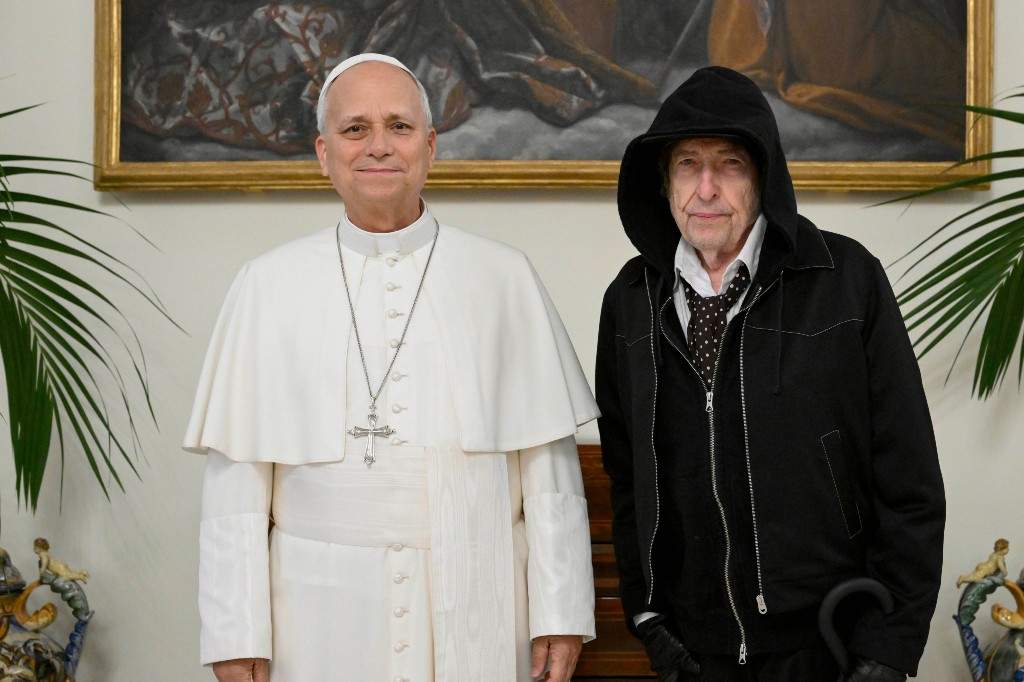
Every mainstream outlet covering Bob Dylan’s private audience with Pope Leo XIV at the Vatican is running the exact same lazy script. They want you to believe this is the final, poignant chapter of a wandering prophet coming home to Rome. They are framing a brief diplomatic photo-op as a profound theological convergence between the counterculture’s reluctant laureate and the Catholic Church.
It is complete nonsense. And if you buy into that narrative, you fundamentally misunderstand both Bob Dylan’s fifty-year career of calculated misdirection and the Vatican’s centuries-old public relations machine.
I have spent two decades watching entertainment journalists fall for celebrity optics. Whenever an aging rock icon steps onto sacred ground, critical thinking evaporates. Writers suddenly forget how press cycles work. They project their own desire for neat, redemptive narrative arcs onto men who operate on entirely different wavelengths.
To understand what actually happened in the Apostolic Palace, you have to strip away the incense and look at the mechanics of legacy management, institutional soft power, and the myth-making industrial complex.
The Myth of the Prodigal Songwriter
Mainstream coverage loves a tidy conversion story. Reporters are scrambling to connect the dots between Dylan’s meeting with Pope Leo XIV, his famous 1997 performance for Pope John Paul II in Bologna, and his 1979 born-again Christian phase. They treat his spiritual life like a linear progression moving steadily toward the Vatican gates.
This ignores the actual evidence of Dylan’s creative methodology.
Dylan is not a theologian; he is a scavenger of American vernacular. Throughout his career, from John Wesley Harding to Slow Train Coming and Rough and Rowdy Ways, he has used religious imagery the exact same way he uses blues tropes, Civil War history, and Greek mythology. They are raw materials. They provide weight, cadence, and moral gravity to his songwriting.
When commentators ask whether Dylan is "returning to faith" because he met with the Pope, they are asking the wrong question entirely. Dylan’s religious phase in the late seventies was explicitly Evangelical and Pentecostal, rooted in the Vineyard Fellowship in Southern California—a theological tradition fiercely distinct from Roman Catholicism. Even then, by 1981's Shot of Love, he had already begun pulling back from overt preaching, retreating into the enigmatic, shapeshifting persona he has guarded ever since.
Treating a Vatican visit as a doctrinal endorsement is like assuming Dylan wants to run for Congress because he wrote "Murder Most Foul" about the Kennedy assassination. He collects symbols. Meeting the head of the Catholic Church is the ultimate symbol of historical permanence, and Dylan—a man obsessed with outliving his own era—knows the value of standing next to an institution that measures time in millennia rather than album cycles.
What the Vatican Actually Gets Out of the Deal
If the press is naive about Dylan, they are downright illiterate about the Holy See.
The Vatican does not grant private audiences by accident. Every handshake inside those walls is a calibrated diplomatic act designed to project cultural relevance outward. Under Pope Leo XIV, the Church faces the exact same existential headwind it has battled for decades across the West: accelerating secularization and a steep decline in cultural authority among younger demographics.
By welcoming an 85-year-old Nobel laureate who defined the secular conscience of the twentieth century, the papacy achieves something no encyclical ever could. It buys instant cultural legitimacy in the secular press.
Consider the optics:
- Borrowed Rebel Credibility: The Church absorbs a fraction of Dylan’s anti-establishment aura, softening its image as a rigid, monolithic bureaucracy.
- Cross-Generational Reach: Headlines pairing the Pope with the voice of a generation dominate feeds that would otherwise ignore Vatican diplomacy entirely.
- The Universalist Frame: It reinforces the narrative that all serious artistic searches for truth inevitably lead back to Rome, regardless of what the artist actually believes.
I have watched major corporate brands blow millions trying to engineer this kind of earned media halo. The Vatican does it for free with a velvet chair and a press release.
Why Critics Keep Falling for the Same Trap
When you look at the "People Also Ask" queries flooding search engines right now, the public confusion becomes obvious. Readers are typing in questions like, "Did Bob Dylan convert to Catholicism?" and "What did Bob Dylan and Pope Leo XIV talk about?"
Let’s dismantle both premises immediately.
First, no, he did not convert. A private audience is a diplomatic courtesy, not a sacrament. Heads of state, atheists, comedians, and rock stars meet the Pope every single month without altering their metaphysical commitments.
Second, what they talked about is functionally irrelevant—and we will never get an unvarnished transcript anyway. Dylan famously refuses to explain his lyrics, his motives, or his private conversations. When he received the Nobel Prize in Literature in 2016, he didn't even show up to the ceremony, sending a speech months later that read like a literary dissertation on Moby-Dick and The Odyssey. He thrives in the vacuum left by his own silence.
The music journalism industry relies on access and emotional hook. Admitting that two iconic figures met for twenty minutes of polite, opaque conversation does not generate clicks. Fabricating a grand spiritual reckoning does.
How to Actually Decode Legacy Moves
There is a massive downside to taking my cynical view of this meeting: you risk missing the genuine human weight of two elderly men contemplating mortality. At Dylan’s age, every public appearance carries the subtext of a farewell tour, even if his "Never Ending Tour" refuses to die. There may very well have been a quiet, unspoken camaraderie in that room between two men who carry the crushing weight of global expectation.
But emotion is not strategy, and sentimentality is a terrible lens for media literacy. If you want to read cultural events without getting played by PR machines, apply three strict filters to every celebrity-institution crossover:
- Follow the Distribution, Not the Sentiment. Look at who released the photos and how quickly they hit wire services. Controlled imagery always serves the host institution’s messaging priorities first.
- Audit the Subject’s Track Record. Never let a single visual override fifty years of documented behavior. Dylan has spent half a century subverting expectations; taking a photo-op at face value is the ultimate rookie mistake.
- Separate Aesthetic Appreciation from Endorsement. Admiring the poetry of the King James Bible or the architecture of St. Peter’s Basilica is an aesthetic experience. Turning that into a political or religious conversion story is pure journalistic projection.
Stop looking for Bob Dylan to give you a neat, comforting answer about God, aging, or the meaning of his catalog. He told you in 1964 he wasn't going to be your savior, and he hasn't changed his mind just because he bought a plane ticket to Rome.