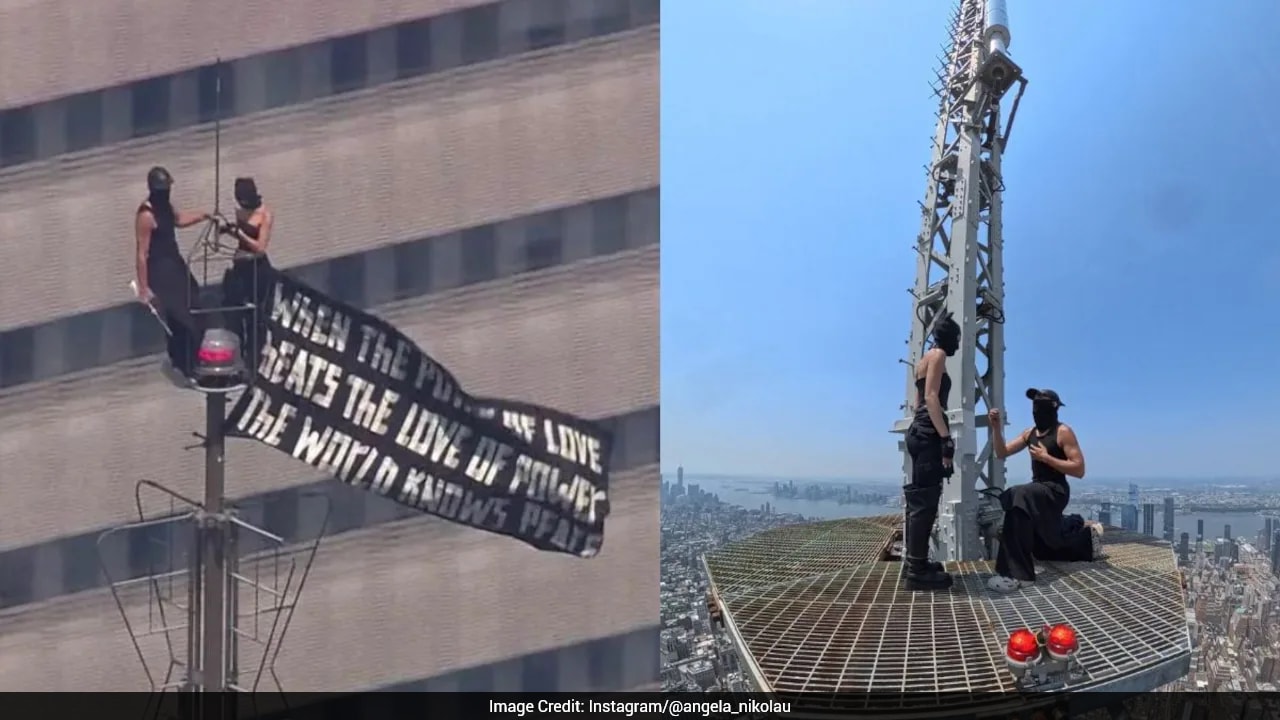
The mainstream press loves a simple villain. When a Russian couple recently bypassed security at the Empire State Building, scaled a restricted section of the iconic tower for a marriage proposal, and subsequently faced arrest and potential deportation, every outlet in New York dusted off the exact same script. They painted a picture of reckless foreign daredevils invading a sacred American landmark, followed by a triumphant victory lap for the NYPD and U.S. Immigration and Customs Enforcement.
It is a lazy, comforting narrative. It is also completely backwards.
If you look past the sensationalist headlines about deportation proceedings and romantic stunts, you find a much uglier truth that building management and city officials are desperate to bury. Two tourists with zero specialized tactical training walked past millions of dollars in modern surveillance infrastructure, bypassed physical barriers, and compromised a Tier-1 national security target—all to take an Instagram photo with a ring.
The real story here is not that two people broke the law. The real story is that the security apparatus at one of the most famous, heavily fortified skyscrapers on earth failed catastrophically, and federal deportation is being used as a convenient smokescreen to distract from gross corporate negligence.
The Illusion of Post-9/11 Security Theater
Anyone who has ever paid eighty dollars to visit the 86th or 102nd floor of the Empire State Building knows the drill. You are herded through airport-style magnetometers. Your bags are X-rayed. Uniformed guards bark orders at tourists moving too slowly through the stanchions.
We accept this friction because we have been conditioned to believe it keeps us safe. Security experts call this security theater—measures that provide the feeling of improved security while doing little or nothing to actually achieve it.
I have spent fifteen years auditing physical security protocols for high-profile commercial real estate and hospitality assets in Manhattan. I have watched building owners blow eight-figure budgets on facial recognition cameras, biometric turnstiles, and laser perimeter alarms, only to leave a fire stairwell unlocked because the night janitors complained about carrying keys.
The Empire State Building incident is a textbook failure of defense-in-depth, the foundational principle of physical security. Defense-in-depth relies on multiple, independent layers of protection—perimeter detection, physical barriers, active human monitoring, and rapid response—so that if one layer fails, the next one catches the intruder.
Here, every single layer collapsed simultaneously:
- Access Control Failure: The couple separated themselves from the standard tourist flow without triggering an immediate physical intervention.
- Physical Barrier Failure: The fencing, glass partitions, and anti-climb deterrents designed to keep people off the exterior ledges were easily defeated without power tools or climbing gear.
- Surveillance Blindness: Hundreds of high-definition cameras cover every square inch of those observation decks. Either the cameras were pointed at the wrong angles, or the operators in the command center were asleep at the wheel.
- Response Latency: By the time security realized what was happening, the couple had already completed the climb and staged a romantic proposal.
When a major corporation suffers a massive data breach, we do not exclusively blame the teenager who guessed the CEO's password; we crucify the Chief Information Security Officer for leaving the front door wide open. Yet, when two unarmed civilians breach the physical perimeter of a historic Manhattan skyscraper, the media acts as if the building itself was an innocent victim of criminal masterminds.
Deportation As A Public Relations Mop
Let us look closely at the mechanics of the legal aftermath. Following their arrest by the NYPD on charges including criminal trespass and reckless endangerment, the narrative immediately shifted to their immigration status. Suddenly, the headlines were dominated by the threat of deportation.
Why? Because deportation is loud, final, and shifts the burden of accountability entirely onto the outsiders.
Under the Immigration and Nationality Act, non-citizens—including tourists on B-1/B-2 visitor visas—can be placed into removal proceedings if they violate the terms of their admission or are convicted of certain crimes, particularly those classified as crimes involving moral turpitude (CIMTs) or offenses demonstrating a disregard for public safety. Even before a criminal conviction occurs, U.S. Customs and Border Protection and ICE possess broad discretionary authority to revoke visas and initiate removal when a visitor becomes a public safety liability.
The legal mechanism is real, and the consequences for the couple are devastating. Losing the right to ever enter the United States again, facing detention, and having a permanent federal mark on your travel record is a massive price to pay for a stunt.
However, the aggressive publicizing of the deportation angle serves a distinct political and corporate purpose. It allows the Empire State Realty Trust, the NYPD, and city tourism boards to project an image of zero-tolerance strength. It tells the public: The system worked. The bad guys are being thrown out of the country.
It is pure misdirection. Throwing two tourists out of the United States does not fix the unlocked door, the blind camera, or the inadequate parapet wall they climbed over. It merely removes the witnesses to the building's embarrassment.
The Daredevil Economy And The Hypocrisy of Outrage
To understand why this keeps happening, you have to understand the economics of modern travel and social media. We live in an attention economy where risk is directly monetized. Platforms like Instagram, TikTok, and YouTube have created a global class of extreme content creators—commonly known as "rooftoppers"—who scale cranes, bridges, and skyscrapers from Moscow to Dubai to New York.
Major landmarks love the free marketing generated by viral proposals and breathtaking photography—right up until someone crosses an arbitrary line.
Every single day, influencers violate rules at major tourist attractions. They fly drones in restricted airspace, sneak into closed wings of museums, and hop fences at national parks to get the shot. Most of the time, security looks the other way because those same influencers drive millions of dollars in free organic reach to the venue.
The outrage only triggers when the stunt exposes a liability that threatens the venue's insurance premiums.
Consider the reality of what happens when someone climbs the exterior of a 1,454-foot building. The primary danger is not actually to the climbers; they made a conscious, albeit foolish, calculation regarding their own mortality. The catastrophic risk is to the thousands of pedestrians walking on Fifth Avenue and 34th Street below. A dropped smartphone, a slipping shoe, or a falling body from the 86th floor turns into a lethal projectile at terminal velocity.
Building management knows this. Their insurers certainly know this. That is why the legal response has to be nuclear. If they treat this as a simple misdemeanor trespass—which, for a local New Yorker with no prior record, often results in a desk appearance ticket, community service, or an Adjournment in Contemplation of Dismissal (ACD)—they invite copycats. By weaponizing federal immigration enforcement, the authorities are trying to buy deterrence on the cheap instead of paying for actual structural security upgrades.
What Everyone Gets Wrong About The Legal Fallout
If you read the comments sections or listen to cable news pundits talk about this case, you will hear a lot of nonsense about how the U.S. justice system operates. Let us dismantle the most common myths surrounding incidents like this.
Myth 1: "They will spend years in an American prison before being deported."
Wrong. New York State criminal courts are notoriously congested, and non-violent trespass cases rarely result in lengthy state prison sentences, especially for first-time offenders. In fact, prosecutors frequently coordinate with federal immigration authorities to expedite removal. Why spend tens of thousands of taxpayer dollars housing and feeding foreign nationals in Rikers Island when ICE can put them on a commercial flight back to their home country at a fraction of the cost? Deportation is often used in lieu of prolonged incarceration, not in addition to it.
Myth 2: "This only happened because they are Russian."
While geopolitical tensions between Washington and Moscow certainly add spice to the headlines, the nationality of the climbers is legally irrelevant to the enforcement mechanism. Under U.S. immigration law, a British, Brazilian, or Australian tourist pulling the exact same stunt at a high-profile federal or landmark target would face the exact same visa revocation and removal proceedings. The trigger is the high-profile breach of a critical infrastructure site, not the passport cover.
Myth 3: "New anti-climb barriers will make the building 100% secure."
Physical security is never absolute; it is merely a game of buying time. Every barrier can be defeated given enough time, tools, or determination. The goal of landmark security is not to build an impenetrable fortress—which would ruin the tourist experience and destroy the architectural integrity of a historic landmark—but to detect an anomaly early enough that human guards can intervene before a climber reaches a point of no return.
The Uncomfortable Truth About The Contrarian View
Now, let us be brutally honest about the flaw in my own argument. Critiquing the Empire State Building's security theater is easy, and pointing out the hypocrisy of immigration-as-PR is accurate. Yet, if you run a landmark that welcomes over four million visitors a year, you face an impossible operational paradox.
If you turn the observation deck into a maximum-security prison with floor-to-ceiling plexiglass cages, armed guards every ten feet, and invasive pat-downs, nobody will pay eighty dollars to go up there. The views will be ruined, the photographs will be ruined, and the revenue stream that maintains the historic structure will dry up.
Furthermore, leniency is not an option. In 1974, French high-wire artist Philippe Petit walked between the Twin Towers of the World Trade Center. He was arrested, charged with criminal trespass and disorderly conduct, and had all charges dropped in exchange for performing a free show for children in Central Park.
We romanticize Petit today because nobody died and because it happened in a pre-9/11 world. If a modern landmark shows that kind of poetic leniency to a viral stunt couple in 2026, within forty-eight hours there will be fifty TikTokers scaling the scaffolding of the Chrysler Building, the Brooklyn Bridge, and the Statue of Liberty. The copycat effect in the algorithmic era is instantaneous and deadly.
So yes, the couple had to be arrested. Yes, the penalty had to hurt enough to deter the next wave of clout-chasers.
How Landmarks Must Actually Fix This
If city officials and corporate property managers actually care about preventing the next viral breach—rather than just scoring cheap points in the press—they need to abandon the current playbook immediately.
- Audit the human element, not just the hardware. Stop buying shiny new surveillance tech when your existing camera feeds are being watched by underpaid, overworked contractors staring at forty screens at once. Invest in automated behavioral analytics that flag abnormal movement patterns—like someone lingering near a barrier or stepping out of a crowd flow—and route those alerts immediately to roving guards on the deck.
- Redesign physical choke points using CPTED. Crime Prevention Through Environmental Design (CPTED) uses subtle architectural cues—angled surfaces, slippery coatings, un-grippable materials, and acoustic triggers—to make climbing physically impossible without ruining sightlines for paying guests. If two tourists in street clothes can scale your barrier, your architectural engineering failed.
- Prosecute the platforms that monetize the crime. Arresting the climbers is playing whack-a-mole. If social media platforms continue to allow creators to monetize footage of illegal trespassing on critical infrastructure, the financial incentive will always outweigh the legal risk.
The next time a couple breaches a major landmark for a viral stunt, do not applaud the press release announcing their deportation. Ask the building owners why their doors were open in the first place.