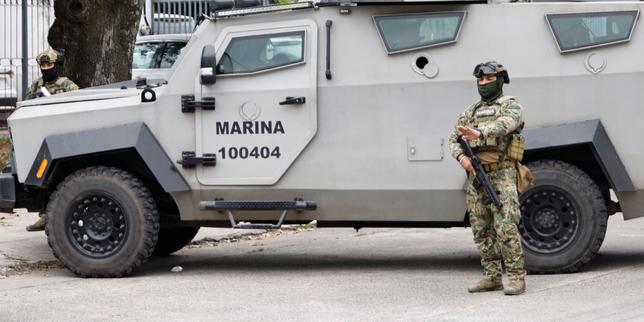
Three Salvadoran troops are dead in Haiti, blown apart while handling explosives, and the mainstream press is already filing the tragedy under "regrettable operational accident."
That framing is not just lazy. It is dangerous.
When wire services report the first official deaths of the multinational security mission in Port-au-Prince as an isolated ordnance mishap, they hand international policymakers a convenient alibi. They allow Washington, San Salvador, and the United Nations to treat a systemic command failure like a bad roll of the dice. If you read the standard coverage of the Multinational Security Support (MSS) mission, you walk away believing a coalition of well-meaning nations simply hit a tragic bump on the road to stabilizing Haiti.
I have spent years watching international security interventions rot from the inside out. I have seen donor nations dump hundreds of millions of dollars into ad-hoc coalitions where the press releases are spotless and the logistics chains are held together with zip ties and wishful thinking. The death of three Salvadoran soldiers handling explosives in Haiti is not a freak accident. It is the predictable, mathematical consequence of deploying a fragmented, under-resourced force into an urban asymmetric warzone without unified doctrine, standardized equipment, or honest political backing.
The Myth of the Plug-and-Play Coalition
The prevailing consensus among foreign policy pundits is simple: Haiti’s gangs overwhelmed the Haitian National Police (PNH), so the international community assembled a patchwork of partner forces—led by Kenya, supplemented by Jamaica, Belize, the Bahamas, and El Salvador—to restore order. On paper, bringing in Salvadoran personnel looks like a masterstroke. Nayib Bukele’s government dismantled MS-13 and Barrio 18 at home, earning a reputation for ruthless efficiency against entrenched street gangs.
Here is the reality nobody in diplomatic circles wants to admit: domestic mass-incarceration tactics do not translate to expeditionary explosive ordnance disposal in a foreign failed state.
In El Salvador, security forces operated on home turf with total state monopoly over infrastructure, familiar terrain, centralized intelligence, and absolute legal impunity under a state of exception. In Haiti, Salvadoran troops are guests inside a fractured, improvised coalition operating out of a besieged capital where supply lines are contested and command structures are polyglot.
When you drop troops from five different nations into an active conflict zone without years of joint NATO-style interoperability training, friction kills people before enemy fire ever does. Ordnance handling is the ultimate stress test of military standardization. Every army stores, transports, primes, and disposes of explosives according to its own manuals, safety tolerances, and legacy hardware. When a multinational mission cobbles together donated gear from the United States, surplus munitions from local stockpiles, and personnel trained under disparate national doctrines, the margin for catastrophic error shrinks to zero.
Why "Non-Combat" Deaths Are the Loudest Warning Siren
Mainstream outlets love to draw a thick, comforting line between "killed in action" and "died in an explosives handling incident." The implication is obvious: the gangs didn't get them, so the mission's tactical superiority remains intact.
Ask any combat engineer or Explosive Ordnance Disposal (EOD) veteran what a fatal handling incident actually signals. It signals one of three things, and every single one of them is an indictment of mission leadership:
- Degraded or improperly stored munitions. Tropical heat, high humidity, and rushed airlifts degrade unstable propellants and aging fuzes. When coalition logistics rely on ad-hoc warehousing near Port-au-Prince's Toussaint Louverture International Airport, unstable ordnance becomes a ticking clock in the hands of the technicians tasked with moving or clearing it.
- Improvised or unfamiliar hardware. Partner nations deploying to Haiti are heavily reliant on American-supplied vehicles, communications gear, and tactical equipment they may have only trained on for weeks prior to deployment. Handling unfamiliar demolition charges, breaching munitions, or captured gang explosives under operational pressure is a recipe for fatal misfires.
- Tempo outstripping safety protocols. Political leaders in Washington and Port-au-Prince are desperate for optics. They need headlines showing reclaimed neighborhoods, cleared barricades, and reopened roads. When political pressure forces engineering and clearance units to rush through standard operating procedures, safety checklists get skipped.
Calling these deaths "non-combat" hides the truth. In modern urban counterinsurgency, logistics and ordnance management are the battlefield. If a coalition cannot safely handle its own explosives inside its own perimeter, it has no business claiming it can pacify a metropolis controlled by heavily armed alliances like Viv Ansanm.
Dismantling the Wrong Questions About Haiti
Whenever blood is spilled in a foreign intervention, the public debate immediately defaults to two exhausted questions. Both miss the point entirely.
Are foreign troops properly trained for Haiti?
This question assumes the problem lies with the individual soldier on the ground. It does not. Salvadoran military personnel are disciplined, hardened, and accustomed to high-stress environments. Blaming troop quality insults the dead while protecting the bureaucrats who designed a broken mission architecture. The failure is institutional. Unlike a formal United Nations peacekeeping operation—which, for all its notorious bloat, possesses established administrative frameworks, standardized logistics protocols, and clear reimbursement mechanisms—the MSS mission in Haiti was deliberately engineered as a non-UN, voluntary-contribution hybrid to bypass Security Council vetoes from Russia and China. That diplomatic workaround solved a problem in New York and created a nightmare in Port-au-Prince.
Will these deaths cause troop-contributing countries to pull out?
Pundits treat troop withdrawals as the primary risk factor. They shouldn't. Governments like El Salvador's and Kenya's are deeply invested in the diplomatic capital they earn from Washington by putting boots on the ground in Haiti. They will absorb three deaths. They will issue solemn statements honoring fallen heroes, collect their diplomatic favors, and keep troops deployed. The real danger isn't a sudden pullout. The real danger is mission drift paired with chronic underfunding—a slow bleed where troops stay pinned in defensive postures, taking casualties from accidents, disease, and ambushes while failing to fundamentally alter the balance of power on the streets.
The Unspoken Truth About Asymmetric Urban Warfare in Port-au-Prince
Let’s look at what the MSS mission is actually up against, stripping away the sanitized briefings from the State Department.
Haiti’s gang coalitions are no longer loose collections of street thugs with rusty revolvers. Over the past several years, groups operating across Port-au-Prince have acquired high-caliber rifles, belt-fed machine guns, armored vehicles, commercial surveillance drones, and explosive materials looted from state armories or smuggled through porous coastlines. They do not hold fixed lines like a conventional army. They melt into dense, unmapped slums like Cité Soleil, Bel Air, and Martissant, where the civilian population serves as both cover and hostage.
Countering that threat requires overwhelming intelligence, surveillance, and reconnaissance (ISR) dominance, seamless air-ground coordination, and sustained civil-affairs capacity to hold territory once it is cleared.
Instead, the international community has delivered a fraction of the promised 2,500 personnel, starved the mission's trust fund of cash, and expected a patchwork of police and military units from developing nations to improvise a miracle. Imagine a scenario where a fire department is sent into a raging high-rise inferno with five different hose couplings that don't fit the building's standpipes, half the promised water pressure, and a mayor standing across the street demanding to know why the top floor isn't open for business yet. When a firefighter gets burned in the stairwell, you don't blame the firefighter's technique. You indict the city council that sent them in blind.
What Actually Works (And Why Nobody Will Fund It)
If international stakeholders actually want to stop foreign troops from dying needlessly while Haiti burns, they need to abandon the fantasy of cheap, outsourced stabilization.
First, kill the patchwork model. You cannot run high-risk kinetic and explosive-clearance operations with a dozen micro-contingents operating under separate national caveats. Either commit a single, unified command structure with standardized NATO-grade logistics and organic EOD battalions, or stop pretending this is a real military intervention.
Second, choke the supply lines before clearing the streets. Every bullet, drone, and pound of explosive material used by Haitian gangs enters the country from somewhere else—predominantly trafficked from the United States and across the Dominican border. Deploying foreign soldiers to dodge bullets and clear bombs in Port-au-Prince while failing to enforce maritime blockades and customs interdiction is like mopping the floor while the burst pipe sprays water in your face.
Third, admit the timeline is measured in decades, not quarters. The UN's own track record in Haiti—from MINUSTAH's 2004–2017 deployment, which ended up introducing cholera and leaving state institutions hollowed out, to the current crisis—proves that short-term stabilization missions without deep judicial, economic, and political reconstruction simply reset the clock for the next collapse.
Of course, there is a massive downside to this approach, and anyone pretending otherwise is selling snake oil. Full-spectrum, unified intervention with maritime interdiction and multi-decade institutional overhaul costs tens of billions of dollars, requires direct military commitment from major powers rather than subcontracting the risk to smaller nations, and risks triggering nationalist backlash among Haitians who rightfully distrust foreign occupation after centuries of predatory interference. Major powers will not pay that political or financial price.
So they choose the middle ground. They fund a half-measure, slap a multilateral flag on it, and hope nobody notices the structural cracks until the casualty reports start trickling in.
The Price of Diplomatic Convenience
Three Salvadoran families are burying their dead because international diplomacy prioritized political convenience over operational integrity. The officials in Washington, New York, and Port-au-Prince who designed this mission will offer condolences, launch an internal investigation, and tweak a few handling protocols.
They will not fix the broken command structure. They will not fully fund the mission. And until someone forces them to confront the lethal absurdity of running a cut-rate war through a fragmented coalition, those three body bags from El Salvador will not be the last.