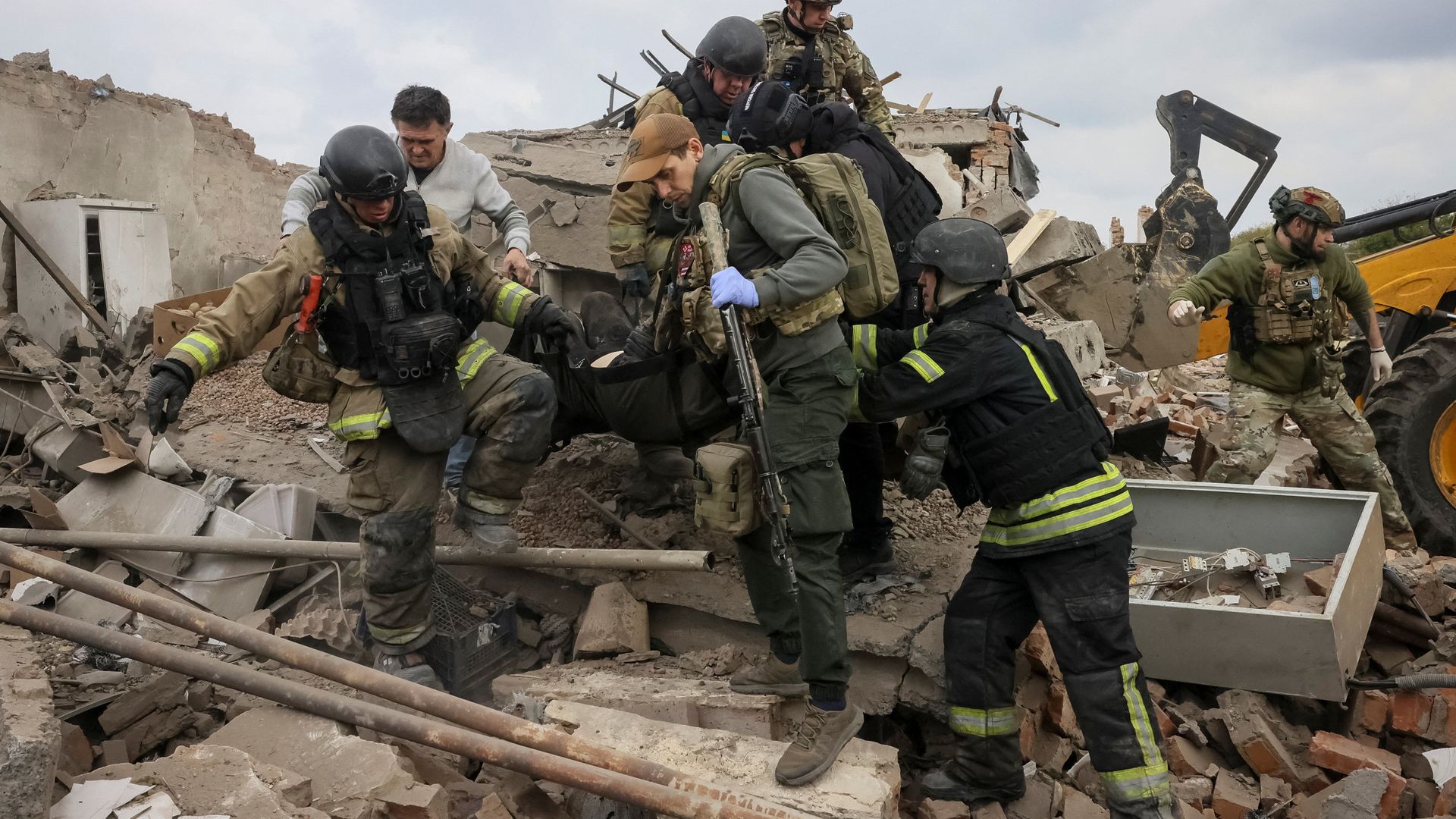
Every time a Russian missile obliterates a warehouse full of blankets, medical kits, and flour in eastern Ukraine, the mainstream press runs the exact same obituary. They count the dead. They quote a shocked local official. They express moral outrage that Moscow violated international humanitarian law. Then, they move on until the next warehouse gets flattened.
That coverage is emotionally satisfying and operationally lethal.
By treating strikes on Ukrainian aid hubs solely as isolated spasms of Russian cruelty, legacy outlets miss the glaring tactical failure happening on the ground. We are watching modern conflict logistics collide with a 20th-century charity model. When you stack tons of supplies into a single, static, easily identifiable building within range of hypersonic missiles and long-range glide bombs, you haven't built a sanctuary. You have built a target.
Moral outrage does not intercept ballistic missiles. If aid organizations and Western backers refuse to abandon centralized distribution models in active war zones, they will keep handing the Kremlin high-value targets on a silver platter.
The Myth of the Protected Emblem
International humanitarian law is clear on paper. Under the Geneva Conventions, specifically Additional Protocol I, relief personnel and humanitarian relief objects must be respected and protected. Intentionally directing attacks against buildings dedicated to charitable purposes or humanitarian aid is a war crime.
Here is the brutal reality of modern warfare: legal protections are only as strong as the enforcement mechanism behind them, and in Ukraine, there is none.
I have spent over a decade consulting on high-risk supply chains and crisis logistics in active conflict theaters. The single hardest lesson to beat into well-meaning NGO executives is that a red cross or a blue UN flag painted on a roof does not function as an active defense system. In asymmetric or total-war environments where an aggressor uses terror and infrastructure degradation as primary strategic tools, visibility is not protection. Visibility is intelligence.
Russia’s military doctrine relies heavily on disrupting the enemy's rear-area sustainment. Moscow does not meaningfully distinguish between a depot holding artillery shells and a depot holding generators, trauma kits, and MREs. To the Russian General Staff, anything that keeps a Ukrainian city functioning, warms its population through winter, or sustains civilian morale is dual-use infrastructure.
Yet, Western media reports every strike on a distribution center as if it were an unforeseeable anomaly. Journalists act shocked that an enemy violating the UN Charter on a daily basis also ignores Article 71 of Protocol I. This lazy consensus—that the sole problem is Russian lawlessness rather than our own predictable logistics—prevents the aid sector from adapting to survive.
Why Centralized Aid Hubs Are Tactical Suicide
To understand why these strikes are so devastating, look at the physical mechanics of how traditional humanitarian aid moves.
Standard disaster relief relies on economies of scale. Organizations rent massive, single-story commercial warehouses—often former supermarkets, industrial hangars, or municipal sports complexes—located near major railheads or highway intersections. Dozens of volunteers gather at predictable hours. Forklifts beep. Marked white vans queue up in neat rows outside.
In an earthquake zone in Turkey or a flood zone in Pakistan, that model is efficient. In eastern or southern Ukraine, where Russian reconnaissance drones orbit 24 hours a day and ballistic missiles can strike within minutes of target acquisition, that model is suicidal.
Consider the signature a traditional aid hub broadcasts to modern intelligence, surveillance, and reconnaissance (ISR) networks:
- Thermal and visual footprints: Large roofs, heavy vehicle traffic, and concentrated human movement stand out starkly on commercial and military satellite imagery.
- Signals intelligence (SIGINT): Dozens of volunteers and drivers carrying unencrypted personal cell phones create a massive cellular heat map in otherwise evacuated or low-density areas.
- Human intelligence (HUMINT): Local spotters and collaborators on Telegram channels regularly sell coordinates of any facility where uniformed personnel, trucks, or large crowds gather.
- Predictable schedules: Aid distributions often happen at fixed times to help civilians plan, giving enemy artillery or missile batteries a guaranteed window for maximum casualties.
When a single Iskander-M missile or a volley of S-300 rockets hits a facility operating like this, the casualties skyrocket. You lose the warehouse, months of stockpiled supplies, specialized transport vehicles, and—worst of all—experienced local volunteers who cannot be replaced.
What Everyone Gets Wrong About Logistics Under Fire
When people search for answers after a strike like this, they usually ask the wrong questions. They ask why air defenses didn't stop the missile, or whether the International Criminal Court will prosecute the commanders responsible.
Let’s dismantle both premises brutally and honestly.
Why didn't Patriot or IRIS-T batteries protect the hub?
Because basic math makes that impossible. Ukraine has a front line stretching over 1,000 kilometers and dozens of major cities, power plants, and military airfields to defend. A single Patriot interceptor missile costs roughly $4 million, and global production rates are severely bottlenecked. Military planners cannot station scarce, billion-dollar air defense systems over every humanitarian warehouse in Kharkiv, Dnipro, or Odesa. Expecting military air defense to babysit civilian aid depots is a fantasy.
Won't documenting these strikes as war crimes deter future attacks?
No. Documentation is vital for historical record and post-war tribunals, if those ever materialize. As a real-time deterrent during an active conflict, war crimes investigations have zero kinetic effect. You cannot file an injunction against a glide bomb.
If hubs are dangerous, shouldn't aid agencies pull out of frontline cities?
Pulling out abandons the exact people who need help most—the elderly, the disabled, and the impoverished who cannot evacuate. The answer is not abandonment. The answer is radical decentralization.
The Decentralized Playbook: Moving Aid Like an Insurgency
If humanitarian organizations want to stop burying their staff, they need to stop operating like Amazon and start operating like a distributed logistics network built for contested environments.
Leading thinkers in military logistics, such as those at the Modern War Institute at West Point, have spent years hammering home the concept of contested logistics—the reality that rear areas are no longer sanctuaries and supply chains must survive constant targeting. Humanitarian NGOs need to steal that exact doctrine.
Here is what actually works when missiles are falling:
1. Kill the Mega-Warehouse
Stop leasing 50,000-square-foot hangars. Break bulk shipments down at secure border crossings in Poland or Romania, or far in the western rear of Ukraine, before they ever enter range of tactical ballistic missiles. Instead of one massive hub in a frontline oblast, use twenty micro-stashes—basements, unmarked garages, abandoned residential basements, and dispersed retail spaces. If one gets hit, you lose 5% of your inventory and zero crowds.
2. Ditch the Branding in High-Threat Zones
In stabilization zones, clear humanitarian markings build trust and facilitate access. Within 100 kilometers of an active front line against an enemy that targets civilians, high-visibility branding is a bullseye. Unmarked civilian vehicles, plain-clothes logistics teams, and low-profile drop-offs keep workers alive.
3. Asynchronous, Door-to-Door Micro-Distribution
Gathering 300 civilians in a parking lot to hand out bread and hygiene kits is an invitation for a double-tap strike—a tactic Russian forces have repeatedly used where a second missile hits first responders arriving at the scene of the first blast. Replace mass distribution lines with neighborhood-level wardens, dispersed pickup windows, and direct-to-door delivery using small, fast vehicles.
4. Strict Operational Security (OPSEC)
Aid workers are not soldiers, which is precisely why they leak data effortlessly. Enforce strict OPSEC protocols:
- Ban personal smartphones on mission runs or mandate Faraday bags and burner devices.
- Strip EXIF metadata and background landmarks from every social media post. Donors love seeing photos of volunteers standing in front of pallets of aid, and Russian OSINT analysts love geolocating those photos within fifteen minutes.
- Rotate routes, staging areas, and delivery times constantly.
The Uncomfortable Trade-Offs Nobody Wants to Admit
I am not going to pretend this approach is clean, cheap, or easy. Decentralizing humanitarian operations comes with brutal downsides that make donors and compliance officers break out in hives.
First, it is wildly expensive and inefficient. Moving ten small vans instead of one semi-truck burns more fuel, requires more drivers, and multiplies maintenance headaches. Overhead costs go up, which means a smaller percentage of every donated dollar buys actual food or medicine.
Second, accountability drops. Large institutional donors—like USAID, the European Commission, and major UN agencies—obsess over audit trails. They want signed manifests, photographic proof of delivery, and centralized inventory tracking to prevent theft or corruption. When you scatter supplies across thirty basements in a war zone, paperwork gets messy. Some boxes go missing.
Third, abandoning visible neutrality blurs the line between civilian aid and covert operations. Critics within the traditional humanitarian sector—including purists aligned with the International Committee of the Red Cross's strict Dunantist principles—rightly point out that if aid workers act like covert operatives, belligerents have an easier excuse to claim the aid isn't genuinely neutral.
That is a valid philosophical objection. It just doesn't survive contact with reality in Ukraine. Moscow already claims Western aid is an arm of NATO warfare regardless of how many Geneva Convention stickers you slap on a truck. Sacrificing human lives to maintain an illusion of regulatory neatness or ideological purity is indefensible.
Stop Building Targets
The next time a Russian strike levels an aid facility in Ukraine, pay close attention to how the story is framed. If the reporting stops at condemning Moscow's brutality while ignoring the operational vulnerability of the site, the media is doing half its job.
Aggressors will always exploit soft targets. That is the nature of war. The responsibility of those running aid networks—and the donors funding them—is to stop making the targets so easy to find, track, and destroy.
Burn the warehouse blueprints, turn off the geotags, scatter the inventory, and stop gathering crowds under static roofs.