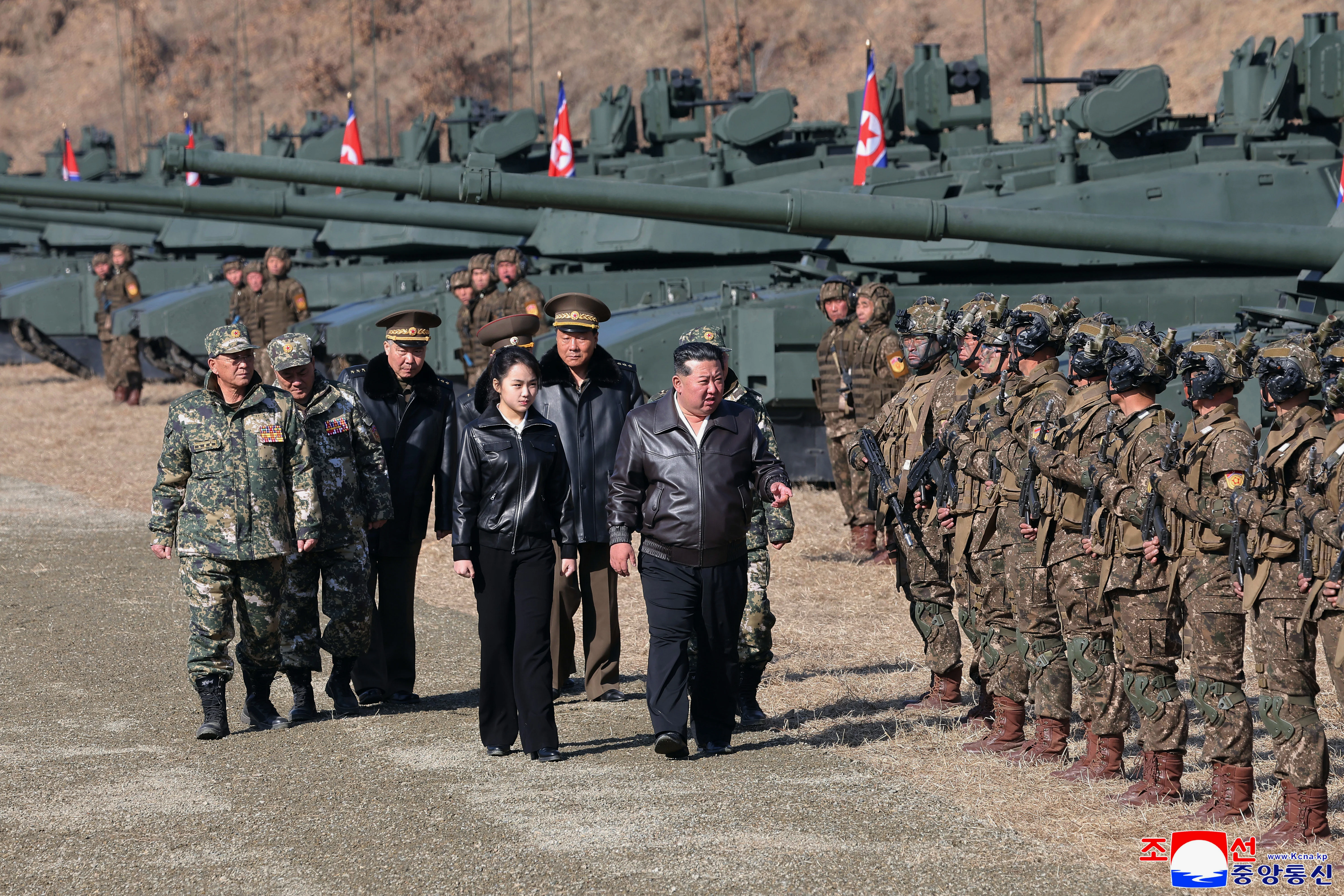
Western pundits love a simple fairy tale, even when the characters wear olive-drab parkas and inspect intercontinental ballistic missiles.
The lazy consensus dominating international coverage goes like this: Kim Jong Un trots his pre-teen daughter out to missile launches, hands her the binoculars, lets state media call her "beloved" and "respected," and therefore, she is the crowned heir apparent. Defectors who fled the regime years ago chime in, calling the Kim family "gods reigning over humans," and analysts nod along as if the succession question in Pyongyang is settled.
It is not. In fact, treating Kim Ju Ae as the guaranteed fourth-generation ruler of the Democratic People's Republic of Korea is a textbook misreading of how authoritarian dynasties actually survive.
I have spent years dissecting the gap between what Pyongyang broadcasts for domestic consumption and what actually happens behind the closed doors of the Workers' Party of Korea. Every few years, the intelligence community and cable news panels fall for the exact same head-fake. They mistake state propaganda choreography for constitutional succession. They confuse a symbol with a successor.
If you want to understand who will rule North Korea after Kim Jong Un, stop looking at the girl standing next to him at the launchpad and start looking at the structural mechanics of the regime itself.
The Defector Blind Spot Nobody Wants to Admit
Let us address the elephant in the briefing room. Surveys and interviews with North Korean defectors frequently form the backbone of sensational headlines declaring Kim Ju Ae the next leader. When defectors say the Kim bloodline is viewed like deities, they are describing a real ideological conditioning that saturates daily life in the North.
Here is the problem: defectors are experts on the North Korea they left, not the elite inner circle they never entered.
The vast majority of defectors come from border provinces like North Hamgyong or Ryanggang. They fled economic desperation, political persecution, or starvation. They did not sit in the Politburo. They did not attend meetings of the Organization and Guidance Department. Relying on grassroots defector sentiment to predict top-tier palace succession is like asking a factory worker in Ohio to predict the next CEO of a Fortune 500 tech conglomerate based on a Super Bowl commercial.
Even high-level defectors—former diplomats, intelligence officers, and trade officials who escaped in recent years—have repeatedly warned that insider visibility into Kim Jong Un’s private family decisions is virtually nonexistent. When former South Korean Unification Ministers or NIS officials speculate about Ju Ae, they are reading the exact same KCNA press releases and watching the exact same Korean Central Television broadcasts as everyone else.
The "gods reigning over humans" framing makes for a gripping quote, yet it obscures a far colder reality. The Kim dynasty does not run on divine right alone. It runs on institutionalized patronage, military loyalty, and ruthless internal balancing. Gods do not need to purge their own uncles with anti-aircraft guns or assassinate their half-brothers in foreign airports. Kim Jong Un did both because bloodline alone never guarantees survival in Pyongyang.
What Kim Ju Ae Actually Represents
If she is not the heir apparent, why is she everywhere?
Look at the staging. Look at the timing. Kim Ju Ae made her public debut in November 2022 at the test launch of a Hwasong-17 intercontinental ballistic missile. Since then, she has appeared almost exclusively at military events, aerospace facilities, and parades celebrating nuclear capability.
Notice where she is not. She is not chairing Party plenums. She is not touring collective farms to inspect grain quotas. She is not receiving foreign dignitaries on bilateral diplomatic missions.
In the visual grammar of North Korean propaganda, Kim Ju Ae is not being groomed as a policy administrator. She is functioning as a living totem of intergenerational nuclear deterrence.
Think about the domestic audience Kim Jong Un needs to convince. North Koreans have endured decades of crushing sanctions, catastrophic flood damage, and chronic food insecurity on the promise that nuclear weapons are the ultimate shield protecting their future. By placing his young daughter directly in front of massive solid-fuel ICBMs, Kim is sending an unmistakable visual message to his own population and to Washington: These weapons are not going anywhere. They belong to the next generation.
She is the human face of the regime's permanent nuclear status.
Why a Female Supreme Leader Breaks the Regime's Own Operating System
Those arguing that North Korea is ready for a female supreme leader point to Kim Yo Jong, Kim Jong Un’s powerful sister, as proof that gender is no longer a barrier in Pyongyang.
This comparison collapses under scrutiny.
Kim Yo Jong is an adult political operator who cut her teeth in the Propaganda and Agitation Department, managed summits with Donald Trump and Xi Jinping, and acts as her brother's chief enforcer and attack dog. Even with that resume, virtually no serious Korea watcher believes Kim Yo Jong could take over as sole Supreme Leader without triggering a legitimacy crisis among the aging, hyper-patriarchal generals of the Korean People's Army.
North Korea is not an egalitarian socialist utopia. It is a deeply conservative, Neo-Confucian military-first state. The entire mythology of the Paektu bloodline is built around patriarchal lineage—the Great Leader Kim Il Sung, the Dear Leader Kim Jong Il, the Respected Comrade Kim Jong Un.
Imagine a scenario where Kim Jong Un suffers a sudden medical emergency tomorrow. Does anyone genuinely believe a 12- or 13-year-old girl would walk into a room full of four-star generals in their seventies and command absolute obedience?
Of course not. A child cannot wield the suryong (Supreme Leader) system. The suryong is not merely a ceremonial monarch; it is the central nervous system of the entire state apparatus. Every military promotion, every foreign currency slush fund, and every purge flows through that single office. Put a child on that throne, and a regency council takes over within hours. And in Pyongyang, a regency council is just a polite term for a slow-motion coup.
The Succession Playbook History Actually Proves
To see how nonsensical the current hype is, look at how Kim Jong Un himself was actually groomed—and how completely invisible he was until the final hour.
- Kim Jong Il spent nearly twenty years working inside the Workers' Party apparatus before his father died in 1994. He built his own power base, took control of the Propaganda and Agitation Department, then the Organization and Guidance Department, and systematically sidelined his stepmother and half-brothers through bureaucratic warfare.
- Kim Jong Un was kept completely hidden from the North Korean public until September 2010—barely fifteen months before Kim Jong Il died of a heart attack. Nobody outside a tiny circle of elites knew what he looked like or even how to spell his name accurately. He was hastily given the title of four-star general and Vice Chairman of the Central Military Commission to manufacture institutional legitimacy before the clock ran out.
Notice the pattern. Real heirs in North Korea are kept in the shadows while they build institutional muscle inside the Party and the military. They are not paraded around on television as children in designer coats before they have held a single Party card.
Exposing an actual heir at age ten or twelve violates the most basic rule of regime security in Pyongyang: never paint a target on your successor before they have the armor to survive it.
By putting Ju Ae in the spotlight so young, Kim Jong Un is either breaking every precedent of his father and grandfather—or he is intentionally using her as a decoy to keep rivals, foreign intelligence agencies, and ambitious generals guessing while a real successor (potentially an older son kept entirely out of sight, as South Korea's National Intelligence Service has long suspected) stays protected.
Answering the Questions You Should Actually Be Asking
When headlines scream about Kim Ju Ae, readers naturally ask the wrong questions. Let us dismantle the most common ones.
Is Kim Ju Ae officially the heir apparent?
No. North Korean state media has used honorifics like "respected" (jongyeonghaneun) and "great person of guidance" (hyangdo), which are normally reserved for top leaders. While those linguistic shifts are notable, Pyongyang has never conferred a single Party title, military rank, or administrative post on her. In North Korea, titles without institutional office are theater. Until she holds a seat on the Politburo or the Central Military Commission, she is a symbol, not a successor.
What happens if Kim Jong Un dies suddenly?
Forget the fantasy of a smooth father-to-daughter handoff. If Kim Jong Un dies within the next five to ten years, North Korea faces an acute succession vacuum. Power would immediately consolidate around a collective crisis management group led by key Party and military figures—likely involving Kim Yo Jong, Jo Yong Won (the powerful Organizational Secretary), and top military brass. Whether that junta holds together or fractures into competing factions is the single biggest security risk on the Korean Peninsula, far more dangerous than a planned transition.
Does Kim Ju Ae have brothers?
South Korean intelligence has maintained for years that Kim Jong Un’s firstborn child is a son, born around 2010. While hard photographic evidence has never been released publicly, keeping a male heir completely hidden while showcasing a daughter aligns 100% with Pyongyang's historical obsession with operational secrecy. Even if no older brother exists, Kim Jong Un is in his early forties. Despite his well-documented health issues—heavy smoking, obesity, and cardiovascular risks—he could easily rule for another two or three decades, rendering any succession talk in the 2020s wildly premature.
The Real Blind Spot in My Own Argument
Intellectual honesty requires admitting where a contrarian thesis could break down.
Could Kim Jong Un genuinely be rewriting the rules of the Paektu dynasty? Yes. He has already broken precedent in ways his father never dared. He abandoned the decades-old policy of peaceful reunification with South Korea, formally declaring the South a permanent hostile enemy state. He tore down the Arch of Reunification in Pyongyang. He elevated his sister to levels of public authority no woman in North Korean history has ever held.
If Kim Jong Un lacks a viable male heir, and if his health is deteriorating faster than Western intelligence estimates, he may have concluded that the only way to preserve his immediate family's survival is to shatter the patriarchal taboo early. By conditioning the military and the public to revere Ju Ae from childhood, he could be attempting a high-wire act: forging legitimacy through sheer familiarity over a ten-year runway.
That is a plausible contingency. It is not, however, a fait accompli. Treating a risky, unproven contingency as an established reality is sloppy analysis.
How to Actually Read North Korea Without Getting Played
If you want to track real power shifts in Pyongyang instead of falling for every glossy photo op from KCNA, use a better filter:
- Ignore adjectives; track titles. Stop hyper-analyzing whether state media calls someone "beloved" or "respected." Wait until a name appears on the roster of the Central Committee, the Politburo, or the State Affairs Commission. Bureaucratic rank is the only currency that buys loyalty in Pyongyang.
- Watch the military purges, not the parades. Real succession preparation always leaves a trail of purged generals and reshuffled security chiefs. Before Kim Jong Un took over, Kim Jong Il systematically cleared out officers whose loyalty was questionable. Until you see the KPA high command reorganized around a new patron, succession has not begun.
- Follow the Organization and Guidance Department. The OGD is the true engine room of North Korea. Whoever controls personnel appointments and ideological surveillance controls the state. Keep your eyes on figures like Jo Yong Won and the senior cadres running the Party's internal machinery—they are the kingmakers, regardless of whose portrait hangs on the wall.
Pyongyang wants the world staring at a young girl waving beside a rocket because it projects permanence, vitality, and dynastic inevitability. It is a masterclass in psychological projection.
Do not confuse the stage magic for the machinery behind the curtain. Until Kim Ju Ae holds actual command over the guns, the money, and the Party apparatus, calling her the next Supreme Leader is not intelligence analysis—it is just falling for the show.