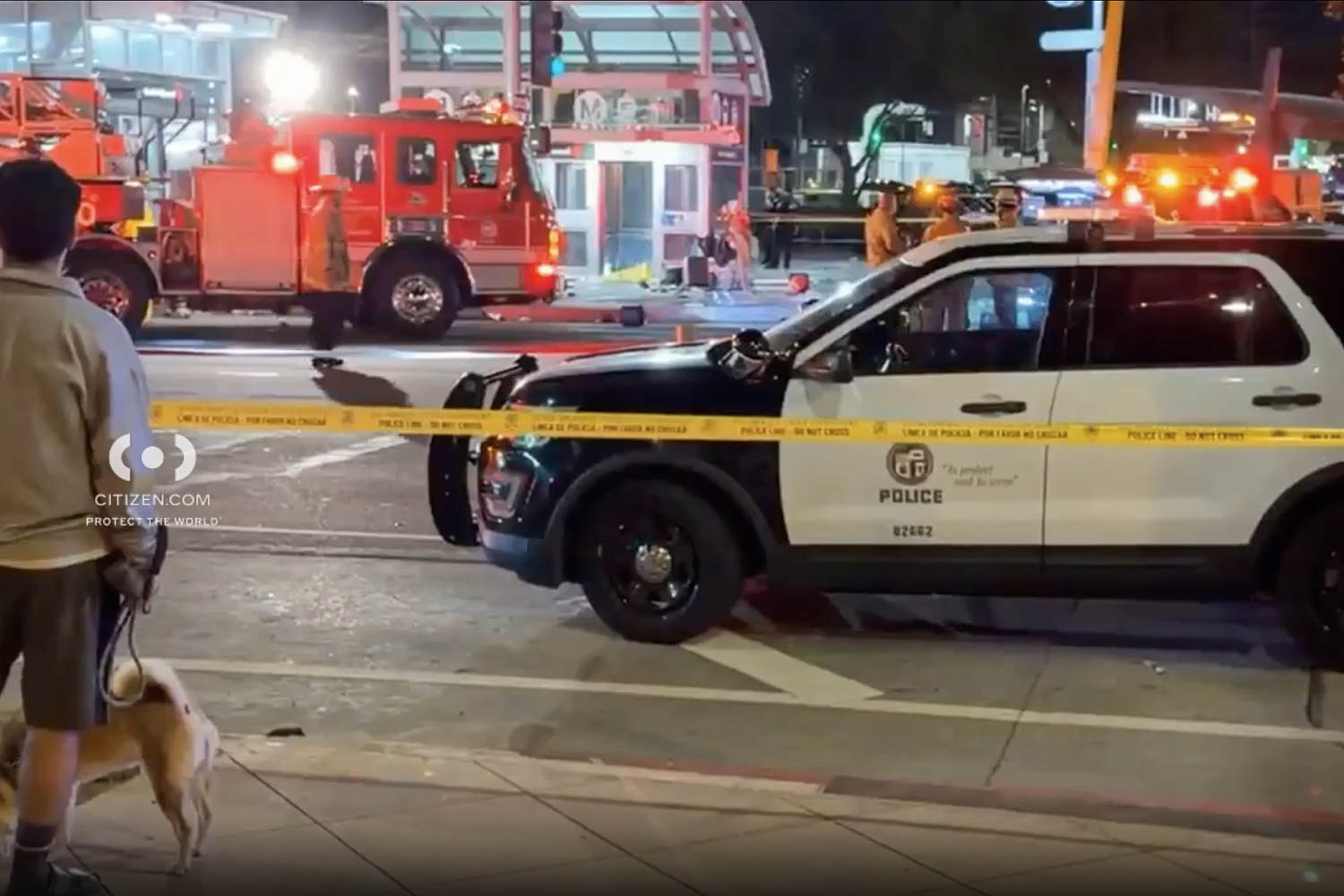
A car jumps a curb in Los Angeles. Three people die. Three more land in the trauma unit fighting for their lives. Within hours, local news outlets publish the exact same copy-paste template they have used for thirty years.
"Vehicle smashes into pedestrians." You might also find this connected article interesting: The Structural Insolvency of Modern Social Care Systems.
Read that phrasing again. Look at the grammar. The vehicle is the active agent, as if a two-ton slab of steel and aluminum woke up, felt a sudden burst of homicidal rage, and independently decided to mount a sidewalk. There is no mention of the street width. No mention of the sightlines. No mention of the fact that Los Angeles traffic engineers built a drag strip directly next to a space meant for human beings walking to get groceries.
The lazy consensus in local journalism treats every fatal crash in Southern California like an act of God or a freak statistical anomaly caused by one rogue driver. Reporters show up at the scene, interview a grieving neighbor, quote a police lieutenant saying the investigation is ongoing, and move on to the next news cycle. That approach is completely broken. It protects the institutions that build lethal infrastructure while framing predictable engineering failures as unavoidable tragedies. As extensively documented in detailed articles by The Guardian, the implications are widespread.
If you want to understand why people keep dying on Los Angeles sidewalks, stop looking at the bumper of the car and start looking at the asphalt beneath it.
The Lie of the Rogue Driver
Every time a major crash happens in Los Angeles, the public conversation immediately splits into two predictable camps. One side blames the individual behind the wheel—speeding, intoxication, distraction, recklessness. The other side calls for more traffic enforcement, harsher penalties, or vague public awareness campaigns telling drivers to slow down.
Both camps are missing the point entirely.
Human beings make mistakes. People get distracted. People misjudge distances. People drive tired, angry, or impaired. You cannot legislate away human fallibility, and you cannot station a police cruiser on every block of a four-thousand-square-mile city. When an industry or a municipality relies on 100 percent human perfection to prevent mass casualties, that system is fundamentally defective.
In commercial aviation, if a pilot makes a mistake and a plane crashes, investigators do not just blame the pilot and call it a day. They tear apart the cockpit ergonomics, the air traffic control protocols, the maintenance schedules, and the regulatory standards. They redesign the system so that a single human error cannot result in a fatal catastrophe.
Surface transportation in Los Angeles operates under the exact opposite philosophy. Traffic engineers design wide, straight, multi-lane arterials that subconsciously signal to every driver that it is safe to travel at highway speeds. Then, when a driver inevitably loses control at fifty miles per hour and plows into a bus stop, the city blames the driver's moral failing while leaving the exact same street geometry intact for the next driver to repeat the process six months later.
How Street Geometry Dictates Speed
Most people think speed limit signs control how fast cars move. They do not. Paint and metal signs are suggestions. Concrete and asphalt are commands.
Urban planners and traffic engineers have known this for decades, yet American cities—and Los Angeles in particular—continue to prioritize vehicle throughput over human survival. Let us break down the actual mechanics of how a Los Angeles street kills people.
- Lane Width: Standard highway lanes are twelve feet wide. Many surface streets in Los Angeles use eleven- or twelve-foot lanes. When a driver sits inside a modern vehicle with soundproofing, power steering, and independent suspension, a twelve-foot lane feels expansive. The brain registers zero peripheral friction, which causes drivers to accelerate comfortably to forty-five or fifty miles per hour regardless of whether the sign says thirty-five.
- Clear Zones: Traffic manuals historically demanded "clear zones"—areas beside the roadway free of trees, poles, or bollards so that if a car veers off the road, the driver will not hit a solid object. When you apply highway clear-zone logic to a city street, the sidewalk becomes the clear zone. Pedestrians become the crumple zone.
- Curb Radii: Wide, sweeping corners allow cars to make right turns without slowing down. Instead of forcing a driver to brake to ten miles per hour to navigate a sharp ninety-degree turn, a wide curb radius lets them whip around the corner at twenty-five or thirty miles per hour directly across a crosswalk.
- Slip Lanes: Dedicated right-turn lanes separated by triangular concrete islands are designed entirely to keep cars moving without stopping at red lights. They force pedestrians to cross multiple streams of high-speed traffic while drivers are looking over their left shoulders for oncoming cars, completely blind to the person walking right in front of their hood.
When a vehicle leaves the roadway on a corridor built with these specifications, physics takes over. Kinetic energy scales with the square of velocity ($E_k = \frac{1}{2}mv^2$). Doubling a vehicle's speed does not double its destructive force; it quadruples it. A pedestrian struck at twenty miles per hour has roughly a 90 percent chance of surviving. A pedestrian struck at forty miles per hour has less than a 20 percent chance of surviving. At fifty miles per hour, survival is practically a miracle.
Why Vision Zero Failed in Los Angeles
In 2015, Los Angeles officially adopted Vision Zero, an international road safety initiative built on a simple, radical premise: no loss of life on the streets is acceptable, and human error should never be fatal. The city pledged to eliminate traffic deaths by 2025.
Instead, traffic deaths skyrocketed.
I have watched municipalities burn millions of dollars on consultants, task forces, and glossy public relations rollouts while refusing to touch the physical geometry of their roads. Los Angeles fell into every single trap in the bureaucratic playbook. City officials painted green bike lanes without physical barriers. They installed flashing yellow lights at crosswalks instead of raised speed tables. They launched ad campaigns telling pedestrians to wear bright clothing and make eye contact with drivers.
Telling a pedestrian to make eye contact with a driver behind tinted windows traveling at forty-five miles per hour is absurd. It shifts the burden of survival onto the most vulnerable person on the street.
The real reason Vision Zero stalled in Los Angeles comes down to political cowardice and outdated engineering metrics. For decades, traffic engineers measured success using a single metric: Level of Service (LOS). Level of Service grades intersections from A to F based entirely on how quickly cars move through them. Under LOS standards, an intersection where cars flow smoothly at forty-five miles per hour gets an A, even if pedestrians are regularly maimed there. An intersection where cars wait thirty seconds to let people cross safely gets an F.
Even after California officially moved away from Level of Service toward Vehicle Miles Traveled (VMT) for environmental reviews, the institutional muscle memory inside local departments of transportation remained unchanged. Engineers still fear congestion more than they fear funerals. Whenever a city council member proposes a "road diet"—converting a four-lane speedway into two travel lanes, a center turn lane, and protected bike lanes—vocal drivers complain about a two-minute delay on their commute, and politicians immediately cave.
The Heavyweight Reality of Modern Vehicles
You cannot talk about pedestrian fatalities without addressing the massive shift in what people are actually driving. Fifteen years ago, the average passenger vehicle in the United States was a sedan with a low hood height. If a sedan struck a pedestrian, the bumper hit the person's legs, rolling them onto the hood. It was violent and often injurious, but frequently survivable.
Today, American streets are dominated by full-size pickup trucks, luxury SUVs, and heavy electric vehicles.
The physics of these vehicles are brutal for anyone outside the cabin:
- Blind Zones: The front hoods of modern trucks and SUVs have grown so tall and flat that drivers often cannot see a child—or even a seated wheelchair user—standing ten feet directly in front of the grille.
- Impact Geometry: Instead of striking a pedestrian in the legs, a tall, blunt front grille strikes an adult directly in the chest, pelvis, and head. Rather than rolling onto the hood, the victim is thrown forward onto the asphalt and pulled underneath the chassis.
- Mass and Acceleration: Electric vehicles deliver instant torque, allowing a six-thousand-pound SUV to accelerate from zero to sixty miles per hour faster than a 1990s Ferrari. Combine extreme mass, instant acceleration, and wide Los Angeles boulevards, and every minor lapse in driver attention turns into a kinetic missile strike.
Federal regulators at the National Highway Traffic Safety Administration (NHTSA) spent years ignoring hood height and pedestrian crashworthiness in their five-star safety ratings. They rated vehicles almost exclusively on how well the occupants survived a crash, completely ignoring whether the vehicle obliterated everything else in its path.
Dismantling the Flawed Questions People Ask
When news breaks of multiple pedestrians killed on a Los Angeles sidewalk, the public immediately searches for answers. Most of those questions are built on broken premises.
Was the driver drunk or distracted?
Maybe. Often, yes. But asking this question first lets the city off the hook. Whether the driver was intoxicated, having a medical emergency, checking a text message, or simply taking a corner too fast, the physical environment should have prevented the car from reaching the sidewalk at lethal speed. Sober drivers lose control every single day. If a street design only works when every single driver is 100 percent sober, alert, and compliant with the law, that street design is a failure.
Why didn't the pedestrians pay more attention?
This is pure victim-blaming disguised as common sense. People walking on a sidewalk have a fundamental right to exist in public space without wearing body armor or maintaining the situational awareness of a combat soldier. You cannot dodge a car moving at seventy feet per second when it jumps a six-inch concrete curb three feet behind you.
Won't slowing down traffic ruin the Los Angeles economy?
This is the most persistent myth in urban planning. Business associations frequently fight street-calming projects because they assume faster cars mean more customers. Data from cities across North America—from New York's Times Square to commercial corridors in Seattle and San Francisco—consistently proves the exact opposite. Cars flying past a storefront at forty-five miles per hour do not stop to buy coffee or browse retail shops. People walking on safe, shaded, protected sidewalks do. When you slow down vehicles and widen sidewalks, retail foot traffic and local tax revenues go up, not down.
What Actually Stops Cars From Killing People
If paint, signs, and police enforcement do not work, what does? Physical friction and hardened infrastructure. Engineers already know how to stop cars from jumping curbs; they just refuse to deploy these tools where ordinary people walk.
- Steel Bollards: Walk outside any high-end luxury retailer on Rodeo Drive, any federal courthouse, or any major sports arena in Los Angeles. You will see thick, concrete-filled steel bollards embedded deep into the sidewalk. Those bollards exist because property owners know a rogue vehicle can easily mount a standard curb. Yet the city leaves bus stops, school zones, and neighborhood sidewalks completely exposed. Placing crash-rated bollards at high-risk intersections and transit stops physically stops a speeding car before it reaches human bodies.
- Raised Crosswalks and Speed Tables: Instead of forcing pedestrians to step down off a curb into the domain of cars, raise the asphalt of the crosswalk to meet the height of the sidewalk. This forces every single driver to slow down physically or risk destroying their suspension.
- Chicanes and Curb Extensions: Narrowing the roadway at intersections forces drivers to make sharp, deliberate turns at low speeds. It also shortens the distance pedestrians have to spend exposed in the street.
- Automated Speed Enforcement: Human police officers are expensive, inconsistent, and prone to bias. Speed cameras operate twenty-four hours a day without prejudice. When drivers know that exceeding the speed limit by ten miles per hour guarantees an automatic fine in the mail, average speeds drop almost overnight.
The Trade-Off Nobody Wants to Admit
Taking a contrarian stance means owning the downsides, and there is a massive trade-off to fixing Los Angeles streets that advocates often gloss over.
If you redesign Los Angeles infrastructure to prioritize human survival, driving will become slower, less convenient, and more frustrating. Commute times on surface streets will increase by several minutes. Right turns on red will disappear. Parking spaces near intersections will be removed to improve sightlines. Delivery trucks will have fewer places to double-park. In a sprawling metropolis where millions of working-class residents rely on cars because public transit remains fragmented and slow, restricting vehicle flow creates real daily friction for ordinary people trying to get to work or pick up their kids.
That friction is the price of admission for a civilized city. Right now, Los Angeles is paying for fast commutes with human lives on the pavement.
Stop Writing Passive Headlines
Journalists bear a heavy share of the blame for keeping this broken system alive. Language shapes policy. When newsrooms write that a "vehicle smashes into pedestrians," they strip away human agency and institutional responsibility. They turn a preventable engineering failure into weather.
A car does not drive itself onto a sidewalk. A driver steers a massive machine down a road designed like a runway, through an intersection devoid of physical barriers, into a space where human beings were left completely unprotected.
Until reporters start naming the traffic engineers, city council members, and outdated design manuals alongside the drivers, nothing will change. Strip out the twelve-foot lanes, drop the steel bollards into the concrete, and force every vehicle on a city street to move at a speed the human body can actually survive.