The Fetishization Of Roman Trash
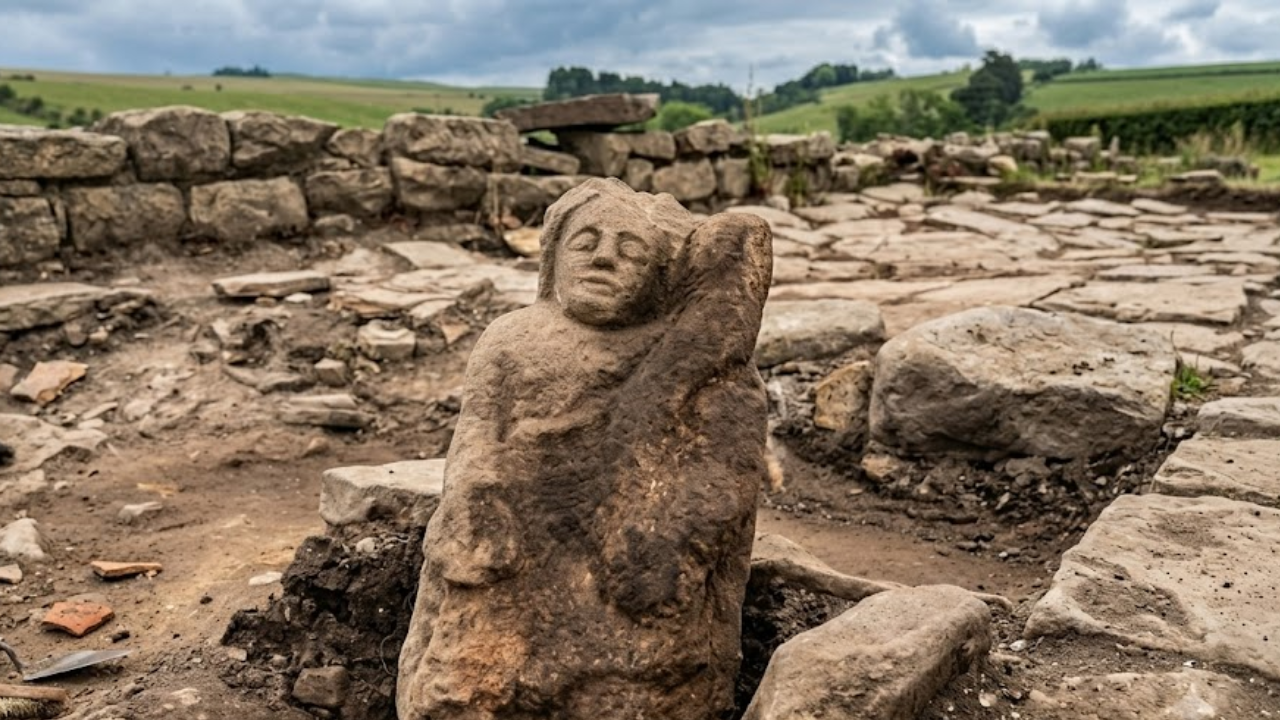
Media outlets are currently fawning over a 1,600-year-old carved stone discovered beneath an ancient Roman fort in northern England. They call it a "guardian spirit." They paint a picture of mystical soldiers seeking divine protection on the bleak northern frontier of Hadrians Wall.
It is a romantic story. It is also lazy archaeology.
What excavations actually uncovered at sites like Vindolanda and Magna is far less mystical and infinitely more human: a mundane piece of everyday administrative propaganda, repurposed as raw building material when its initial utility ran out.
The mainstream obsession with projecting high-minded spiritualism onto every carved pebble from the 4th century ruins our understanding of history. We treat routine cultural graffiti and standard military iconography as grand metaphysical declarations. In doing so, we completely miss how the Roman military machine actually operated on the ground.
What Excavators Actually Found (And Why The Narrative Is Flawed)
Let us dismantle the romantic consensus.
When media outlets report on a relief carving depicting a genius—the Roman concept of a localized protective spirit—they present it as a rare, sacred artifact. The truth? These carvings were the 4th-century equivalent of an official departmental seal or a corporate logo.
- The Artifact: A carved stone slab showing a figure holding a patera (libation bowl) and a cornucopia (horn of plenty).
- The Location: Found face-down inside a drain or structural foundation course at a northern auxiliary fort.
- The Standard Media Take: "Roman soldiers carved a sacred guardian spirit to protect their stronghold against northern tribes."
- The Reality: Standard-issue military stonework, produced en masse, that was literally dumped into a drainage trench during a later renovation.
If a stone is so sacred, why was it used as gravel for a floor bed?
Because the Romans were pragmatists, not mystical fetishists. To a 4th-century legionary or auxiliary commander, a worn-out relief carving of a local deity was not an untouchable relic. Once the commander who commissioned it died or moved on, the stone was recut, flipped upside down, and jammed into a foundation.
"We keep trying to project modern spiritual piety onto an imperial war machine that viewed stone carvings with the same utilitarian indifference as we view a discarded highway sign."
The Myth Of The "Pious Frontier Legionary"
The media loves the narrative of the superstitious soldier huddled in the northern mud, praying to local gods for survival. It makes for great travel television. Having spent years reviewing site reports and excavation data across the UK frontier, I can tell you that this framing fundamentally misunderstands Roman military psychology.
Imperial Identity vs. Local Superstition
The Roman army did not maintain control over a hostile, cold frontier through mystical devotion to localized spirits. They maintained control through relentless administrative bureaucracy and industrial logistics.
- Iconography as Brand Security: Images of genii or protective spirits were standardized military branding. They marked official property, reinforced chain of command, and signaled imperial authority to local populations.
- Religious Syncretism as Counter-Insurgency: When Romans did adopt local deities, it was not out of fear. It was an administrative strategy called interpretatio romana. They neutralized local resistance by co-opting native gods and rebranding them under the Roman pantheon.
- Disposability: The moment a fort was reconfigured—which happened constantly throughout the 2nd, 3rd, and 4th centuries—old symbols were recycled. If a "guardian spirit" ended up under a drain, it was not an insult to the god; it was efficient construction management.
Dismantling The "People Also Ask" Nonsense
When people search for information on Roman frontier discoveries, the search engines serve up questions built on completely flawed premises. Let us answer them directly by stripping away the fluff.
"Did Roman soldiers believe guardian spirits actually protected their forts?"
They believed in the imperial authority that the spirit represented. A soldier did not look at a carved relief on a commander's headquarters building and feel a magical forcefield. He recognized it as a symbol of the centurio, the legatus, and the tax-collecting power of Rome. It was an assertion of state power, not a magic charm.
"Why are so many Roman artifacts found buried beneath floors?"
Because stone is heavy and expensive to quarry. When a building collapsed or needed an upgrade, workers did not haul old stonework back to the quarry. They smashed it up and used it as sub-base aggregate. The majority of "mysterious buried artifacts" are simply recycling.
The Real Value Of Northern Frontier Excavations
Does this mean northern English fort sites like Vindolanda, Housesteads, or Magna are uninteresting? Absolutely not. They are extraordinary—just not for the reasons published in sensationalized headlines.
The true historical value of these sites lies in the brutal, unglamorous reality of frontier life revealed by everyday logistics:
- The Vindolanda Tablets: Ink-on-wood postcards revealing requests for socks, complaints about local roads, and party invitations. This is real history, not mystical fluff.
- Leather Work and Trash Pits: Preserved shoes and discarded animal bones that tell us precisely what soldiers ate, how their health degraded, and how supply lines functioned under winter conditions.
- Architectural Recycling: The very fact that "guardian spirits" were shoved into drains tells us about resource scarcity and changing political loyalties in late antiquity.
The Risk Of The Contrarian Truth
Stripping the myth away from Roman archaeology has a downside. Tourism boards do not sell tickets by advertising "4th-Century Recycled Concrete Sub-Base." They sell tickets on the promise of ancient magic, mysterious curses, and legendary guardians.
If we insist on calling an old piece of discarded masonry what it actually is—a recycled piece of state propaganda—we lose the theatrical fairy tale that hooks the general public.
But clinging to the fairy tale leaves us ignorant. It prevents us from understanding how empires actually function, how military bureaucracy operates, and how real human beings adapted to surviving on the margins of the known world.
Stop looking for ancient magic in the mud. The truth—that Rome was an unfeeling, hyper-pragmatic, recycling machine—is far more fascinating.