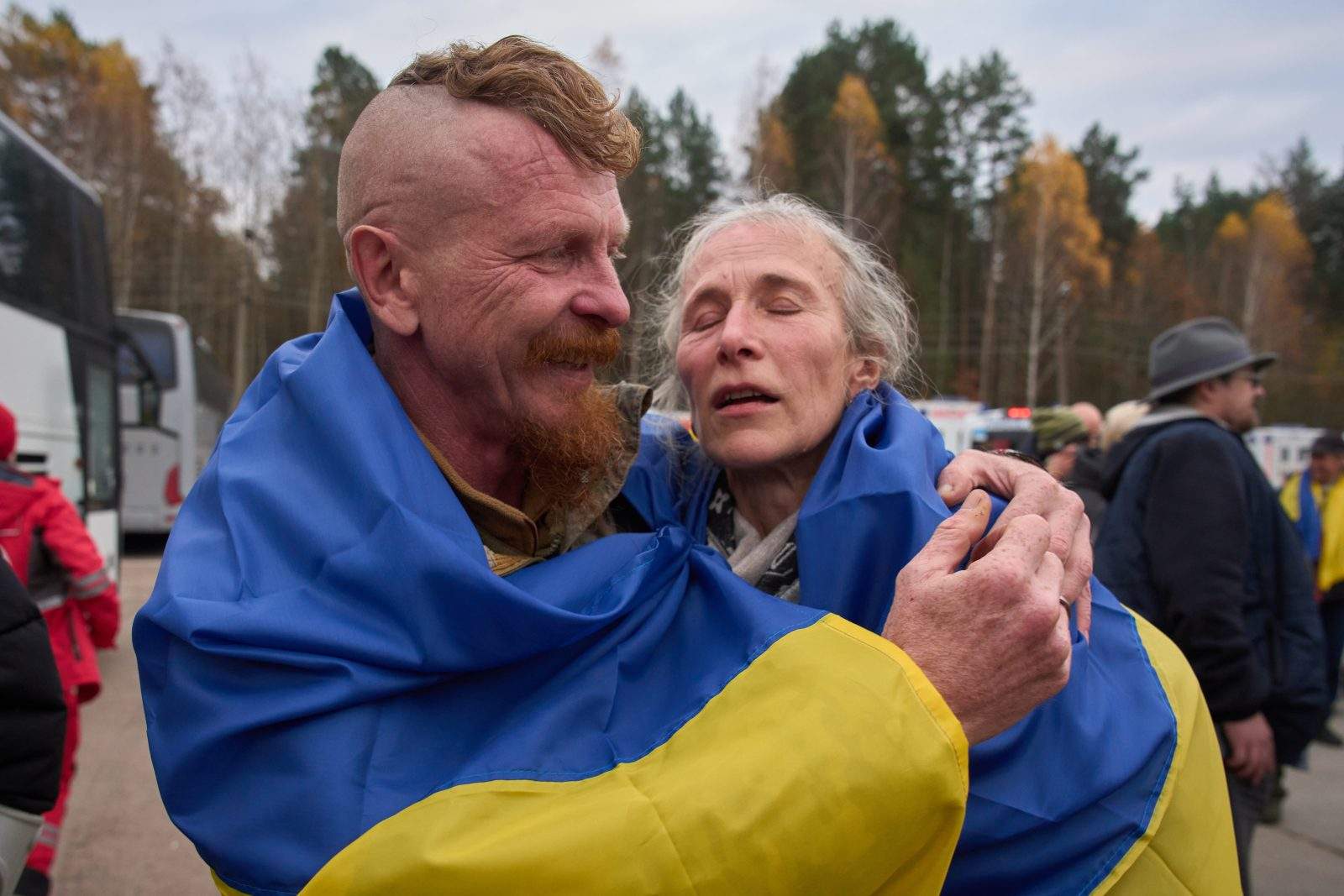
The cameras love a tearful embrace at a barbed-wire fence. They zoom in on the trembling hands, the winter coats, the raw relief of families stepping across the Mogilyov or Gomel crossings after months of separation. Legacy outlets eat it up. They frame these moments as pure, unadulterated humanitarian triumphs—beacons of warmth cutting through the bleak frost of Eastern European geopolitics.
They are missing the entire board.
When you look at a reunion on the Ukrainian-Belarusian border and see only a heartwarming human-interest story, you are falling for one of the oldest, most calculated illusions in modern statecraft. These corridors are not organic miracles of goodwill. They are tightly choreographed pressure valves, geopolitical bargaining chips, and intelligence-gathering funnels operated by regimes that do not do favors for free.
I have spent over a decade tracking cross-border humanitarian corridors, prisoner swaps, and grey-zone diplomacy across Eurasia. I have watched NGOs and Western media outlets repeatedly mistake tactical state concessions for genuine humanitarian breakthroughs, only to act shocked when the same borders snap shut—or turn into traps—six months later. If we do not strip away the sentimentalism surrounding the Ukrainian-Belarusian border, we fail to understand how hybrid warfare actually operates on the ground.
The Myth of the Neutral Humanitarian Corridor
Mainstream reporting treats the operating border checkpoints between Ukraine and Belarus—like the Mokrany-Domanove crossing—as neutral ground. A simple bridge where civilians pass from danger to safety.
That framing is dangerously naive.
There is no such thing as a neutral square inch on the Belarusian side of that border. Since February 2022, Belarus has functioned as a co-belligerent staging ground, a logistics hub, and an intelligence annex for Moscow. Every single bus that rolls up to the barrier, every passport stamped, and every tearful reunion filmed by state-adjacent media happens under the microscopic supervision of the Belarusian State Border Committee and the KGB.
Let’s define the actual mechanism at play here: coercive humanitarianism.
In standard conflict resolution, a humanitarian corridor is established under international law—specifically the Geneva Conventions—through mutual agreement by neutral third parties like the International Committee of the Red Cross (ICRC) to protect non-combatants. What happens on the Ukrainian-Belarusian frontier is the exact opposite. It is unilateral, selective access granted by an authoritarian state to project legitimacy, extract concessions, or gather human intelligence.
When Minsk allows evacuees from occupied Ukrainian territories—who often have no choice but to travel through Russia and Belarus to reach Ukrainian-controlled soil—to cross at these specific bottlenecks, Minsk gets three immediate strategic wins:
- Image Laundering: State media broadcasts footage of Belarusian border guards handing out hot tea and blankets. For domestic and international audiences, the regime transforms overnight from an aggressor’s accomplice into a benevolent peacemaker.
- Information Harvesting: You do not walk across that border without enduring hours of "filtration." Smartphones are cloned. Contacts are scraped. Social media histories are combed through. Every evacuee becomes an involuntary data point on morale, troop movements, and underground networks inside occupied territories.
- Diplomatic Leverage: By keeping a single narrow valve open, Minsk reminds Kyiv and Brussels that it holds the keys to thousands of divided families. That creates silent, immense pressure on Ukrainian negotiators during prisoner swaps and backchannel talks.
The media reports the hug. They ignore the interrogation room fifty yards behind it.
Why Families Are Forced Through Enemy Territory in the First Place
To understand why these border reunions are a symptom of failure rather than a triumph of humanity, look at a map.
Why is a grandmother from Melitopol or Mariupol reuniting with her daughter at the Belarusian border in the first place? Because the direct front lines inside Ukraine are impassable minefields, artillery kill zones, and fortified trenches.
To get from Russian-occupied southern Ukraine to Kyiv, civilians have to execute a massive, exhausting horseshoe maneuver. They travel east into Russia, north toward Moscow or St. Petersburg, west into Belarus, and finally south to the Ukrainian border. It is a thousand-mile detour through the territory of the very states responsible for their displacement.
Let’s look at the mechanics of this journey:
- The Financial Drain: Private carriers charge exorbitant rates for these routes. Families sell off remaining assets just to pay for a seat on a cramped minibus.
- The Filtration Gauntlet: Travelers face multiple checkpoints operated by Russia’s FSB before they even reach Belarusian border guards. Men of fighting age are routinely pulled off buses, detained indefinitely, or pressured into signing military contracts.
- The Psychological Toll: By the time these evacuees reach the Ukrainian-Belarusian border, they are sleep-deprived, financially depleted, and terrified of saying the wrong word that might get them turned back at the final hurdle.
When journalists frame the end of this ordeal simply as a "joyful reunion," they erase the systemic weaponization of geography that forced the journey. It is the equivalent of applauding an arsonist for handing a bucket of water to the family whose house he just burned down.
The Hard Questions Nobody Wants to Ask
When people search for news about the Ukrainian-Belarusian border, they usually ask surface-level questions: Is the border open? How do evacuees cross? Are families safe once they reunite?
Those are the wrong questions. If you want to understand the reality of these crossings, you have to ask the uncomfortable ones that disrupt the feel-good narrative.
Are these border crossings actually safe for evacuees?
Physically, the checkpoint itself is rarely shelled. Politically and legally, it is a minefield.
Once an evacuee crosses into Ukrainian territory, their ordeal isn't over. Ukrainian counterintelligence (the SBU) has to screen incoming travelers just as rigorously as the Belarusians did, albeit for entirely different reasons. Russian intelligence services actively use these humanitarian flows to insert saboteurs, spotters, and informants into Ukraine.
Imagine a scenario where a desperate father is stopped by the FSB in Rostov-on-Don on his way to Belarus. The officers tell him his elderly mother—who is staying behind in occupied Kherson—will lose her medical care unless he agrees to drop a SIM card or take photos of a railway junction once he reaches Kyiv. He agrees just to get across the border.
Now, when he hugs his wife at the Belarusian border, is that a simple reunion, or is it the beginning of an espionage nightmare? Ukrainian security services know this happens constantly. Every person coming through that corridor carries a shadow of suspicion that takes weeks of vetting to clear.
Why doesn't Ukraine just close the border completely?
Kyiv fortified its northern border with Belarus with anti-tank ditches, dragon's teeth, and dense minefields. Militarily, it is sealed tight. Yet, the humanitarian trickle at Mokrany-Domanove remains open.
Why? Because shutting it completely would trap hundreds of thousands of Ukrainian citizens inside occupied territories with zero exit routes, except through the Baltic states—a route that requires valid international passports that many elderly or displaced Ukrainians lost when their homes were destroyed.
Kyiv is forced to swallow the bitter pill of Minsk’s propaganda wins in order to save its own citizens. It is a brutal, pragmatic trade-off. Recognizing it as a calculated necessity is vastly more respectful to the people making that trek than pretending it is a heartwarming fairytale.
The Blind Spot of Western Journalism
Legacy media operates on an emotional economy. Complexity doesn't generate clicks; tears do.
When a correspondent files a dispatch from the border, editors want the human angle. They want the quote about missing a grandchild’s birthday. They want the imagery of borders dissolving in the face of familial love. In doing so, they inadvertently validate the strategic messaging of authoritarian regimes.
Think back to the 2021 Belarus-EU border crisis, when Alexander Lukashenko’s regime weaponized migrants from the Middle East, flying them into Minsk and pushing them toward Poland and Lithuania. Back then, Western analysts immediately recognized the cynical manipulation of human suffering for geopolitical leverage. Heavy hitters in security studies—from Chatham House to the Institute for the Study of War—documented how Minsk used human beings as hybrid weapons.
Yet, when the exact same regime controls the flow of Ukrainian evacuees at its southern border, that analytical rigor evaporates. Suddenly, the geopolitical context is scrubbed out in favor of a Hallmark-card narrative.
Admitting this nuance does not mean we lack empathy for the families. The relief a mother feels holding her child after two years of occupation is real. The trauma they survived is real. What is fake is the sanitized framing that divorces their reunion from the ruthless machinery controlling the gate.
The Downside of Cynicism—And Why We Still Need It
There is an obvious risk to viewing every humanitarian corridor through a hard-nosed intelligence lens: you risk dehumanizing the victims.
If policymakers and the public start viewing every evacuee crossing from Belarus as a potential security threat or a pawn in Lukashenko’s propaganda game, public support for keeping these vital escape routes open will collapse. Families trapped in occupied territories need that corridor, regardless of how cynically Minsk exploits it.
That is the tightrope. You have to hold two competing truths in your head at the exact same time:
- The corridor must stay open because human lives depend on having an exit ramp from occupation.
- The corridor is a hostile environment weaponized by adversarial intelligence services and state propagandists.
When you collapse those two truths into a single, saccharine news story about love conquering borders, you blind the public to how modern conflict actually functions. You train readers to consume war through emotional soundbites rather than strategic reality.
How to Actually Read Border News
If you want to stop being manipulated by feel-good war reporting, change how you consume coverage of humanitarian corridors and prisoner exchanges.
- Look at the timing. Crossings rarely surge by accident. Check what happened diplomatically 48 hours prior. Was there a sanctions vote in Brussels? A stalled prisoner swap? A diplomatic visit from Beijing or Moscow? Humanitarian gestures in hybrid wars are almost always receipts for backroom transactions.
- Watch who holds the microphone. Notice which journalists are allowed on the Belarusian side of the fence versus the Ukrainian side. Access on the Belarusian side is strictly curated by state security. Anything filmed there is an approved state product.
- Follow the friction, not just the embrace. Pay attention to who isn't crossing. Look at the demographic breakdown of the evacuees. Mostly women, children, and the elderly. Ask yourself where the young men are, and what price was paid at the checkpoints three hundred miles back.
The tears at the Ukrainian-Belarusian border are real. The love between those families is undeniable.
Everything else about that scene is a weapon.