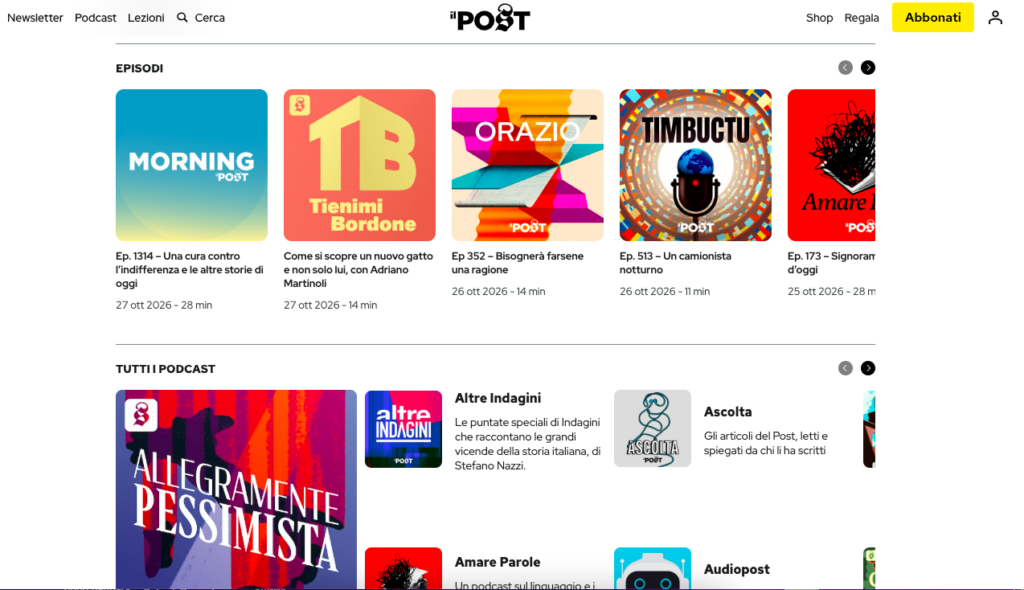
Media consultants love a tidy fairy tale. Right now, their favorite bedtime story goes like this: launch a daily morning podcast, get commuters hooked on your voice, put a paywall around the bonus episodes, and watch the recurring revenue roll in.
They point to Il Post in Italy and El Orden Mundial (EOM) in Spain as proof of the formula. Don't miss our previous post on this related article.
They are looking at the scoreboard and completely missing the game.
If you are a publisher trying to copy their audio-to-subscription funnel today, you are walking straight into a cash incinerator. I have watched media executives blow millions building gleaming podcast studios, hiring expensive audio producers, and pumping out daily news shows, only to watch their conversion rates flatline below half a percent. If you want more about the background of this, Business Insider offers an informative breakdown.
The lazy consensus in digital publishing says audio builds habits, and habits build subscriptions. That is backwards. Audio did not turn Il Post and El Orden Mundial into thriving subscription businesses. Pre-existing editorial authority and acute market vacuums did. Audio was simply the friction-free delivery mechanism they used to monetize trust they had already spent years earning.
The Audio Funnel Myth
To understand why the standard industry playbook fails, you have to look at the mechanics of podcast consumption versus subscription behavior.
Podcasts are terrible conversion engines for cold audiences. An RSS feed is an open, decentralized pipe. When someone listens to your free show on Apple Podcasts or Spotify, they are renting your content inside someone else’s walled garden. Getting a listener to stop walking their dog, pull out their phone, open a mobile browser, navigate to your website, type in their email address, and enter a sixteen-digit credit card number is one of the highest-friction user journeys on the internet.
Yet, industry case studies routinely treat Il Post’s flagship morning podcast, Morning—hosted by deputy director Francesco Costa—as a magical customer acquisition machine.
Look closer at the actual sequence of events. Il Post launched in 2010. For over a decade, Luca Sofri and his team built a reputation in Italy for doing something remarkably rare in Italian journalism: explaining the news plainly without partisan hysteria, clickbait headlines, or insider political jargon. They launched their membership program in 2019, and Morning arrived in 2021—exclusively behind the paywall from day one.
Read that again. Morning was not a free top-of-funnel podcast that converted casual listeners into paying members. It was a subscriber-only retention and acquisition weapon built on top of an already fiercely loyal readership. People did not subscribe because they had an "audio habit." They subscribed because Il Post had spent eleven years proving it was the only adult in the Italian media room, and Francesco Costa had already built a massive personal following through his newsletters and reporting on American politics.
El Orden Mundial followed a different tactical path, yet the underlying economics tell the exact same story. Founded in 2012 as a university project, EOM spent years publishing deep, accessible geopolitical analysis in Spanish—a massive global market starved for serious international coverage that wasn't merely translated wire copy. By the time EOM leaned heavily into podcasts like No es el fin del mundo and rolled out its paid membership tiers, it was already the dominant digital reference point for Spanish-language geopolitics.
Why Most Publishers Fail at the Audio-to-Paywall Pivot
When mid-sized newspapers, digital magazines, or niche B2B publications try to replicate this, they confuse correlation with causation. They see the audio player on the homepage and assume the microphone is the magic wand.
Here is what actually happens when a standard publisher tries to manufacture an "audio habit" from scratch:
- They mistake reach for affinity. A download is not a relationship. Most news podcasts are consumed as background noise while commuting or washing dishes. Listeners tolerate mid-roll ads, skip through promos, and rarely feel the emotional urgency required to pull out a wallet.
- They underestimate the editorial voice requirement. Il Post’s Morning works because it is a curated press review filtered through a single, unmistakable human sensibility. Most corporate media podcasts are sterile, over-scripted committee products. Nobody pays €8 a month to listen to two journalists politely reading a press release to each other.
- They ignore market timing and supply. Both Il Post and EOM exploited massive structural gaps in their respective language markets. Italy’s legacy newspapers were bloated, subsidized, and unreadable to younger digital natives. Spain’s mainstream media largely treated international news as an afterthought. Launching a serious, explanatory audio product in English today means competing against The Daily, The Rest Is Politics, Today, Explained, and ten thousand independent Substackers. You are not filling a vacuum; you are screaming into a hurricane.
Define Your Terms Before You Spend a Euro
Part of the confusion stems from sloppy industry terminology. Media executives throw around words like "habit," "community," and "membership" as if they are interchangeable. They are not.
- A Habit is an automatic behavior triggered by a cue—like hitting play on a morning briefing while brushing your teeth. Habits generate impressions and ad inventory. They do not inherently generate pricing power.
- A Paywall is a transactional gate. It sells utility, exclusivity, or access to information the user cannot get elsewhere.
- Membership is an identity purchase. The user pays not because the content is locked, but because they want the institution to exist and want to belong to the tribe that supports it.
Il Post and El Orden Mundial do not run traditional paywalls. Il Post famously leaves almost all of its written articles completely free to read. Their paying subscribers—now numbering well over 100,000—pay for newsletters, podcasts, ad-free browsing, and, above all, identity. They pay because supporting Il Post signals something about who they are.
EOM operates on a similar psychological axis. While they lock deeper analytical pieces and offer exclusive audio and community perks, their core value proposition is helping smart, curious Spanish speakers feel like they actually understand how the world works.
If you try to slap a hard paywall onto a mediocre podcast when you have zero brand affinity, you are asking strangers to pay for an identity they do not want.
Answering the Questions Media Executives Are Too Afraid to Ask
When publishers sit down to plan their subscription strategy, they usually ask the wrong questions. Let’s dismantle the most common ones.
How many podcast downloads do we need before launching a paid tier?
Stop counting downloads. Download numbers are vanity metrics inflated by auto-downloads on Apple Podcasts and passive background listening. A show with 100,000 downloads per episode can easily fail to convert 500 paying subscribers, while a hyper-niche B2B podcast with 3,000 dedicated listeners can generate six figures in recurring revenue.
The real metric is direct email capture. If you cannot convince a podcast listener to give you their email address for free in exchange for a companion newsletter or show notes, you have zero chance of convincing them to give you their credit card.
Should we put our best podcast behind the paywall or keep it free?
If you are starting from zero, putting your flagship show behind a paywall is suicide. Il Post could lock Morning behind a paywall because its free website already reached millions of monthly readers who knew and trusted the brand. EOM kept its main podcast free on open platforms to build reach while offering ad-free feeds and bonus episodes to members.
The rule is simple: monetize the depth, not the discovery. Keep your sharpest, most accessible audio completely free on every open platform. Use it to prove your competence. Put the granular, high-utility extensions—the raw data briefings, the AMA sessions with editors, the serialized deep dives—behind the member gate.
Is audio better for retention than written newsletters?
In isolation, no. Written newsletters live inside the inbox—the exact same digital environment where password resets, receipts, and subscription billing notifications live. Clicking a link in an email takes a reader directly to a mobile web checkout flow.
Audio wins on emotional intimacy. Hearing a human voice in your headphones for thirty minutes every morning builds parasocial trust faster than text ever could. When you combine the two—using audio to build warmth and personality, and email to drive the actual conversion click—you get a functional engine. Relying on audio alone leaves your conversion funnel broken in half.
The Uncomfortable Truth About The Contrarian Approach
Before you scrap your audio strategy and go all-in on text and brand-building, you need to face the downside of this reality.
Building the kind of deep, pre-existing editorial trust that Il Post and El Orden Mundial leveraged is brutally slow. It takes years of consistent, unglamorous publishing before you earn the right to ask for money. Investors hate it. Board members lose patience with it. You cannot growth-hack credibility in two quarters, and you cannot buy it with Meta ads.
Even when you do everything right, audio remains a high-cost, low-margin medium compared to text. One sharp editor with a laptop can write a newsletter that converts thousands of subscribers. Producing a daily, broadcast-quality podcast requires hosts, editors, sound engineers, and relentless daily deadlines that burn out creative talent within eighteen months.
What to Do Instead of Building a Podcast Funnel
If you want to build a resilient subscription business without lighting your budget on fire, invert the standard playbook:
- Fix your written editorial voice first. If your articles read like dry wire summaries or algorithmic SEO filler, no amount of crisp studio audio will save you. Develop a distinct, opinionated, indispensable point of view in text—the cheapest, fastest medium to test and iterate.
- Build an owned email list before you touch a microphone. Treat every piece of public content as a vehicle to capture an email address. Own the direct distribution channel before you start renting space in Spotify’s app.
- Launch audio as a loyalty reward, not a growth hack. Wait until you have an active core of readers who reply to your emails, share your work, and ask for more. Give them a podcast to deepen their habit and reduce churn.
- Sell identity and utility, never "content." Nobody wakes up wishing they had more content to consume. People pay for clarity in a noisy world, status among their peers, and membership in an institution they respect.
Stop looking at Il Post and El Orden Mundial as podcasting case studies. They are case studies in relentless editorial discipline that happened to buy microphones. Until you build something people actually trust, your podcast is just expensive noise.


