Every financial reporter in Washington is currently peddling the same lazy, two-dimensional narrative. On one side, you have the scrappy domestic steelmakers and solar manufacturers waving the American flag, begging the Department of Commerce to slap punitive tariffs on Vietnamese imports. On the other side, you have tech giants like Tesla and Samsung wringing their hands, warning that any border tax on Hanoi will wreck the American consumer and stall the green energy transition.
Pick your villain. Choose your hero. Go back to sleep.
It is complete nonsense. Having spent two decades untangling global supply chains and watching corporations burn hundreds of millions of dollars chasing tariff loopholes, I can tell you that both sides of this public brawl are hiding the real story. This fight has nothing to do with protecting American workers, and it has even less to do with keeping consumer prices low.
This is a turf war over who gets to profit from the single greatest geographic shell game in modern economic history.
The China Plus One Fairy Tale
To understand why Tesla, Samsung, American steel producers, and domestic solar panel makers are screaming at each other in federal trade dockets, you first have to dismantle the myth of "China Plus One."
Over the past eight years, corporate boards patted themselves on the back for diversifying their manufacturing footprints. The pitch to Wall Street was simple. Move assembly lines out of Shenzhen and Dongguan, set up shiny new factories in Bac Ninh or Hai Phong, and insulate the business from geopolitical friction between Washington and Beijing.
Here is what actually happened on the ground.
In almost every heavy industrial sector—from corrosion-resistant steel to photovoltaic solar cells and lithium-ion battery subcomponents—Vietnam did not replace the Chinese supply chain. Vietnam became the final zip code for Chinese raw materials.
When a company shifts final assembly to Southeast Asia, they rarely bring the entire upstream ecosystem with them. They cannot. Building an integrated polysilicon refinery, a blast furnace, or a cathode precursor plant takes years, massive capital expenditure, and environmental permitting that simply does not happen overnight. So what do they do? They import the semi-finished Chinese steel coils, the Chinese silicon wafers, and the Chinese battery chemicals into northern Vietnam. They run them through a light manufacturing process—cutting, coating, assembling, and packaging—and slap a Made in Vietnam sticker on the shipping container.
In trade law, this is evaluated under substantial transformation rules and circumvention statutes. Specifically, the U.S. Department of Commerce looks at whether the processing done in a third country changes the fundamental character of the product, or if the third country is merely acting as a transshipment hub to dodge Section 301 and antidumping duties meant for China.
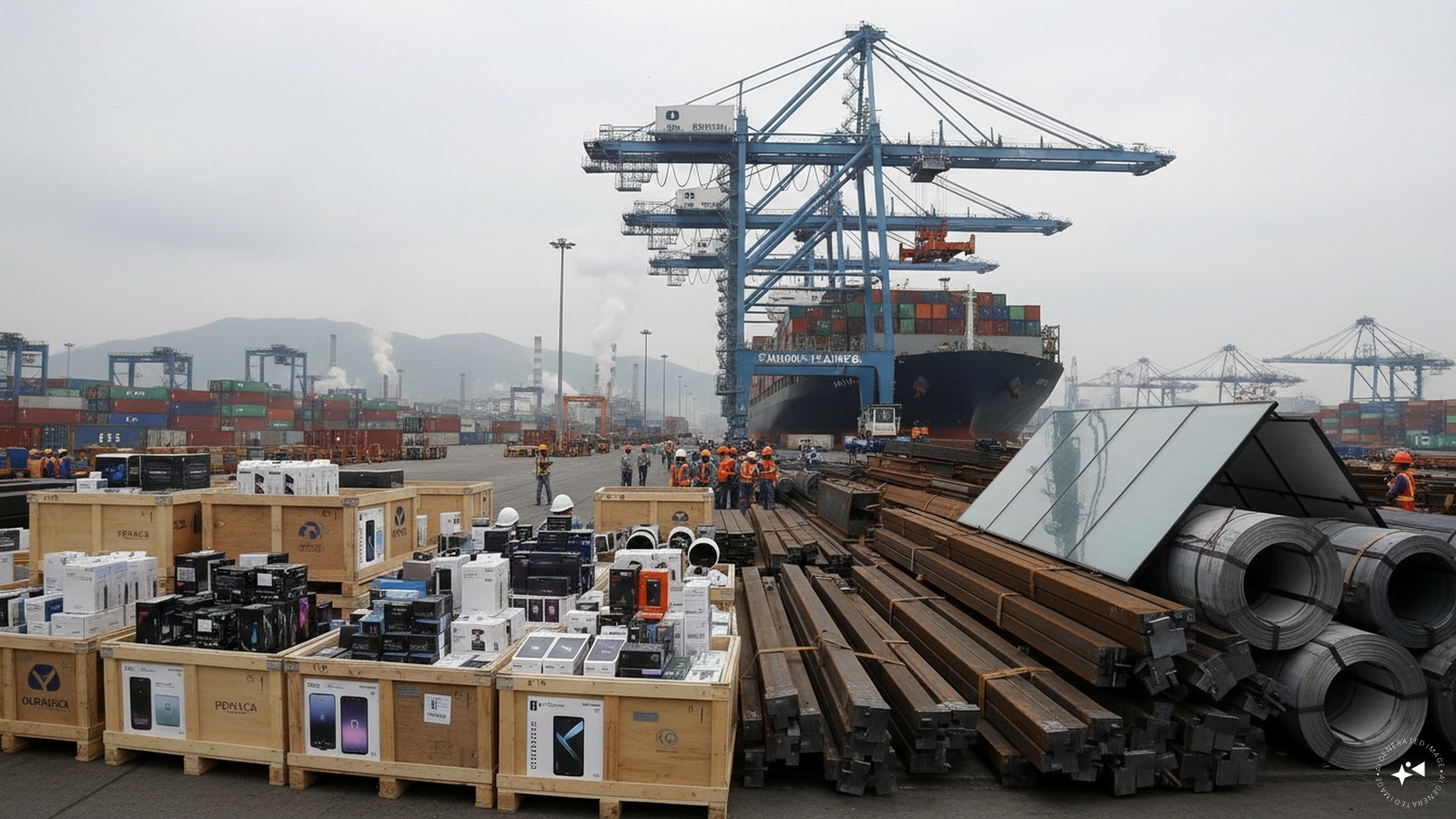
Domestic steelmakers like Cleveland-Cliffs and Nucor, alongside domestic solar alliances, are not stupid. They have satellite imagery, customs manifests, and bill-of-lading data showing massive surges of raw materials flowing south across the Guangxi border into Vietnam, followed almost instantaneously by identical volume surges of finished goods landing at the Port of Los Angeles.
They are right to call foul. What they leave out of their press releases is that slapping a 200 percent tariff on Vietnam will not magically resurrect a competitive domestic supply chain in Ohio or Georgia overnight.
Why Samsung and Tesla Are Actually Panicking
Now look at the other side of the ledger. When Samsung and Tesla file formal comments opposing U.S. trade penalties on Vietnam, they frame their resistance around American economic health. They argue that tariffs act as a regressive tax on domestic buyers, disrupt fragile supply networks, and undermine the Inflation Reduction Act's clean energy goals.
That is boardroom theater. Let us look at their actual balance sheets and operational exposure.
Samsung is the single largest foreign investor in Vietnam. The South Korean conglomerate accounts for roughly a fifth of Vietnam's entire export economy. Billions of dollars in fixed capital—massive semiconductor packaging facilities, display module plants, and smartphone assembly campuses—are bolted to the Vietnamese floor. If Washington treats Vietnam as an extension of the Chinese manufacturing apparatus, Samsung's multi-billion-dollar hedge against U.S.-China decoupling evaporates instantly. They cannot pick up a fab in Thai Nguyen and move it to Texas before the next quarterly earnings call.
Tesla's calculus is equally self-serving, though slightly different in mechanics. Electric vehicle margins have been compressed by brutal global price wars. To defend profitability, automakers rely on ruthless cost engineering across thousands of Tier 2 and Tier 3 suppliers. Many of those suppliers migrated to Vietnam specifically because Washington encouraged "friendshoring." Treasury Secretary Janet Yellen literally flew to Hanoi to pitch Vietnam as a trusted partner.
Now, companies that followed the U.S. government's implicit playbook are being told their supply routes might be taxed out of existence. Tesla is not fighting to save the American consumer a few hundred dollars on a Model Y. Tesla is fighting because re-qualifying automotive-grade component suppliers takes 18 to 24 months of rigorous safety validation. A sudden tariff wall turns their just-in-time logistics into a cash-burning nightmare.
What Everyone Gets Wrong About Trade Penalties
If you search for coverage on these trade disputes, you run into the same recycled questions from investors and operations managers. Let us dismantle the flawed premises behind them.
Do tariffs on Vietnam bring manufacturing jobs back to the United States?
No. Rarely, if ever, does a tariff on a Southeast Asian nation result in a one-to-one reshoring of factories to the American Midwest. Capital flows toward the path of least resistance, not the path of highest patriotism. When Washington choked off direct imports from China in 2018, manufacturing did not flood back to Pennsylvania. It flowed to Vietnam, Mexico, India, and Malaysia. If the Department of Commerce slams the door on Vietnam, supply chains will simply splinter further into Indonesia, Cambodia, or Thailand. Domestic producers get temporary price protection—allowing them to raise their own prices to just below the tariff-inflated import price—while downstream American manufacturers pay more for inputs.
Is Vietnam violating international trade rules?
This is the wrong question. Vietnam is doing what every export-led developing economy from South Korea in the 1970s to China in the 2000s has done. They are maximizing foreign direct investment, offering tax holidays, and leveraging their geographic proximity to the world's largest industrial inputs market. The failure is not Vietnam's ambition. The failure is Washington's incoherent trade policy, which tried to execute a surgical decoupling from Beijing using blunt, country-specific tariffs rather than strict rules of origin tied to value-added percentages.
Can companies just absorb the tariffs without raising prices?
In commodity industries like steel and solar modules, net margins are razor-thin. Nobody absorbs a 50 percent or 250 percent duty. Either the exporter goes bankrupt, the importer eats the loss and cancels future orders, or the end customer pays a massive premium. In specialized electronics or automotive parts, big buyers like Samsung and Tesla use their monopsony power to force Tier 1 suppliers to eat the tariff cost for the first two quarters, right up until those suppliers start cutting corners on quality or threatening insolvency.
The Uncomfortable Truth About Protectionism
I have sat across the table from steel executives and solar lobbyists who genuinely believe that without aggressive trade enforcement, China will systematically bankrupt every strategic industry in the Western hemisphere. And here is the part where I admit the downside to my own skepticism: they are not entirely wrong about the threat.
State-subsidized overcapacity is a real weapon. When Beijing floods global markets with below-cost steel or solar wafers, free-market competition ceases to exist. If the United States allows its domestic industrial base to be hollowed out completely, it surrenders national security and technological sovereignty. You cannot fight a modern conflict or build an energy grid if your enemies control 90 percent of your refined minerals and foundational metals.
The tragedy is that our current tariff mechanism is a broken tool for a real problem.
When you apply country-level tariffs based on where a ship left port, you create an endless game of whack-a-mole. Every time Commerce spends two years investigating circumvention in Vietnam, the supply chain shifts three hundred miles west before the final ruling is even published in the Federal Register. Taxpayers fund massive bureaucratic investigations, domestic firms spend millions on Washington trade lawyers, and global conglomerates spend billions shuffling shipping containers across Southeast Asia without adding a single ounce of genuine industrial resilience.
How Smart Operators Actually Play This Game
If you are running a business, managing procurement, or allocating capital in sectors caught in the crossfire between domestic protectionists and global assemblers, waiting for Washington to find a sensible middle ground is financial suicide.
Stop watching the headlines about which tech giant is lobbying the White House. Start auditing your bill of materials at the sub-tier level.
- Map to the Smelt, Pour, and Mine. If your supplier tells you a component is made in Vietnam, ask for the mill test certificates, the polysilicon origin documentation, or the chemical precursor manifests. If you cannot trace the raw material back to the mine or the furnace, assume the Department of Commerce will eventually treat that part as Chinese.
- Price in a 25 Percent Geopolitical Tax. When modeling unit economics for any hardware, metal, or energy product sourced from Southeast Asia, stop using baseline tariff rates. Build your financial models assuming a punitive duty will hit within 18 months. If the deal only works at zero percent duty, you do not have a business; you have a regulatory arbitrage play with an expiration date.
- Exploit the North American Loophole—Carefully. While Washington fights over Asia, the United States-Mexico-Canada Agreement (USMCA) remains the most insulated trade corridor on earth. However, the exact same Chinese circumvention scrutiny is currently descending on Monterrey and Tijuana. Nearshoring only protects you if your regional value content legitimately meets strict North American thresholds.
- Watch the Downstream Winners. When steel and solar tariffs spike, the worst place to be is an unhedged installer or a mid-market fabricator. The best place to be is in domestic logistics, specialized compliance auditing, or upstream North American raw material extraction where supply is structurally constrained.
The battle between Tesla, Samsung, American steel, and domestic solar is not a clash between free trade and protectionism. It is a clash between two different dependency models. One side wants to depend on subsidized Asian supply chains to hit aggressive growth targets today. The other side wants to depend on federal trade walls to guarantee domestic margins tomorrow.
Neither side is building a truly independent industrial base. Stop picking a side in their public relations war, audit your sub-tier supply chain down to the raw dirt, and price your risk before the customs agents do it for you.