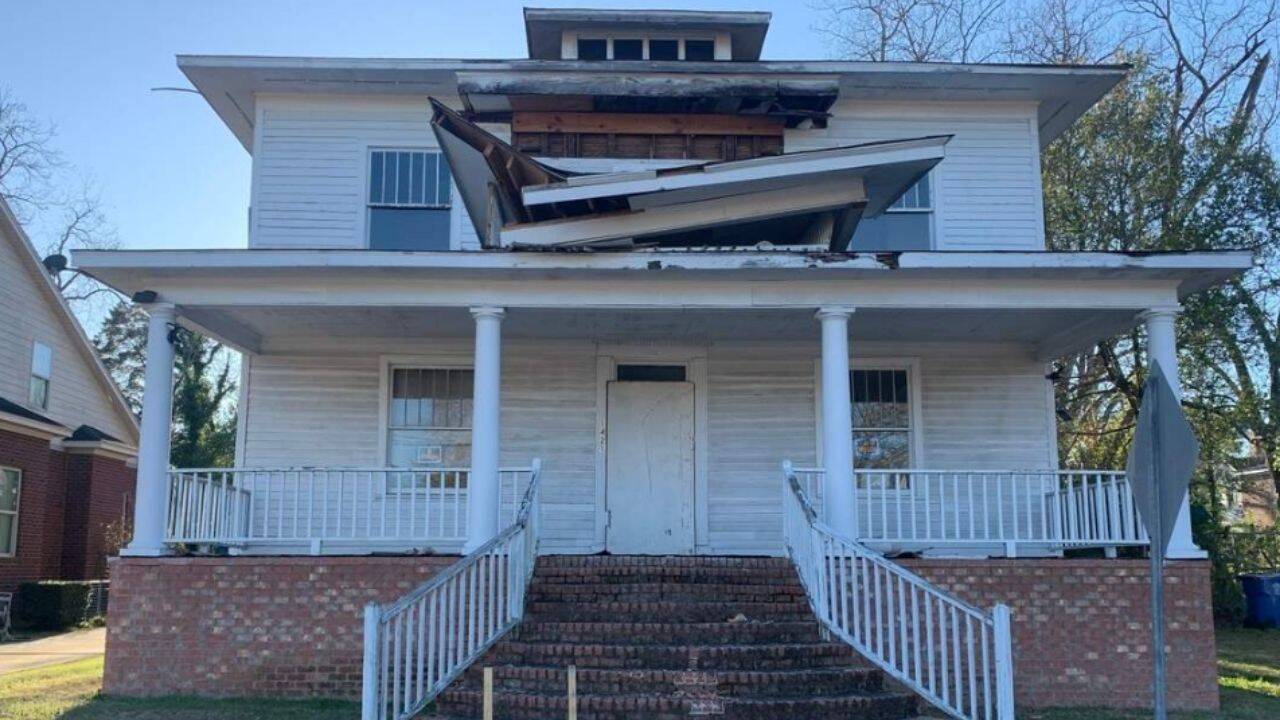
Historic preservation is a secular religion with zero self-awareness. Every time an old building turns to dust, the internet floods with self-righteous weeping about lost heritage, callous institutions, and the betrayal of community trust. The recent demolition of the 1903 house moved by Allen University decades ago is the latest casualty in this predictable cycle of manufactured outrage. Heritage groups are screaming about broken promises. Pundits are lamenting the erasure of Black history. Everyone is pointing fingers at a historically black university for failing to act as a real estate charity.
They are all missing the point entirely.
The lazy consensus says institutions have a moral duty to act as curators of decaying wood, regardless of financial gravity. The truth is much colder. Forcing an under-resourced university to maintain a rotting architectural white elephant is an act of economic violence disguised as civic pride.
I have watched non-profits and small institutions drain their operating budgets down to zero trying to satisfy the romantic fantasies of local historical societies who never offered a single dollar for maintenance. Let us pull back the curtain on how preservation dogma actually operates in the real world.
The Romantic Myth Of Adaptive Reuse
Adaptive reuse sounds great in a graduate seminar. In practice, taking a wood-frame structure built at the dawn of the twentieth century, moving it across town, and expecting it to function as a modern educational or administrative asset is an exercise in financial self-harm.
People look at historic structures through a soft-focus lens. They see charm. They see character. They refuse to see lead paint, asbestos, knob-and-tube wiring, structural rot, and the complete impossibility of ADA compliance. When a university relocates a building like the 1903 house, they are handed a liability disguised as an artifact.
Let us be precise about the economics. Historic preservation is not free. It is a luxury good. Wealthy suburban enclaves can afford to pass zoning ordinances that force homeowners to keep historic clapboard pristine. Cash-strapped urban institutions operating in higher education cannot. Every dollar spent shoring up rotting pine studs is a dollar taken away from student scholarships, faculty retention, or modern lab spaces.
When Allen University originally moved that house in 2008, they did so with good intentions, high hopes, and likely zero appreciation for the staggering capital expenditure required to keep a century-old corpse upright. Intentions do not pay contractors. Inflation does not care about local history.
The Hypocrisy Of Outsourced Nostalgia
The loudest critics of this demolition are almost never the people who had to walk past the rotting eyesore every day or fund its upkeep. It is a classic tragedy of the commons. The community claims ownership of the building's historical value while refusing to shoulder any of its financial weight.
Imagine a scenario where the local historical society was legally required to escrow the full cost of restoration and perpetual maintenance before criticizing an owner for demolition. The outrage machine would grind to an immediate halt. It is very easy to demand that someone else preserve history when you have no skin in the game.
Universities are engines of upward mobility, not museums. Their primary mandate is to educate living, breathing students who need Wi-Fi, modern classrooms, and competitive facilities. Sacrificing the future of living students on the altar of dead lumber is a moral failure, yet preservationists demand it every single day.
We need to stop treating age as an inherent moral virtue. Not every old building is a masterpiece. Some old buildings are just old buildings that have outlived their structural and economic utility. Clinging to them is a symptom of a culture terrified of the future, hiding in the past because the present is too difficult to manage.
The Cost Of Doing Nothing
The alternative to demolition was leaving the structure to slowly collapse inward, a hazard to the neighborhood and an embarrassment to the campus. Restoration was not a shelved option; it was a mathematical impossibility.
When an institution reaches the point where a structure must come down, they have usually already absorbed years of carrying costs, insurance premiums, and deferred maintenance headaches. The decision to demolish is rarely made lightly. It is the grim acknowledgment of reality after hope has failed.
If we genuinely care about preserving history, we need a complete overhaul of how we fund it. Stop shaming universities and small property owners for lacking infinite capital. Start creating aggressive, fully funded endowment models specifically for historic structures, or accept that entropy is undefeated.
Until the critics are willing to open their own checkbooks to fund the unglamorous, back-breaking labor of true restoration, their outrage is cheap.
The house is gone. The students remain. Choose the students.