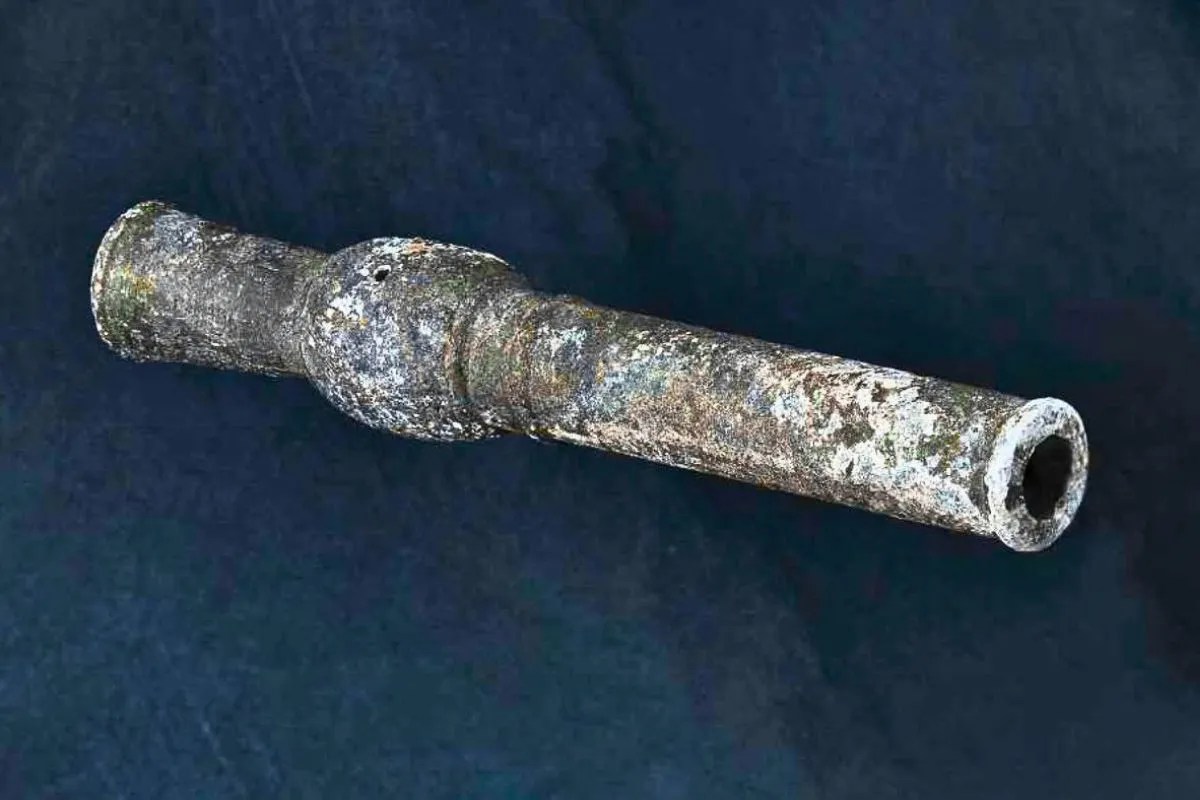
Archaeologists love dirt. Give them a rusty hunk of iron buried six centuries deep in the soil, and they will spin a yarn about brilliant tactical innovation and lost imperial secrets. Headlines breathlessly scream about a 600-year-old firearm unearthed in South Korea, acting as if someone dug up the missing blueprint to modern geopolitical dominance. It makes for nice clicks. It makes for nationalist chest-thumping. It is also completely wrong about how military technology actually evolves.
The lazy consensus in every mainstream historical breakdown of medieval ordnance is that finding an intact barrel or early hand cannon proves a civilization possessed superior tactical foresight. If they built it, they must have used it to dominate. If it was buried, it must have been a secret weapon. For a closer look into similar topics, we recommend: this related article.
Nonsense.
Most early firearms were dangerous, expensive, structurally unstable novelties that spent more time blowing up in the faces of the people firing them than changing the outcome of a siege. Digging up a medieval artifact tells us very little about military supremacy and a great deal about what people were willing to throw away when it failed. For further background on this issue, detailed reporting can be read at BBC.
Let us dismantle the mythology surrounding early East Asian ballistic technology, why ancient metal doesn't equal modern strategic advantage, and why your obsession with artifacts is blinding you to the messy, chaotic reality of how power actually worked centuries ago.
The Myth Of The Technological Leap
When people see an ancient firearm recovered from an archaeological site in the Korean peninsula, they immediately assume a linear path of progress. They think: Gunpowder was invented, guns were made, warfare changed forever.
History does not move in straight lines. It moves in fits, starts, expensive failures, and massive regressions.
During the early Joseon Dynasty, military planners were not sitting around dreaming of infantry units laying down suppression fire. Gunpowder weapons were fringe experiments. They competed against composite bows that could out-range, out-rate, and out-shoot early smoothbore iron tubes by a factor of five.
Imagine a scenario where a fifteenth-century commander is handed a choice between a newly cast bronze hand cannon that takes three minutes to swab, load, and aim—with a twenty percent chance of shattering his own wrist—and a seasoned archer who can loose ten arrows a minute with pinpoint accuracy. Any commander with half a brain chose the archer.
Yet, popular culture treats every historical pipe that shoots lead as a revolutionary pivot. It is a fundamental misunderstanding of operational friction. The presence of a weapon in the dirt proves it was manufactured. It does not prove it mattered.
Why Recovered Artifacts Lie To Us
Survivorship bias rules historical analysis. We find what didn't rust completely away, or what was buried deep enough to escape the recycle bin of a cash-strapped military command.
Metal was precious. In medieval societies, bronze and iron were constantly melted down and beaten into plowshares, cooking pots, or newer, better weapons when old ones proved useless. If a 600-year-old gun was left intact in the ground, it usually means one of two things: it was lost during a rout, or it was discarded because it was fundamentally flawed junk.
Historians love to romanticize the craftsmanship of the past. Having handled and studied early metallurgy preservation projects myself, I can tell you that early casting techniques were wildly inconsistent. Impurities in the iron created microscopic fissures. Uneven cooling rates meant that internal pressures during combustion could turn a barrel into a grenade.
When we uncover these weapons, we are often looking at the medieval equivalent of a recalled product line that the manufacturer desperately wanted to bury.
Treating every ancient metal tube as a testament to tactical genius ignores the economic reality of pre-modern statecraft. Gunpowder was expensive. Saltpeter had to be imported or painstakingly brewed from organic waste. Sulfur was scarce. Setting off a small charge to fling an inaccurate lead ball fifty yards was an astonishingly inefficient way to spend state revenue.
The Real Driver Of Conflict Was Logistics, Not Cool Toys
We romanticize hardware because hardware is tangible. You can put it in a museum case. You can photograph it for a news site. You can write an evocative headline about secrets hidden beneath the soil.
Logistics do not look good in a glass case.
The empires that triumphed in East Asia did not win because they had a cooler prototype gun buried in a trench. They won because they figured out supply chains, crop yields, labor conscription, and bureaucratic communication lines that could keep an army fed four hundred miles from the capital.
When firearms finally reshaped East Asian warfare—such as during the Imjin War in the late sixteenth century, when Japanese forces armed with matchlocks initially shocked Korean defenses—it was not because of some hidden medieval Korean hand cannon prototype dug up centuries later. It was because of mass adoption, standardized manufacturing, and tactical doctrine borrowed, adapted, and scaled under extreme existential pressure.
Technology without doctrine is just a paperweight. Or, in this case, a rust-bucket in the mud.
Stop Looking Backwards For Answers
The obsession with ancient milestones feeds a comforting narrative that progress is inevitable and that our ancestors were constantly unlocking secrets we forgot.
The truth is much colder. Most historical experiments failed. Most military gear was garbage. Most tactical innovations were stumbled into by accident, abandoned for decades, and then reinvented later when economic conditions finally made them viable.
Stop treating an archaeological footnote as a paradigm shift. The next time a headline tries to sell you on a revolutionary discovery buried beneath the dirt, remember that the people who lived back then were just as confused, pragmatic, and desperate as we are now—and they threw away a lot more junk than they kept.