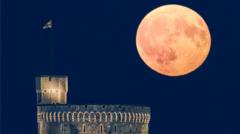
Every July, media outlets lose their collective minds over a chunk of grey rock reflecting sunlight. Headlines hyperventilate about the majestic Buck Moon, treating a routine orbital alignment like the second coming of the cosmos. Photographers scramble to hilltops across Britain, clutching telephoto lenses, desperate to capture a slightly larger-than-average orb hanging over a random water tower or a medieval church spire.
It is mass hysteria fueled by clickbait astronomy. Don't miss our earlier coverage on this related article.
Let us dismantle the romanticized fluff. The July full moon is not a mystical celestial event. It does not possess hidden powers, it bears no magical connection to growing antlers on deer, and photographing it next to a historic landmark does not make you an astrophysicist. You are simply pointing a glass tube at a lit-up ball of basalt and anorthosite that happens to be sitting at a convenient angle relative to your horizon.
The Myth of the Giant Orange Orb
Every summer, social media feeds flood with photos of a massive, blood-orange moon looming low over British skylines. People whisper about optical anomalies or rare planetary alignments. If you want more about the context of this, Apartment Therapy provides an informative breakdown.
They are falling victim to basic human psychology.
It is called the moon illusion. When the moon sits low on the horizon, your brain compares it to familiar earthly objects like trees, buildings, and hills. Because those reference points exist in your immediate field of view, your brain misinterprets the scale, making the moon look massive. The moment that exact same rock climbs twenty degrees higher into the black void of open space, devoid of terrestrial landmarks, it suddenly shrinks back to its normal, underwhelming size.
Nothing changed up there. Your brain simply tricked you.
Photographers exploit this optical glitch daily. By positioning themselves miles away from a subject and compressing the shot with a massive telephoto lens, they make the moon look bigger than a cathedral. It is a neat parlor trick, but it is not science. It is forced perspective wrapped in a cheap cloak of mysticism.
Why the Folklore Falls Flat
We inherited the moniker Buck Moon from Native American traditions tracking seasonal shifts. Male deer—bucks—grow new antlers at this exact time of year. Attaching that biological detail to a lunar cycle made sense when humanity relied entirely on seasonal markers to survive harsh winters.
Using it today as an excuse for modern astrology-lite content is intellectually lazy.
The moon does not care about your personal growth intentions. It does not govern your emotional energy, and it certainly does not dictate whether your weekend camping trip will succeed. Treating a standard lunar phase as a self-help milestone reduces actual astronomy to the level of a crystal-shop pamphlet.
If you want to look at something genuinely awe-inspiring, point your equipment away from the moon. Look past it. Point your lens at the Perseid meteor showers ramping up around the same time, or track the actual movement of planetary bodies like Jupiter and Saturn. Those objects feature complex atmospheric dynamics, moons of their own, and orbital mechanics that require actual mathematics to map.
The full moon is the participation trophy of the night sky. Anyone with a smartphone can snap a glowing white dot against a black backdrop and call themselves a landscape artist.
The Technical Reality of Lunar Photography
If you insist on joining the herd on the nearest British moor this July, at least stop making rookie mistakes.
The biggest error amateurs make is relying on auto-exposure. Your camera’s light meter sees a dark night sky and panics, trying to brighten everything up. It floods the sensor with light, turning the moon into a blinding, featureless white blob. You do not need a long exposure to capture a moon. The moon is a sunlit rock. It reflects direct solar radiation. Treat it like a daytime subject.
Use the loony f-sixteen rule if you want a quick baseline. Set your aperture to f/16 and your shutter speed to the reciprocal of your ISO. If your ISO is 100, shoot at 1/100th of a second. Dial in a fast shutter speed, drop your ISO, and suddenly those flat, washed-out craters snap into sharp, high-contrast relief.
Stop waiting for the media to tell you when to look up. The universe operates on its own schedule, completely indifferent to your Instagram aesthetic.
Put down the telephoto lens, stop chasing ancient folklore, and go look at something that actually requires an explanation.