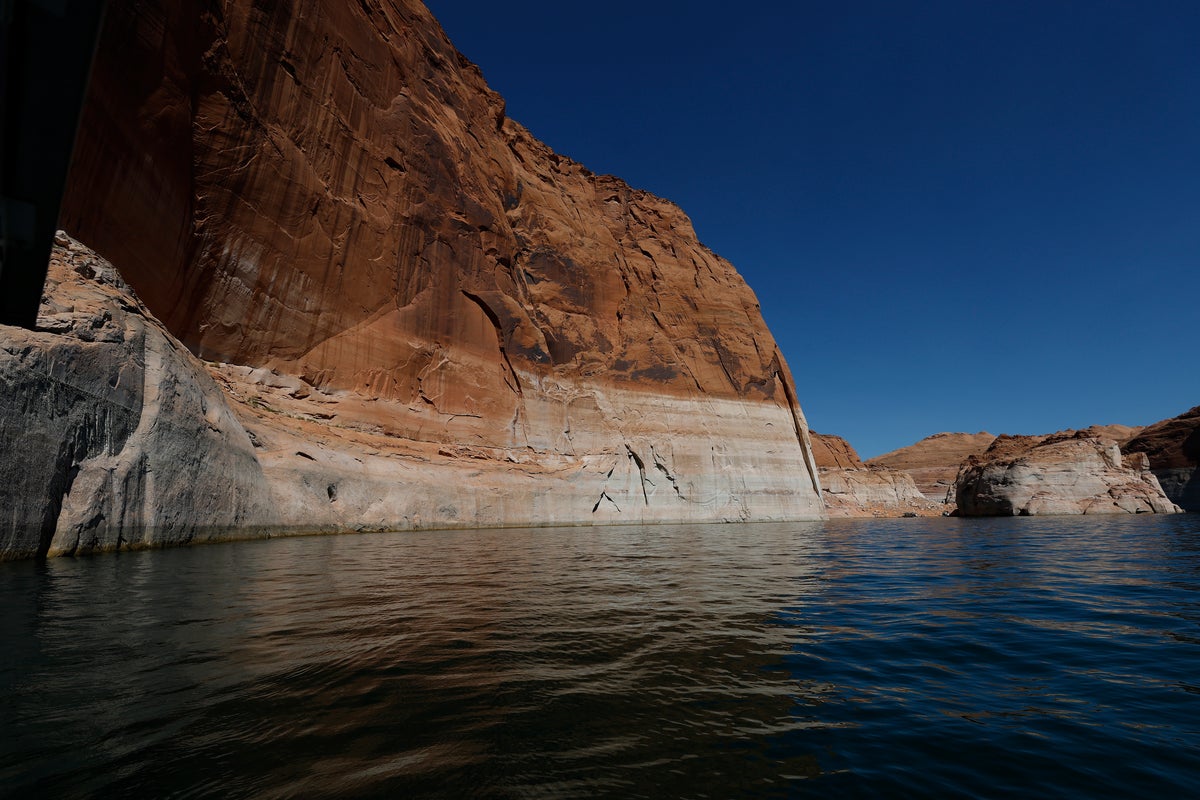
Every summer, the media dusts off the exact same template. A drone films a bathtub ring around Lake Powell or Lake Mead. A breathless anchor warns that millions of households are moments away from sitting in total darkness. The lazy consensus writes itself: climate doom, structural collapse, and the impending end of hydropower in the American West.
It is a great script for ratings. It is also completely wrong. For another view, check out: this related article.
I have spent years watching energy markets panic over every inch of fluctuation in the Colorado River basin. I have seen investors flush capital down bad transmission bets while ignoring the actual physics of how the Western grid balances itself. The panic over low water levels treats a multi-use plumbing system like a sacred stationary lake.
Lake Powell is not a natural ecosystem meant to stay full for postcard photos. It is a giant industrial battery and a silt trap. When water levels drop, the headline writers scream about catastrophe. Engineers look at the math, adjust the discharge curves, and watch the system absorb the shock. Similar analysis regarding this has been provided by NBC News.
Here is the contrarian truth nobody in the mainstream press has the stomach to print: a low reservoir is not a system failure. It is the system working under extreme stress to keep the lights on, even if it hurts to watch.
The Plumbing Problem the Headlines Ignore
Let us start with basic hydrology, because the internet loves to pretend that water vanishes into thin air. When snowpack melts in the Rockies, it flows into a series of federal drainage projects designed primarily for flood control and downstream agricultural compact delivery, with power generation tacked on as a financial bonus to pay off the dam construction debt.
The popular narrative assumes that hitting "dead pool"—the point where water can no longer flow through the penstocks to spin turbines—means the entire electrical grid of the Desert Southwest instantly flatlines.
That is nonsense.
Hydropower accounts for a fraction of the region's actual generation capacity today. Ten or twenty years ago, losing a major hydro facility would have caused rolling blackouts across Arizona, Nevada, and California. Today? The grid has evolved. Solar proliferation, battery storage buildouts, and natural gas peaking plants have fundamentally altered the supply stack.
When Lake Powell’s output drops, the grid does not collapse. It shifts load. Thermal and solar assets pick up the slack. The real casualty of low water is not your air conditioning; it is the revenue stream used to fund environmental mitigation programs upstream. That is a budget crisis, not a blackout crisis. Conflating the two is lazy journalism designed to farm clicks from anxiety.
Why Full Reservoirs are Actually a Liability
Imagine a scenario where federal water managers artificially forced Lake Powell to stay at 90 percent capacity year-round, regardless of drought cycles or downstream agricultural demands.
It would be an engineering disaster.
Keeping a reservoir unnaturally full during a multi-decade dry spell requires choking off downstream delivery to the point of catastrophic legal warfare among the basin states. Worse, it ignores the primary job of the upper basin storage units: compliance with the 1922 Colorado River Compact.
Water must move downstream to Arizona, California, and Mexico. If Powell holds back water just to keep tourists happy at the marinas, the legal penalties and economic damages dwarf any local electricity loss.
Low levels force efficiency. They force municipal water districts in Phoenix and Las Vegas to stop pretending they live in the Midwest. They force farmers in the Imperial Valley to abandon flood irrigation methods that belong in the nineteenth century. A comfortable, full lake breeds systemic laziness. A dropping lake forces policy reform at gunpoint.
The Economics of the Bathtub Ring
Let us talk about the financial reality that the doomsayers sweep under the rug. Bureau of Reclamation dams operate on strict hydraulic head pressures. As water drops, the pressure decreases, meaning the turbines spin with less force and generate fewer megawatt-hours per acre-foot released.
Yes, that costs money. Power contractors have to buy replacement energy on the open market when Glen Canyon Dam underperforms. But power markets are designed to absorb volatility. Utilities hedge against hydrological risk.
I have watched companies blow millions trying to sue federal agencies over water allocations, thinking they can litigate their way out of a drought. They lose every time because physics trumps injunctions. The smart money stopped fighting the river years ago. They invested in distributed generation, localized storage, and efficiency software that renders bulk hydro volatility irrelevant to the end consumer.
If you are betting your portfolio on the premise that a dry Powell equals a dark West, you are trading on outdated 1970s energy paradigms.
The Real Danger No One is Talking About
While everyone stares at the water gauge on the dam wall, the real threat is not the lack of water—it is the sediment.
Glen Canyon Dam is a giant concrete plug trapping millions of tons of silt every single year. As the water level drops, the delta at the upper end of the reservoir shifts. Sediment management is an expensive, dirty, politically radioactive nightmare that no politician wants to fund because it does not make for a sexy press release.
If sediment chokes the intake structures before water levels hit dead pool, you lose functionality regardless of how much rain falls in the Rockies next winter. That is the engineering bottleneck that actually keeps operators awake at night. Not the media-hyped "grid collapse," but the unglamorous reality of silt accumulation.
Stop Treating Weather Like an Apocalypse
We have to break this cycle of climate hysteria every time Mother Nature shifts gears. The American West is an arid, volatile climate zone. It has been for millennia. Tree-ring data shows droughts that lasted a century make our current dry spell look like a wet weekend.
Building massive concrete walls across the desert was an act of supreme hubris. Pretending those walls can defy the natural hydrological cycle just because we drew a line on a map and called it a lake is worse.
Lake Powell will fluctuate. Sometimes it will look like a puddle. Sometimes it will creep back up toward the spillways. The electrical grid will adapt, the water lawyers will keep billing by the hour, and the desert will remain a desert.
Stop buying the panic. Look at the balance sheet, understand the grid redundancy, and stop mistaking a drop in water pressure for the end of civilization.


