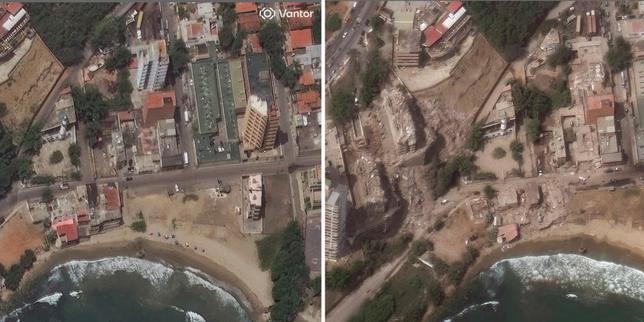
The international media loves a tragedy it can easily package. When an earthquake strikes Venezuela, the cameras rush to the scene. Journalists spin heartbreaking narratives about the endless, agonizing search for victims under the concrete blocks. They focus entirely on the shovel-ready drama, painting a picture of a natural disaster that could not be avoided.
They are wrong. They are focusing on the wrong symptom, asking the wrong questions, and completely missing the true culprit.
Earthquakes do not kill people. Bad building codes and institutional corruption kill people.
The standard media narrative focuses on the heroic, agonizing search for survivors under collapsed buildings. This perspective is a lazy consensus that treats structural collapse as an inevitability. It shifts the blame from human failure to Mother Nature. Having spent two decades analyzing structural engineering failures and disaster capitalism across Latin America, I can tell you that the real tragedy happened years before the ground ever shook.
The Illusion of the Natural Disaster
We need to stop calling these events "natural disasters." The seismic activity is natural; the disaster is entirely man-made.
When a standard reporter stands in front of a collapsed apartment complex in Caracas, lamenting the lack of heavy machinery for rescue efforts, they are looking at the final link in a chain of systemic failure. The real story isn't the lack of shovels today. It is the abundance of bribes ten years ago.
Let us look at the mechanics of structural integrity. In high-seismic zones, modern engineering relies on ductility—the ability of a structure to deform without totally collapsing. This is achieved through precise ratios of steel reinforcement to concrete, proper tying of joints, and strict adherence to building codes.
In Venezuela, the official building code, MINDUR, looks great on paper. It aligns closely with international standards like the American Concrete Institute (ACI) codes. But paper does not stop a 7.2 magnitude tremor.
- The Rebar Scam: Contractors routinely swap out specified high-tensile steel rebar for cheaper, substandard alternatives.
- The Concrete Mix Deception: To save money, local builders stretch cement mixes with excess sand or unwashed aggregate full of organic matter, which radically reduces the structural load capacity.
- The Inspector Payoff: Regulators turn a blind eye to unauthorized extra floors added to buildings already past their structural weight limits.
When the ground moves, these buildings do not deform gracefully. They pancake. A pancaked building leaves zero survivable void spaces. The frantic search for victims under the rubble—the very thing journalists focus on—is largely a theater of despair because the structural corners cut during construction guaranteed a near-zero survival rate the moment the fault line slipped.
The Fatal Flaw in International Aid Priorities
Millions of dollars pour into disaster response, urban search and rescue (USAR) teams, and high-tech listening devices. It is an expensive, reactive industry that satisfies a psychological need to feel helpful after the fact.
It is also an colossal waste of capital.
Imagine a scenario where a city invests $50 million into elite search-and-rescue teams equipped with drones and canine units. When an earthquake hits, they might pull fifty people alive from the ruins. Now imagine that same city invested that $50 million into a structural retrofitting program for vulnerable barrios and schools, alongside independent engineering audits. The buildings do not collapse in the first place. Thousands of people walk out on their own two feet.
But prevention does not make for gripping evening news.
"We are funding the autopsy instead of curing the disease."
The international community operates under the flawed premise that disaster response is the most humane intervention. It is actually the most inefficient. True humanitarian work in seismic zones is boring. It looks like structural engineers checking concrete core samples in a laboratory, not rescuers cutting through rebar on a live television broadcast.
Dismantling the Poverty Excuse
A common counter-argument from the lazy consensus is that developing nations like Venezuela simply cannot afford seismic-resistant infrastructure. This is a myth born of intellectual laziness.
Seismic retrofitting and strict enforcement do not require a nation to be wealthy; they require a government to be functional. Look at Chile. In 2010, Chile was hit by an 8.8 magnitude earthquake—an event releasing roughly 500 times more energy than the 2010 earthquake that leveled Port-au-Prince, Haiti. Yet, Chile’s death toll was under a thousand, while Haiti’s was over two hundred thousand.
Chile is not a hyper-wealthy superpower. It is a nation that decided to ruthlessly enforce its building codes after its 1960 disaster. If a building collapses in Chile during an earthquake, the law treats it as a potential crime, and the developers face actual prison time.
Venezuela’s issue is not a lack of resources; it is the total evaporation of accountability. The country sits on some of the largest oil reserves on the planet. The money existed. It was systematically diverted into private bank accounts instead of public infrastructure safety nets. Framing the tragedy as a resource scarcity issue or an unpredictable act of God gives corrupt officials a free pass.
Why the Current Rescue Model is Broken
People often ask: How can we speed up the rescue of victims trapped under rubble?
The brutal, honest answer is that you cannot optimize a fundamentally broken process. Once a heavy concrete structure collapses entirely, the survival window drops exponentially within the first 24 hours due to crush syndrome and dehydration.
The logistical reality of shipping heavy search equipment into a politically volatile, infrastructure-starved country like Venezuela means that by the time foreign teams arrive with their specialized tools, they are largely recovering bodies, not saving lives.
We must stop asking how to find people under the rubble faster. We must ask how to prevent the rubble from existing.
The Uncomfortable Reality of Retrofitting
To be fair, a contrarian approach has its own harsh realities. Shifting from a response-based model to a prevention-based model means making unpopular decisions:
- Condemning Safe-Looking Buildings: It requires identifying buildings that look perfectly fine but are structurally deficient, and forcing evacuations or expensive retrofits.
- Economic Disruption: Halting construction projects that do not meet rigorous standards, even if it hurts short-term employment metrics.
- Political Friction: Stripping local municipalities of their building inspection powers and handing them over to independent, third-party international engineering bodies to eliminate bribery.
This approach lacks immediate political payoff. A politician cannot cut a ribbon on a building that didn't collapse. It offers no emotional victory lap. It requires a cold, calculated commitment to long-term risk management.
Stop weeping over the rubble on television. Start prosecuting the developers, the inspectors, and the politicians who made that rubble inevitable. Turn off the cameras, fire the corrupt regulators, and enforce the code. Everything else is just performance art.