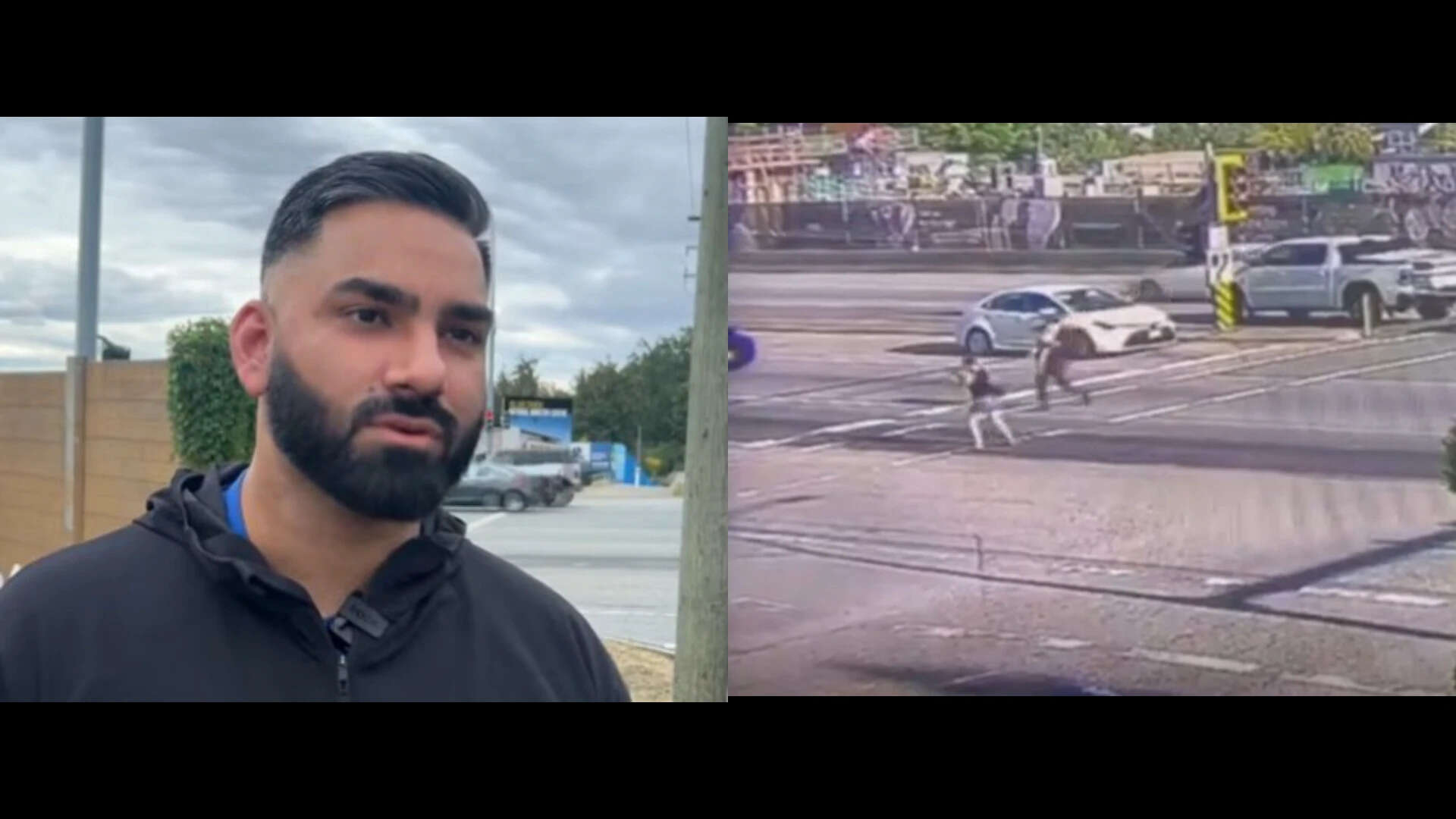
We are so starved for basic human competency that a man slamming on his brakes to keep a child from getting crushed by an SUV gets treated like a secular saint.
Let us look at the headlines making the rounds about a Punjabi man in Surrey stopping his van in heavy traffic to yank an autistic boy out of the path of oncoming wheels. The media wants a tearjerker. They want a feel-good viral clip about a hero stepping out of the ether to rescue the vulnerable. They want you to click, share, wipe a tear, and feel good about humanity for precisely four seconds before scrolling to the next tragedy.
I am done playing along with the feel-good industrial complex.
Every time we turn an ordinary act of preventing a vehicular manslaughter into an Oscar-worthy performance, we commit a collective fraud. We are treating a symptom while ignoring the structural malignancy rotting our neighborhoods from the inside out. A stranger had to act as a human shield because our urban planners built roads designed to maim pedestrians, and our public infrastructure treats neurodivergent citizens as collateral damage.
Stop handing out medals for doing what keeping a pulse demands of you. Start asking why the street layout made survival a lottery in the first place.
The Manufacturing of Manufactured Miracles
Look at the anatomy of these viral hero stories. They follow a predictable, nauseating script. A vulnerable person—often a child, often disabled—is placed in mortal peril by sheer environmental hostility. A bystander reacts with the exact baseline reflex of any functioning primate possessing a survival instinct and peripheral vision. Then, the internet treats it like the moon landing.
This is not heroism. This is emergency management for a broken system.
When we elevate basic intervention to the status of a miracle, we let everyone else off the hook. We absolve the municipal government that refuses to install traffic-calming measures. We absolve the urban designers who prioritize vehicle throughput over human life. We absolve the community zoning boards that prioritize commercial parking spaces over safe corridors for children, let alone children with developmental delays who process sensory environments differently.
I have spent years watching cities spend millions on PR campaigns celebrating local heroes while quietly slashing budgets for actual street safety improvements. It is cheaper to give a guy a plaque and a spot on the local evening news than it is to narrow a lane, raise a crosswalk, or lower speed limits to 30 kilometers per hour.
Hero worship is the opiate of the poorly managed city.
The Surrey Blueprint For Urban Carnage
Surrey is not an anomaly. It is the archetype of modern North American car-centric suburban hellscapes. Wide stroads, high speed limits, sprawling asphalt expanses, and pedestrian crossings spaced half a mile apart. These corridors are explicitly engineered to move cars fast, with human safety treated as an afterthought scribbled in the margin of an engineer's notebook.
When an autistic boy wanders into a busy Surrey intersection, the prevailing narrative focuses entirely on the driver's heroic intervention. Nobody wants to interrogate the road design.
Let us look at the data on pedestrian fatalities across high-density suburban corridors. According to traffic safety audits from urban planning institutes across North America, wide multi-lane stroads with asynchronous timing lights and minimal pedestrian refuges cause an exponential spike in accidents involving children and individuals with cognitive or mobility impairments. People on the autism spectrum often experience elopement behaviors or sensory overload in chaotic traffic environments. They do not process visual hazards the way neurotypical adults expect.
Knowing this—knowing that neurodivergent kids exist, knowing that human beings make mistakes, knowing that drivers speed—our civil engineers still design roads that give zero room for error.
Then, when someone gets lucky and a van driver slams his brakes just in time, we throw a parade for the driver instead of demanding the resignation of the traffic engineer who signed off on that death trap of an intersection.
The Myth of the Vigilant Bystander
There is a dark side to our obsession with bystander hero narratives. It relies on the assumption that safety is a product of individual vigilance rather than systemic design.
Think about the logic of the viral rescue story. It implies that if you just pay attention, look both ways, and have a good Samaritan nearby, you will survive our public spaces. That is gaslighting on a municipal scale. Safety should be a baseline architectural guarantee, not a high-stakes game of dodgeball played against Ford F-150s.
When we credit a man for saving a child from a chaotic street, we are implicitly endorsing a survival-of-the-fittest philosophy. We are saying: The street is inherently lethal, but hey, sometimes a good guy drives by.
Imagine a scenario where our infrastructure assumed human vulnerability as the default parameter. Imagine streets where a child running into traffic results in a minor bumper tap at twenty kilometers per hour instead of a life-flight helicopter ride. Imagine a world where we did not need van drivers to play middle linebacker against oncoming traffic just so a kid could cross the street.
We do not need more heroes. We need fewer hazards.
Dismantling the Feel-Good Trap
Why do we cling so desperately to these stories? Because accepting the alternative requires admitting institutional failure.
Admitting that Surrey's streets are dangerous means admitting that decades of zoning laws prioritized commuter convenience over human life. It means admitting that city councils care more about property tax bases and retail access than the physical safety of disabled children. It means admitting that every single one of us is complicit because we complain about traffic delays whenever a city tries to put in a speed bump or a protected bike lane.
The man who stopped his van did a good thing. He acted with decency. I take nothing away from his split-second decision. But the moment we turn his reflex into a viral spectacle, we sanitize the violence of our built environment.
We take a systemic failure and rebrand it as a heartwarming human-interest segment.
Stop praising the individual band-aid. Pull off the bandage and look at the infected wound underneath.
If you want to save autistic children in Surrey, in Toronto, in Los Angeles, or anywhere else, stop waiting for a guy in a van to hit his brakes. Tear out the stroads. Narrow the lanes. Lower the speed limits. Design cities for the most vulnerable person who uses them, not the guy in a rush to get to a strip mall.
Until we do that, every viral video of a close call isn't a celebration of human goodness. It is an indictment of our collective cowardice.


