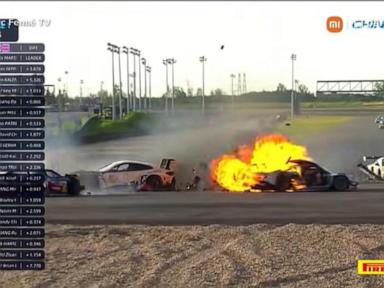
Every time a race car bursts into a wall and turns into a fireball, the internet floods with viral clips of a fellow driver leaping from a cockpit to pull a rival from the wreckage. Commentators lose their minds. Social media algorithms reward the visceral drama. We get treated to a week-long media cycle about brotherhood, raw courage, and the unwritten code of the racing grid.
It is a comforting narrative. It lets us romanticize a blood sport and pretend that the inherent danger is just an acceptable backdrop for human nobility.
It is also a massive distraction from structural failure.
When a driver has to play amateur firefighter because the safety infrastructure failed to do its baseline job, we are not witnessing peak sportsmanship. We are watching a system malfunction in public, covered up by a smokescreen of cheap sentimentality.
I spent over a decade walking pit lanes, talking to track designers, and analyzing telemetry data from catastrophic impacts. I have watched multi-million-dollar sanctioning bodies spend fortunes on public relations campaigns celebrating miraculous saves while quietly ignoring the archaic barrier designs and lazy marshaling protocols that created the emergency in the first place.
If your safety protocol relies on a competitor unbuckling their belts, abandoning their own race, and running across an active track through secondary explosions to drag someone out of an inferno, your safety model is broken.
Let us look at the mechanics of these viral moments. When a car impacts at high speed, fuel cells rupture, batteries arc, and composite materials splinter into razor-sharp projectiles. The golden rule of motorsport engineering has always been energy dissipation. You want the car to absorb the kinetic force, the barrier to redirect it, and the driver to stay isolated from thermal runaway.
When that chain breaks down, the driver’s survival shouldn't depend on the track-side reaction time of the guy running twenty yards behind them. That is a failure of redundancy.
Sanctioning bodies love the hero narrative because it costs nothing. Buying an extra thirty seconds of marshaling response time requires millions of dollars in localized electronic yellow flags, automated fire suppression grids embedded directly into the tarmac, and higher standards for trackside extraction crews. Paying a driver in adulation after they pull a peer out of a burning chassis is free.
Imagine a scenario where Formula 1 or IndyCar decided that every time a driver stopped to assist a burning car, they were immediately fined for creating an unmanaged multi-vehicle hazard on an un-neutralized circuit. The outcry would be deafening. Purists would scream that the soul of the sport was dying.
Yet, that is precisely how high-risk industrial environments operate. In aviation, chemical refining, and nuclear engineering, relying on untrained, impromptu heroics is categorized as a root-cause safety failure. If an operator has to improvise outside of engineered redundancies, the system has already failed them.
Motorsport is the only major high-risk industry that still fetishizes the cowboy era. We demand modern carbon-fiber survival cells and six-point harnesses, but we manage active-duty fires with volunteers holding garden hoses and drivers acting as first responders.
The next time you see a highlight reel of a driver hauling a competitor away from a blazing chassis, do not applaud the bravery. Ask why the fire suppression system didn't put it out in two seconds. Ask why the marshals were outpaced by a competitor who had to take his eyes off his own steering wheel to do their job.
We do not need more heroes on the track. We need engineers who don't need them.