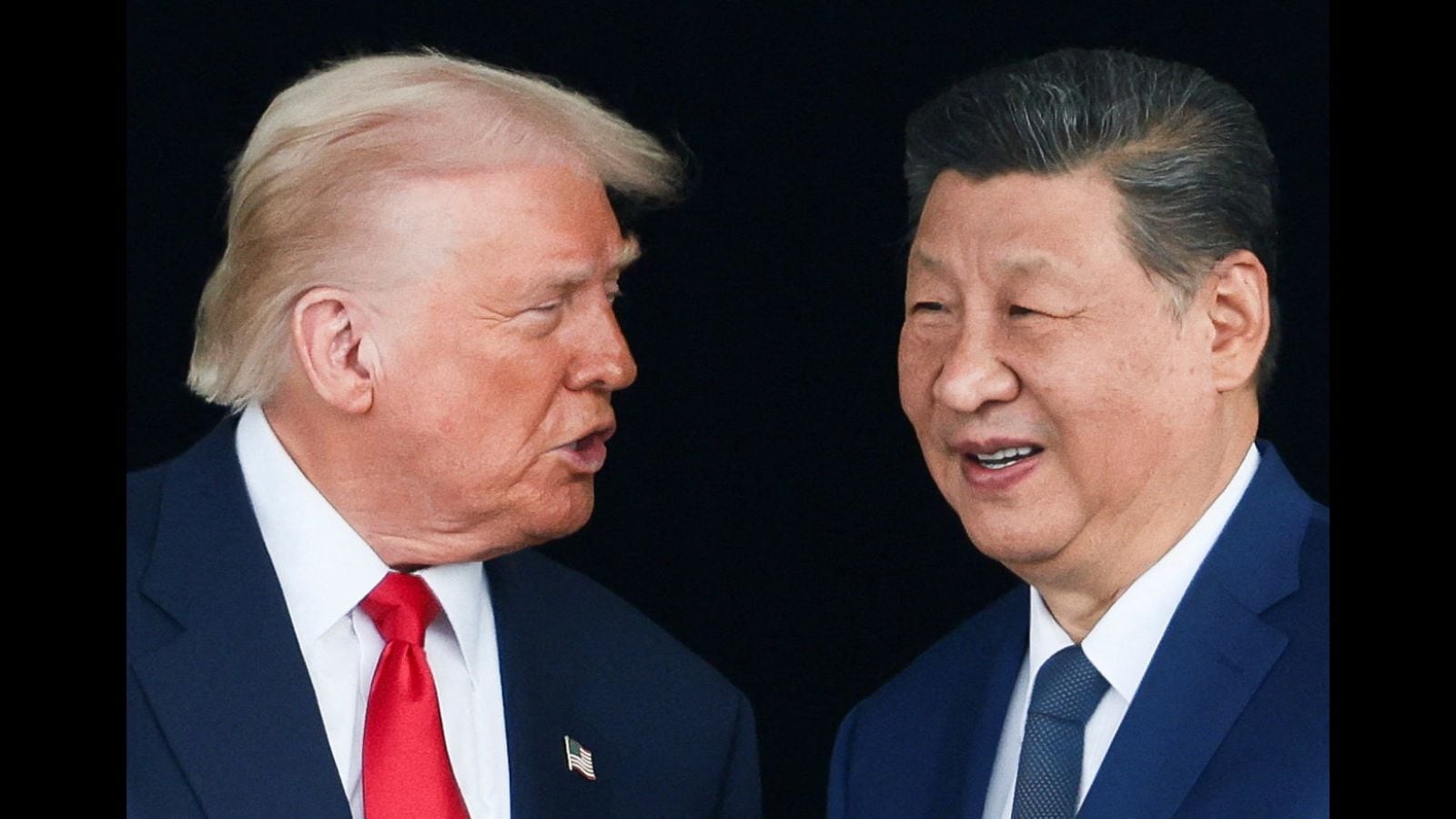
Every mainstream pundit covering the diplomatic theatrics between Washington and Beijing since February 2025 suffers from a collective hallucination. They look at tariff announcements, state visits, joint communiques, and executive orders as chapters in a traditional economic dispute. They talk about negotiations, concessions, and trade deficits as if the year were 1995 and globalized supply chains were still governed by WTO rulebooks.
It is complete nonsense.
I have spent the last decade advising institutional capital allocators who watch manufacturing lines shift across Southeast Asia and financial flows pivot through Singapore and Dubai. I have seen corporations burn tens of millions of dollars trying to outsmart customs officials while missing the actual structural earthquake beneath their feet. The headline-grabbing summits between Donald Trump and Xi Jinping are not policy breakthroughs. They are smoke machines.
To understand why the consensus view on the post-February 2025 trade environment is fundamentally broken, we must first strip away the political theater and examine the hard, cold mechanics of what is actually happening.
The Tariff Fetish Is a Distraction
The lazy consensus dictates that the entire conflict boils down to percentage points on customs duties. Media outlets obsess over whether a tariff sits at ten percent, twenty-five percent, or sixty percent. Wall Street analysts build elaborate spreadsheets trying to model corporate margin compression based on these numbers.
This is an amateurish misdiagnosis.
Tariffs are visible, noisy, and politically useful. They give politicians a scoreboard to flash on cable news and give corporate lobbyists a reason to justify their retainers. But smart capital long ago stopped treating tariffs as a primary risk factor. Tariffs are merely a tax on the past.
Since early 2025, the real battle has shifted from import taxes to systemic exclusion. We are watching the permanent browning-out of dual-use technology access, the weaponization of payment clearing systems, and the strict policing of capital provenance. When Washington restricts outbound investment into critical sectors in mainland China or tightens controls on cloud computing infrastructure exports, it is not a tariff. It is a structural amputation.
Focusing on tariff rates while ignoring capital controls and technological embargoes is like worrying about the paint on a car while the engine block is being removed.
Financial Disconnection Beats Border Taxes Every Time
Let us look closely at what actually transpired in the high-level communications and executive actions following the early 2025 inflection points.
The mainstream narrative treats every meeting between Trump and Xi as a pendulum swinging between escalation and de-escalation. One month brings threats of massive levies; the next month brings a smiling handshake at a neutral summit and a temporary suspension of hostilities. Pundits call this a thaw. They write breathless analyses about supply chain normalization.
They are missing the architecture of the wall being built brick by brick behind the scenes.
Bilateral trade volumes between the United States and China might stabilize or even tick upward in specific consumer categories due to unyielding retail demand, but the underlying plumbing has fractured permanently. Transnational corporations are no longer engaging in China plus one diversification as a clever hedging strategy. They are executing total operational decoupling.
Imagine a scenario where a multinational semiconductor equipment manufacturer splits its entire supply chain, engineering staff, and software repositories into two completely isolated operational ecosystems—one for the Western sphere, one for the Eastern sphere. This is not a hypothetical thought experiment. It is the mandatory operational reality for any firm that wants to survive the next decade without facing sudden regulatory annihilation.
The diplomatic summits do not reverse this trend. They merely accommodate it by setting the speed limit for the divorce.
The Theatre of the Summit
Why do these high-stakes meetings keep happening if the structural split is inevitable? Because both political systems require a pressure valve.
For Washington, projecting toughness on Beijing plays exceptionally well domestically, but pushing the economic system over a cliff too quickly would trigger immediate equity market contagion. Therefore, periodic talks and carefully choreographed truces serve as a stabilizing mechanism. They prevent panic selling, soothe bond markets, and give domestic industries temporary breathing room to reconfigure their supply chains without suffering catastrophic shock.
For Beijing, these engagements project national strength and buy crucial time to indigenize critical inputs—particularly legacy semiconductors, advanced materials, and aerospace components. Xi Jinping’s administration uses every diplomatic window not to beg for market access, but to accelerate domestic self-sufficiency campaigns.
When commentators interpret a diplomatic handshake as a sign that the two superpowers are returning to the old rules-based global order, they are projecting their own wishful thinking onto cold-blooded geopolitical strategists. Neither side wants the old order back. Both sides are actively building the successor architecture.
Supply Chains Do Not Care About Press Releases
Let us examine the logistics ground truth.
Since February 2025, corporate boards have moved past the naive phase of supply chain management. During the early globalization era, supply chains were optimized purely for cost efficiency. Every component came from the cheapest possible source, regardless of geopolitical concentration risk.
Today, cost efficiency is secondary to operational resilience and regulatory compliance.
Consider the electronics sector. A smartphone assembled in Vietnam or India might look like a triumph of diversification away from Chinese factories. But look two or three tiers down the bill of materials. The specialized rare earth magnets, the chemical precursors for display panels, and the sub-assemblies of circuit boards still trace their lineage directly back to mainland processing hubs.
The lazy consensus assumes that shifting final assembly lines across a national border solves the problem. It does not. It simply adds a layer of bureaucratic friction and transportation overhead.
What the post-2025 milestones actually represent is an aggressive, state-directed rewiring of primary processing nodes. Beijing restricts the export of gallium, germanium, antimony, and graphite—critical elements for defense and tech hardware. Washington responds with targeted export bans on advanced logic chips and lithography tools.
This is not a trade war. It is an economic siege, fought with quotas, licensing requirements, and invisible technological barriers rather than naval blockades.
The Myth of Bilateral Coercion
Another persistent delusion held by legacy analysts is the idea that either Washington or Beijing holds definitive economic power over the other through sheer interdependence.
The theory goes like this: China needs American consumer markets to keep its massive industrial base employed, while the United States needs Chinese manufacturing capacity to keep inflation at bay. Therefore, both nations are locked in a cage match of mutual assured economic destruction, forcing them back to the negotiating table.
This framework ignores how rapidly both superpowers have engineered self-reliance over the past several years. Beijing has aggressively pivoted its export destinations toward the Global South, building resilient trade corridors across Southeast Asia, the Middle East, and Latin America. Meanwhile, American industrial policy has funneled hundreds of billions of dollars into domestic semiconductor fabrication, critical mineral refining, and advanced manufacturing incentives.
Interdependence is actively being dismantled. When economic ties are deliberately severed, mutual influence evaporates and gives way to strategic autonomy. The bilateral talks since early 2025 are not negotiations between two interdependent partners trying to find a compromise; they are pragmatic status checks between two sovereign fortresses measuring each other's defensive walls.
What the Consensus Misses Entirely
If you want to understand where global business is heading, you must stop listening to macroeconomic forecasters who treat trade deficits as the core metric of national power.
A trade deficit with China was never a sign of American weakness; it was a reflection of global capital flows and the status of the US dollar as the world's primary reserve currency. Trying to balance a trade ledger through punitive border taxes while ignoring the underlying technological and financial architecture is an exercise in futility.
Furthermore, the idea that a comprehensive grand bargain or Phase Two trade deal will eventually reset relations is pure fantasy. The structural divergence between the two economies has passed the point of no return. The institutional trust required to sustain deep technological and financial integration has been permanently erased.
Future historians will look back at the Trump-Xi communications of 2025 and 2026 not as a series of erratic escalations and reconciliations, but as the orderly managed descent into a bipolar economic reality.
Stop Preparing for the Old Normal
If you run a business, manage an investment portfolio, or design supply chain strategies based on the assumption that things will eventually go back to normal, you are sleepwalking toward obsolescence.
There is no going back to the frictionless globalized economy of the early 2000s. The walls are not coming down; they are getting higher, thicker, and electrified.
Stop waiting for the next summit to save your margins. Stop reading tea leaves into joint statements written by diplomats whose primary job is to manage market psychology.
Redesign your operations for permanent friction. Diversify not just your assembly points, but your legal jurisdictions, your data storage systems, and your intellectual property architecture. Accept that the global economy has fractured into regional blocs, and operate accordingly.
The trade war isn't coming. It happened. You are living in the fallout.