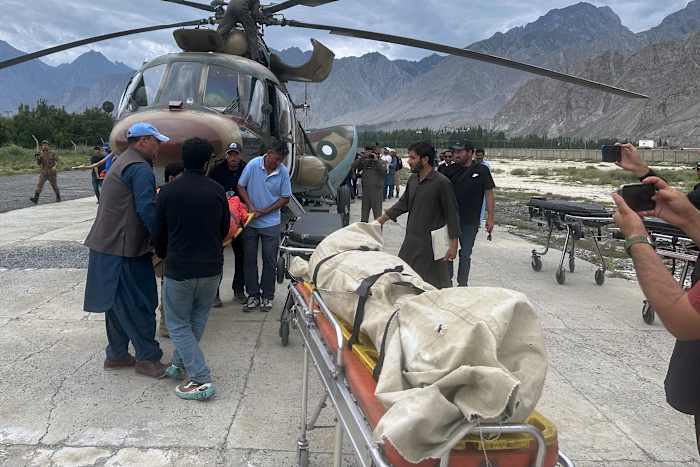
The media wants you to believe that every body recovery on an eight-thousander is a testament to the unbreakable bond of mountaineering brotherhood. They pump out breathless headlines about daring operations, loyal friends risking their lives, and the solemn duty of bringing a fallen climber home from the death zone. It is a neat, emotionally manipulative narrative. It sells clicks, secures sponsorships, and feeds the romantic mythology of the peaks.
It is also complete nonsense. Recently making waves in related news: When Statues Fall and Homes Burn: Shakib Al Hasan and the Trap of Bangladeshi Politics.
When a climber perishes above eight thousand meters, their physical vessel occupies a freezing, inert position in a space where human biology simply fails. Dragging that body down requires an enormous expenditure of high-altitude porter labor, thousands of dollars in helicopter charter fees, and the direct endangerment of living human beings who must haul dead weight down vertical ice walls.
Let us drop the sentimental pretense. We are not talking about sacred rites. We are talking about high-risk logistics, misplaced ego, and a dangerous distortion of rescue economics. Further information on this are covered by ESPN.
The Economics of Death Above the Clouds
To understand why the prevailing narrative surrounding recoveries like Nirmal Purja's team operations is flawed, you have to look at the balance sheet. Mountain tourism in the Himalayas operates on a brutal economic gradient. Wealthy clients pay tens of thousands of dollars for permits, oxygen, and Sherpa support. When things go wrong, the financial engine shifts gears.
A standard rescue operation in the death zone routinely costs anywhere from five thousand to twenty thousand dollars, depending on helicopter flight hours and crew hazard pay. A body recovery? Multiply that exponentially. You are paying multiple elite climbers oxygen-dependent hourly rates to perform heavy excavation and hauling work in an atmosphere where every breath feels like inhaling crushed glass.
I have watched operators drain their contingency funds trying to satisfy grieving families or social media pressure, turning a single tragedy into a compounding financial disaster.
The lazy consensus is that leaving someone on the mountain is an act of disrespect. The reality is that leaving them is often the only ethical choice left. When you demand a body recovery, you are trading living human safety for posthumous closure. You are putting a price tag on the lives of Sherpas and guides, forcing them to run double the danger quotient for a body that no longer feels pain.
The Myth of Closure
Families demand recoveries because they believe physical repatriation brings peace. Psychology tells a different story, but the adventure travel industry would rather keep you hooked on the closure myth.
Grief does not hinge on whether a loved one's remains are buried in a local cemetery or frozen into a ridge on Annapurna. The obsession with bringing everyone back treats the high mountains like local municipal parks where sanitation crews can be dispatched at a moment's notice.
The death zone does not care about your family album. It is a hostile vacuum. Anyone who climbs past the camp four threshold signs an unspoken contract: if I break here, leave me to the elements. To renegotiate that contract after the fact using the leverage of social media outrage and crowdfunding campaigns is a betrayal of the very guides expected to execute the recovery.
Shifting the Burden to the Workforce
Let us talk about who actually does the heavy lifting. It is never the social media influencers or the high-profile expedition leaders doing the primary grunt work in the trench. It is the indigenous workforce.
When a high-profile climber passes, the pressure to retrieve them rolls downhill with absolute force. The Sherpa community absorbs the physical and psychological toll. They are conditioned to endure, but commercialization has turned endurance into exploitation.
We praise the friendship that organizes the rescue op. We fail to scrutinize the power dynamics that make it impossible for local workers to say no to a lethal assignment without risking their future employment in the guiding industry. That is not loyalty. That is coercion wrapped in a flag of camaraderie.
What Real Risk Management Looks Like
If we want to fix high-altitude mountaineering, we need to stop celebrating the reckless spectacles of recovery and start respecting the absolute finality of the mountains.
- Mandatory No-Recovery Clauses: Expedition contracts should legally stipulate that above 8,000 meters, recovery operations are off the table due to the threat multiplier they introduce for support staff.
- Resource Reallocation: Redirect every dollar raised for post-mortem extraction into local climber accident insurance, family stipends, and medical infrastructure at base camps.
- Redefining Respect: True respect for the fallen means acknowledging the lethality of the environment they chose to challenge, rather than treating their final resting place as an administrative error that needs correcting.
The mountains do not owe you a funeral. They do not care about your closure. Until the climbing community accepts that some places are too dangerous to clean up, we will keep sacrificing the living to appease the ghosts of the dead.