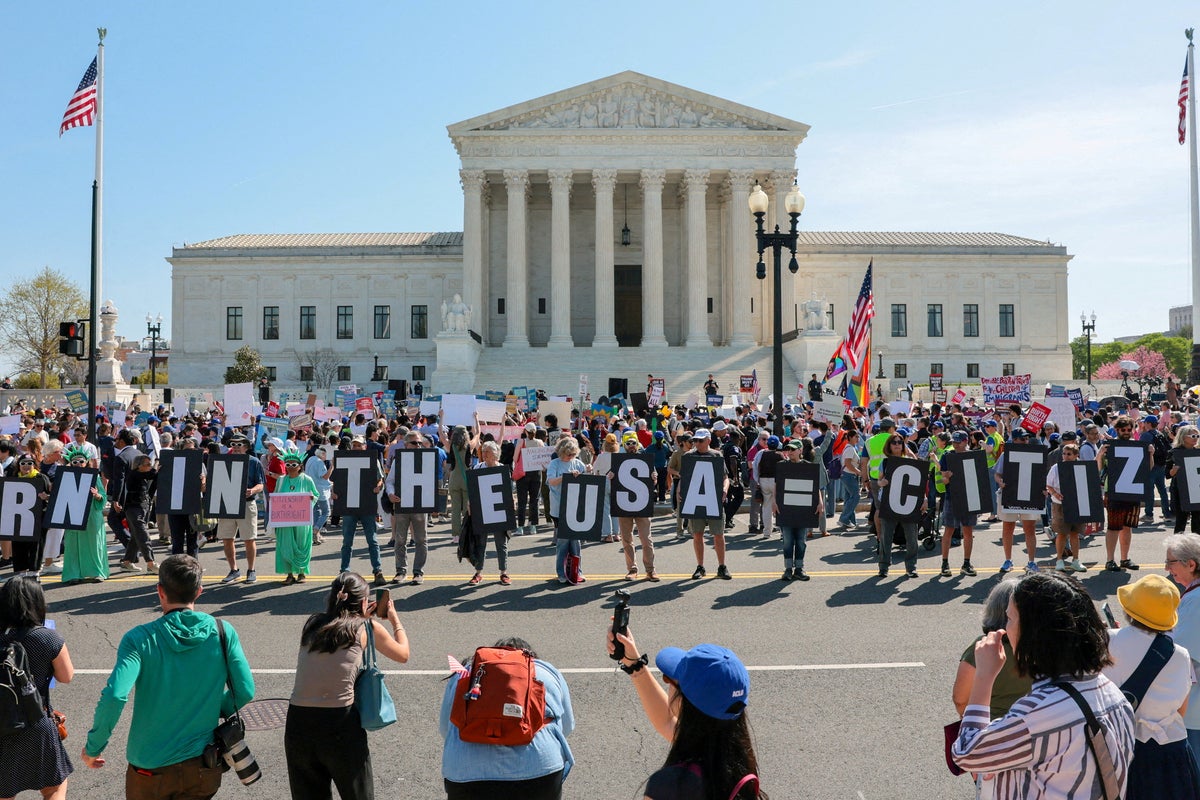
The media elite just spent weeks gasping over Trump v. Barbara, the June 2026 Supreme Court decision that struck down the executive order attempting to ban birthright citizenship. Mainstream pundits are busy high-fiving, running the exact same lazy playbook: "The Constitution has spoken, the 14th Amendment is an unassailable fortress, and any attempt to end birthright citizenship is legally dead."
They are celebrating a victory in a war that doesn't actually matter.
While constitutional scholars jerk their knees over the sacred text of the Citizenship Clause, they are completely blind to a glaring market reality. The legal status of a baby born on American soil is a distraction. The real battleground isn't the Supreme Court, and it never was. It is the highly organized, ultra-profitable, multi-million-dollar industry that packages and sells American citizenship as a premium consumer luxury product.
Chief Justice John Roberts didn't kill the birthright citizenship debate; he just handed the opposition a sharper scalpel. By establishing that the soil guarantees the right, the Court left the entire infrastructure supporting that soil completely unprotected. If you want to disrupt the exploitation of the 14th Amendment, you don't need a constitutional amendment, and you don't need a packed bench. You just need to turn off the economic engine that drives it.
The Lazy Consensus of the Legal Fortress
The prevailing commentary surrounding Trump v. Barbara hinges on a comforting delusion: that because five justices grounded the ruling squarely in the text of the 14th Amendment, the issue is locked in a vault for the next fifty years. Legal analysts point to Roberts’ reliance on United States v. Wong Kim Ark (1898) and English common law (jus soli, or right of the soil) as proof that executive fiat cannot touch birthright status.
This analysis is soft. It treats citizenship as an abstract philosophical virtue rather than what it operates as in the global marketplace: a sovereign asset with distinct cash value.
The media looks at a child born to undocumented or temporary parents and sees a civil rights debate. Savvy international operators look at the exact same scenario and see a business model. Birth tourism agencies in Shanghai, Moscow, and Dubai do not care about the original public meaning of Reconstruction-era text. They care about visa logistics, medical hospitality bundles, and the long-term derivative benefits of a U.S. passport—like lower tuition rates at elite universities and future family sponsorships.
By focusing entirely on the "unassailable" nature of the amendment, the consensus misses the point. The Constitution protects the child; it does not protect the transactional supply chain that brought the parent to the hospital bed in the first place.
The $100,000 Souvenir: How the Industry Actually Operates
To understand why the legal battle is a sideshow, you have to look at the numbers. I have tracked the operational footprints of immigration consultancies that treat the 14th Amendment like a compliance loophole to be optimized.
A standard birth tourism package costs anywhere from $50,000 to $120,000. For that price, a foreign client receives:
- Concierge visa application coaching (designed to obscure pregnancy from consular officers).
- Luxury housing accommodations in "maternity hotels" across Southern California, Florida, or New York.
- Pre-arranged medical care with private doctors who accept cash under the table or look the other way regarding international billing.
- Expedited processing for the newborn's U.S. passport and Social Security number.
Imagine a scenario where a foreign tech executive pays $100,000 to secure an American birth certificate for his child, flies back home three weeks later, and uses that passport two decades later to bypass the H-1B visa lottery. That isn't an immigration story. It is a high-yield investment strategy.
The weakness in the competitor's narrative is the assumption that the only way to stop this is to alter the legal definition of "subject to the jurisdiction thereof." Justice Brett Kavanaugh actually handed opponents the real blueprint in his concurrence. While he voted to strike down the executive order, he explicitly noted that the order contravened a federal statute: Title 8, Chapter 12, § 1401(a). Kavanaugh openly invited Congress to use its legislative and regulatory levers to alter the landscape.
But even a legislative rewrite of § 1401(a) is doing it the hard way. The real vulnerability lies in plain-sight regulatory enforcement that requires zero congressional gridlock.
Dismantling the Product Without Touching the Constitution
If you want to kill a market, you don't sue the consumers; you bankrupt the supply chain. The Constitution guarantees that if you are born here, you are a citizen. Fine. Let them have the citizenship—but strip the transaction of every single piece of economic utility that makes the $100,000 price tag worthwhile.
We can systematically dismantle the birth tourism trade by executing three aggressive, non-constitutional maneuvers.
+------------------------------------+------------------------------------+
| Current Vulnerability              | Disruptive Regulatory Counter      |
+------------------------------------+------------------------------------+
| Consular blind spots on visas      | Rescind the pregnancy "don't ask"   |
| allow planned birth entry.         | rule in the Foreign Affairs Manual.|
+------------------------------------+------------------------------------+
| Unpaid medical debt from foreign   | Mandate cash bonds or international|
| births is absorbed by taxpayers.   | insurance for third-trimester entry|
+------------------------------------+------------------------------------+
| Derivative benefits (sponsorship)  | Restrict adult chain-sponsorship   |
| create long-term family value.     | for parents who entered on visas.  |
+------------------------------------+------------------------------------+
1. Weaponize the Foreign Affairs Manual
The State Department implemented a rule in 2020 stating that traveling to the U.S. primarily for birth tourism is an impermissible basis for a B1/B2 tourist visa. Yet, the State Department simultaneously handcuffed its own consular officers. Under current guidelines in the Foreign Affairs Manual, officers are strictly prohibited from asking a visa applicant if they are pregnant or intend to become pregnant unless they have a hyper-specific, articulable reason. They cannot require a pregnancy test.
This is security theater. By simply rescinding this internal restriction and allowing consular officers to aggressively audit the medical intent of female travelers of childbearing age from high-risk origin countries, the top of the sales funnel collapses.
2. Implement Mandatory Medical Indemnity Bonds
Birth tourism relies heavily on utilizing American medical infrastructure. In many cases, international patients leave behind thousands of dollars in unpaid hospital bills, which are quietly absorbed by U.S. taxpayers via uncompensated care pools.
The Department of Homeland Security has the authority to require any foreign national entering the country on a temporary visa during their third trimester to post a cash medical bond or prove possession of an international health insurance policy that explicitly covers childbirth in the United States without caps. If you make it an immediate financial liability for the foreign traveler and the airline that boards them, the economic friction instantly self-corrects the volume.
3. Evaporate the Derivative Value
The ultimate return on investment for birth tourism isn't just the child's passport; it is the long-term option for the parents to eventually migrate via family sponsorship once the child turns 21.
Congress possesses absolute plenary power over immigration quotas and the definitions of preferential visa categories. Lawmakers do not need to touch the child's citizenship status to pass a statute stating that a natural-born citizen whose parents were not lawful permanent residents or citizens at the time of birth cannot petition for the legal residency of those parents. The child remains a citizen, but the parental payout is permanently deleted.
The Downside of Direct Confrontation
To be fair, pursuing an enforcement-heavy strategy rather than a constitutional rewrite has its own pitfalls. Shifting the battlefield from the Supreme Court to federal agencies means relying on the shifting winds of presidential administrations. What one administration enforces via State Department memos, the next can quietly roll back.
Furthermore, aggressive consular screening runs the risk of catching legitimate business travelers and tourists in the dragnet, potentially harming international commerce and sparking retaliatory visa restrictions from foreign nations.
But compare that operational friction to the alternative. Spending decades trying to pass a constitutional amendment that requires two-thirds of Congress and 38 states is a fool's errand. It is a political fundraising tool, not a serious policy goal.
The mainstream press wants you to believe that the birthright citizenship debate ended on June 30, 2026, because Chief Justice Roberts penned a mathematically clean majority opinion. They are wrong. The legal battle over the 14th Amendment is effectively over, but the economic war against the monetization of American soil is wide open.
Stop trying to fix the Constitution. Start squeezing the business model.
The Supreme Court confirmed that the soil holds the power, but federal law entirely controls who is allowed to step onto it. For a deeper look at the legal mechanics and historical context of the decision, this news report on the Supreme Court birthright citizenship ruling outlines the immediate political aftermath of the 6-3 judgment.