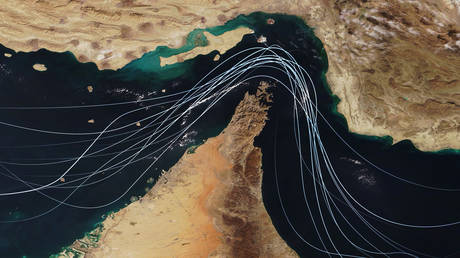
The recent "leaked" cable suggesting the United States is crafting a new "construct" to control the Strait of Hormuz is not a strategic breakthrough. It is a confession of obsolescence. While mainstream media outlets salivate over the prospect of "enhanced maritime security" and "multilateral patrols," they are missing the blunt reality of modern naval warfare. The age of controlling narrow chokepoints with billion-dollar steel targets is dead.
If you believe the traditional narrative, the Strait is a literal jugular vein for the global economy. One closure, we are told, and the world plunges into a dark age of $300-a-barrel oil. This fear is the primary product the defense industrial complex sells to taxpayers. But here is the truth the cable won’t tell you: the US isn't building a "construct" to dominate the Strait. It is building a face-saving exit strategy because the math of defending it no longer works.
The Asymmetric Math That Breaks the Pentagon
The obsession with "controlling" the Strait relies on a 20th-century mindset. In that era, the biggest fleet won. Today, we live in the era of the $20,000 drone versus the $2 billion destroyer.
Let’s talk about the intercept ratio. For a carrier strike group to operate in the restricted waters of the Strait—which is only 21 miles wide at its narrowest point—it must maintain a 100% success rate against incoming threats. The adversary only needs to be right once.
- The Cost Curve: A single SM-2 interceptor missile costs roughly $2 million.
- The Threat: A swarm of loitering munitions or converted speedboats costs less than the paint job on the interceptor.
I have sat in rooms with logistics officers who admit, off the record, that a sustained 48-hour conflict in the Persian Gulf would deplete the theater’s magazine depth of high-end interceptors. Once the tubes are empty, those "pivotal" assets become very expensive floating targets. Any "new construct" that doesn't involve moving the fleet out of range is just theater.
The Myth of the Global Oil Shock
The "People Also Ask" section of your search engine will tell you that a Hormuz closure equals global collapse. This is a fundamental misunderstanding of how the 2026 energy market functions.
The fear-mongers ignore the massive expansion of the East-West Pipeline in Saudi Arabia and the Abqaiq-Yanbu infrastructure. More importantly, they ignore the strategic shift in Chinese and Indian buying habits. China isn't just sitting back hoping the US Navy keeps the lanes open. They are aggressively building overland pipelines through Central Asia and Pakistan.
When the US media screams about "securing the Strait," they are defending a status quo that our primary competitors have already bypassed. We are spending trillions to guard a door that everyone else is walking around.
Drones are the New Sovereignty
The "new construct" mentioned in the cable likely refers to Task Force 59—the US Navy’s push toward unmanned systems. But here is the nuance the analysts missed: Task Force 59 isn't about projecting power. It’s about conceding that humans shouldn't be there.
Deploying a fleet of Saildrones and underwater UUVs is an admission that the risk to a manned crew is now politically and tactically unacceptable. This isn't "innovative leadership." It’s a retreat rebranded as a tech upgrade.
We are moving toward a "Sensor-Based Deterrence" model. This sounds sophisticated, but in practice, it means we will watch the Strait being disrupted in 4K resolution without the ability to stop it. If an adversary decides to mine the Strait, a thousand sensors will tell us exactly where the mines are, but we still lack the specialized minesweeping capacity to clear them under fire. The US Navy has systematically underfunded its mine countermeasure (MCM) capabilities for decades in favor of flashy, expensive jets. You cannot "construct" your way out of a missing capability with a memo.
The Failure of Multilateralism
The cable leans heavily on "regional partnerships." This is diplomatic code for "asking someone else to pay the bill."
I’ve seen these coalitions firsthand. They are a nightmare of incompatible communications systems, conflicting Rules of Engagement (ROE), and varying levels of political will. When the first anti-ship cruise missile (ASCM) flies, half the "coalition" will head for neutral waters to protect their domestic political standing.
Relying on a "multilateral construct" to secure the world's most volatile waterway is like trying to put out a forest fire with a committee. It doesn't work. The only reason the US pursues it is to provide a veneer of legitimacy for a presence that is increasingly viewed as provocative rather than stabilizing.
The Economic Reality of the "Blue Economy"
Business leaders need to stop asking "Will the Strait close?" and start asking "Does it matter if it does?"
The shift toward renewables, the rise of domestic fracking in the Americas, and the burgeoning "circular economy" have reduced the strategic weight of Middle Eastern crude. The real threat isn't the physical blockage of the water; it’s the insurance premiums.
- War Risk Surcharges: These are the real "chokepoint."
- Arbitrage: Traders love volatility.
A "secure" Strait actually hurts the bottom line of certain powerful market players. The "construct" isn't about safety; it’s about managing the optics of risk to keep Lloyd’s of London from hiking rates to the moon.
Stop Defending the Chokepoint
If the US actually wanted to be contrarian and effective, it would stop trying to "control" the Strait of Hormuz.
Control is an illusion in the age of hypersonic missiles and autonomous swarms. Instead of building "constructs" and "task forces," the strategy should be strategic irrelevance. We should be accelerating the transition to energy sources that don't require us to station 19-year-old sailors in a shooting gallery.
The competitor's article wants you to believe this is a chess move. It’s not. It’s a gambler doubling down on a losing hand because he doesn't know how to leave the table.
We are witnessing the final gasps of "Blue Water" dominance in "Green Water" territory. The Strait is a trap. Every ship we send into it is a liability, not an asset. Every dollar we spend on "controlling" it is a dollar we aren't spending on the tech that actually matters for the next century.
The cables are leaking because the system is cracking. The era of the Chokepoint is over. The era of the Distributed Network has begun. If you’re still looking at a map of the Strait to judge the strength of the US Navy, you’re looking at the wrong map.
The Navy isn't securing the Strait. It's hiding its inability to do so.



