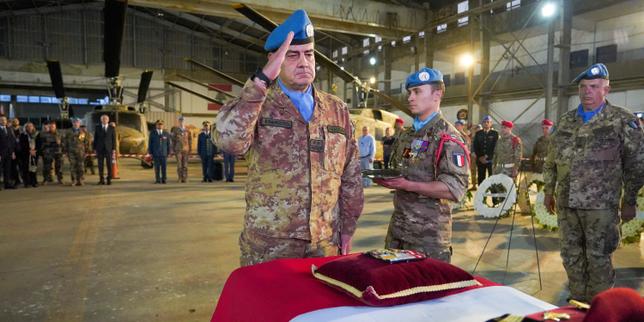
The death of a French soldier in Lebanon during a period of escalating cross-border hostilities between Israel and Hezbollah functions as a stress test for the doctrine of "balanced mediation." While initial reporting focuses on the emotional or immediate tactical details of the incident, the structural reality reveals a deepening misalignment between UNIFIL’s (United Nations Interim Force in Lebanon) operational mandate and the kinetic evolution of modern hybrid warfare. Emmanuel Macron’s assertion that France was not "specifically targeted" addresses the immediate diplomatic risk of escalation, but it ignores the mathematical inevitability of collateral attrition when high-precision strikes are deployed in dense, multi-actor environments.
The Architecture of Vulnerability
The current French military presence in Lebanon operates within a framework established under UN Resolution 1701. This framework assumes a static peacekeeping environment that no longer exists. The operational environment has shifted from a buffer zone to a saturated combat theater characterized by three distinct layers of risk:
- Kinetic Proximity: French units are stationed in sectors where Hezbollah’s infrastructure is deeply integrated into civilian and logistical hubs. This creates a "permanent hazard zone" where the distinction between a combatant target and a peacekeeping observer is erased by the radius of heavy munitions.
- Signal Degradation: The proliferation of electronic warfare (EW) and GPS jamming in the region affects the deconfliction protocols between UNIFIL and the Israel Defense Forces (IDF). If the "blue" digital signature of a peacekeeping unit is suppressed or spoofed, the probability of "accidental" engagement increases exponentially.
- Diplomatic Friction: Macron’s statement serves as a de-escalation tool, yet it highlights the limited leverage of a middle power attempting to maintain neutrality while its personnel are embedded in the line of fire. By dismissing the idea of a specific target, France reinforces its commitment to the UN mandate at the cost of tactical security.
The Myth of Deconfliction in High-Intensity Theaters
The efficacy of deconfliction—the systematic communication between neutral parties and combatants to prevent friendly fire—depends on the stability of the kill chain. In the current Middle Eastern context, this chain is increasingly automated and accelerated by AI-driven target selection.
The IDF utilizes systems designed for high-volume target processing. When a French soldier is killed, the investigation usually reveals a failure in the "Time-Sensitive Targeting" (TST) loop. If a target is identified and authorized within seconds, the window for a UNIFIL officer to verify the absence of peacekeepers in the strike zone closes. This is not a failure of intent, but a failure of the system's latency. France’s refusal to label the incident a deliberate attack is a recognition that the military logic of the conflict has outpaced the bureaucratic logic of international monitoring.
Logistical and Strategic Constraints of UNIFIL
The French contingent, as part of UNIFIL, faces a "Mandate Paradox." They are tasked with monitoring a cessation of hostilities that is no longer in effect, without the legal or physical capability to enforce peace. This results in several operational bottlenecks:
- Fixed Mobility: UNIFIL patrols follow predictable routes and occupy static positions (Blue Line). In a war of movement and precision artillery, static positions are liabilities.
- Restricted Intelligence: Unlike a standard combat deployment, French forces in Lebanon cannot deploy the full suite of ISR (Intelligence, Surveillance, and Reconnaissance) assets needed for self-protection without infringing on Lebanese sovereignty or UN neutral status.
- The Chain of Command Gap: Decisions regarding the safety of French troops are filtered through a UN command structure that prioritizes political consensus over immediate tactical withdrawal, creating a lag in response time during flare-ups.
The Economic and Political Cost Function
Maintaining a presence in Lebanon is not merely a military decision; it is a calculated expenditure of France's "sovereign capital." The cost function of this deployment includes:
$C(d) = O + P + S$
Where:
- O represents the direct Operational cost of maintaining 700+ troops.
- P represents the Political cost of domestic backlash following casualties.
- S represents the Strategic cost of being "locked" into a theater that offers diminishing returns on influence.
Macron’s rhetoric seeks to keep $P$ low by framing the death as a tragic byproduct of war rather than a provocation. However, if the frequency of these incidents increases, the political cost will eventually exceed the perceived strategic value of the "stabilizing" role France claims to play.
Asymmetric Escalation and the French Position
The conflict in Lebanon is not a symmetrical engagement. Hezbollah employs "human shield" tactics and localized concealment, while the IDF utilizes heavy aerial bombardment. France is positioned in the middle of a non-linear battlefield.
One primary mechanism the original reporting failed to address is the "Inadvertent Escalation Spiral." When a third-party soldier is killed, the domestic pressure on the home country (France) to respond can force that country into a conflict it intended to mediate. Macron’s quick dismissal of the "targeting" theory is a deliberate attempt to break this spiral before it gains momentum in the French National Assembly.
Technical Limitations of Peacekeeping in 2026
The technological landscape of the 2026 battlefield makes traditional peacekeeping nearly impossible. The presence of:
- Loitering Munitions: Drones that orbit a zone for hours before striking.
- Autonomous EW Suites: Systems that automatically jam any unrecognized radio frequency.
- Urban Fortification: The transformation of civilian infrastructure into military assets.
These factors mean that even with the best intentions, the "Neutral Observer" becomes a data point in a target acquisition algorithm. France’s reliance on 20th-century peacekeeping methods in a 21st-century autonomous war zone is the core vulnerability.
The Path of Strategic Realignment
France must pivot from "Passive Monitoring" to "Active Deconfliction Technology." This requires a shift in how peacekeepers are equipped and how they communicate with combatants.
- Hardening the Digital Footprint: Equipping French units with encrypted, real-time "Blue Force Tracking" that is integrated directly (though securely) into the strike-authorization platforms of both the IDF and, where applicable, Lebanese State Forces.
- Variable Deployment: Moving away from static outposts toward highly mobile, sensor-heavy units that can vacate high-risk corridors before strikes occur.
- Redefining the Red Line: France must clearly define what constitutes a "deliberate provocation." By accepting the "accidental" narrative too readily, France risks signaling that its personnel are acceptable collateral.
The death of a soldier in Lebanon is a symptom of a deeper obsolescence. If the UNIFIL mandate is not restructured to account for the speed and lethality of modern precision warfare, the French presence will continue to be a source of tactical vulnerability rather than strategic stability. The current posture provides a veneer of diplomatic relevance while exposing troops to a risk profile that lacks a corresponding military objective. France must either negotiate a "Safe Zone" protocol that is technically enforced by both combatants or acknowledge that the era of the neutral ground observer has been ended by the era of the autonomous strike.