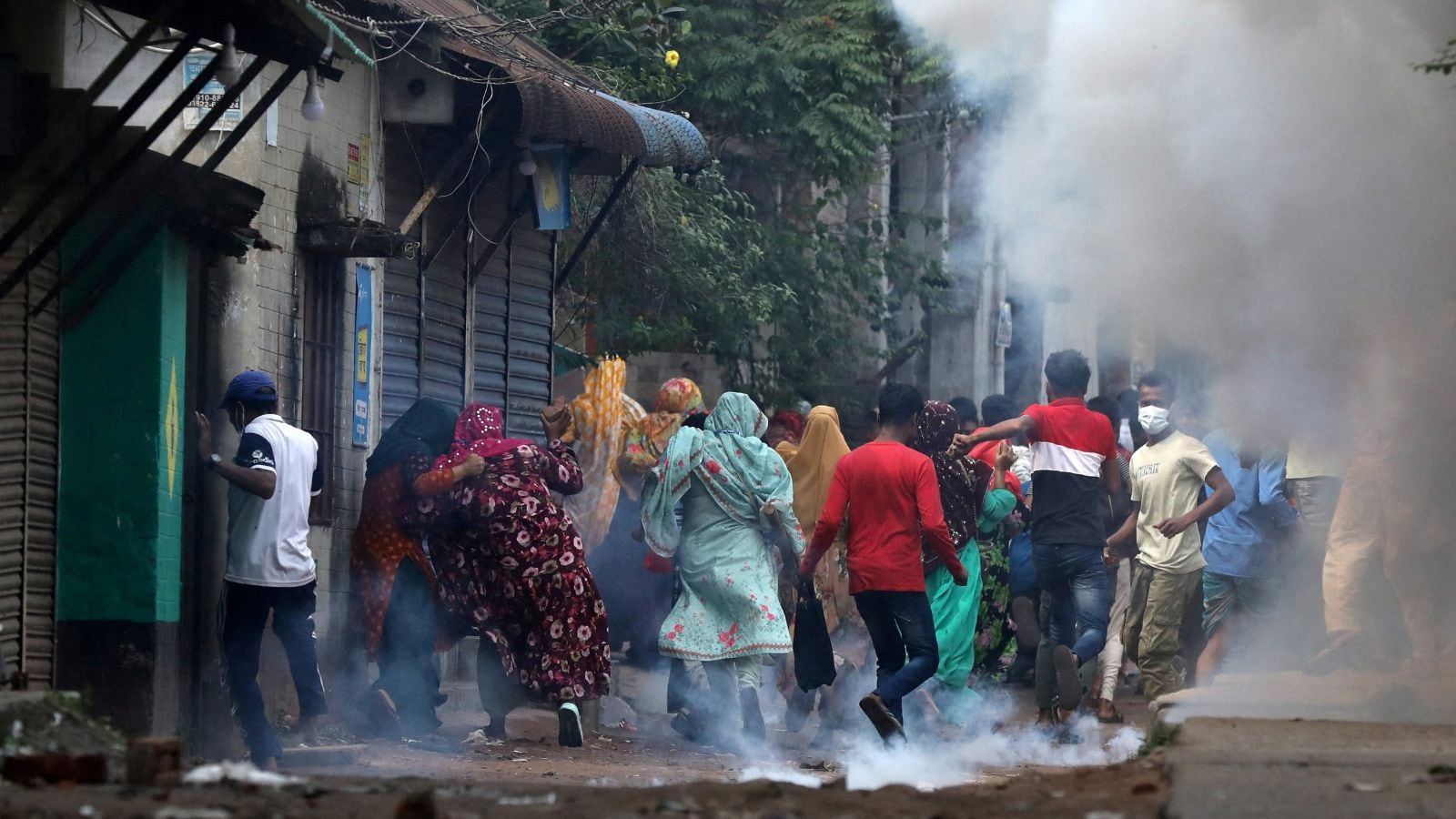
Street confrontations between supporters of the Bangladesh Nationalist Party (BNP) and the Awami League rarely happen by accident. They are the predictable physical symptoms of a winner-takes-all political architecture, where control of the state apparatus determines economic survival, legal immunity, and local authority. Whenever a political vacuum opens, a major anniversary approaches, or control over municipal institutions shifts, rival activists take to the streets in Dhaka, Chattogram, Khulna, and district towns to assert physical dominance over public space.
To understand why these clashes flare up with such regularity, you have to look past the immediate spark—whether it is a disputed rally permit, a torn banner, or a rumor on social media—and examine the machinery underneath. Surface-level news reports usually reduce these incidents to brickbats, chased crowds, and police tear gas. That framing misses the real story. Street mobilization in Bangladesh functions as both a negotiating tool at the national level and a high-stakes turf war at the neighborhood level.
The Anatomy of a Street Confrontation
Most major clashes follow a recognizable sequence that begins days before the first stone is thrown. When one party announces a mass gathering, a divisional rally, or a sit-in program, the rival camp frequently schedules a "peace rally" or a counter-demonstration along overlapping routes or adjacent intersections.
In dense urban corridors—like Dhaka’s Naya Paltan, Baitul Mukarram, or the highway bottlenecks entering the capital—geographic overlap makes friction almost unavoidable. Processions moving from peripheral wards toward a central stage must pass through neighborhoods dominated by opposing local committees. A verbal taunt at a tea stall or an attempt to block a feeder road quickly escalates when dozens of young men armed with bamboo poles, sticks, and crude projectiles converge on the spot.
Law enforcement agencies find themselves caught in a structural bind during these standoffs. Police units deployed to maintain buffer zones often face accusations of partisan bias regardless of how they act. When security forces clear an intersection using batons, sound grenades, or rubber bullets, the targeted party frames the intervention as state-backed suppression. When police hold back to avoid escalating casualties, critics accuse them of allowing rival cadres to terrorize commuters and shopkeepers.
Why Turf Control Matters More Than Ideology
A common misconception among outside observers is that BNP and Awami League supporters clash primarily over irreconcilable ideological doctrines. While the two parties hold distinct historical narratives regarding the 1971 Liberation War, secularism, and the role of religion in public life, the men fighting in the alleys are rarely debating constitutional philosophy.
They are fighting over ward-level patronage networks.
In Bangladesh’s hyper-centralized political economy, party affiliation at the grassroots level acts as a gatekeeper to everyday livelihoods. Local committee leaders and their student or youth wings—such as the Chhatra League and Jubo League on one side, and Chhatra Dal and Jubo Dal on the other—compete for influence over:
- Transport syndicates and bus terminals: Control over route permits, daily collection fees from auto-rickshaws and buses, and terminal management generates steady, untaxed cash flow.
- Local bazaar and construction tenders: From small municipal road repairs to market stall allocations, political backing dictates who wins contracts and who gets pushed out.
- Informal dispute resolution: In areas where formal courts are slow and expensive, local political offices function as de facto arbitration centers, conferring immense social power on whoever holds the neighborhood.
When national political winds shift, those local monopolies are suddenly up for grabs. Defending an intersection during a rally is not just a show of loyalty to central leadership in Dhaka; it is a public demonstration to local merchants, transport workers, and police officials about who actually runs the neighborhood.
The Historical Cycle of Zero-Sum Politics
This dynamic did not emerge overnight. For more than three decades following the restoration of parliamentary democracy in 1991, power in Bangladesh alternated almost exclusively between the Awami League, led by Sheikh Hasina, and the BNP, led by Khaleda Zia. Rather than producing a stable two-party consensus, that rivalry hardened into a zero-sum system.
Every transition of power brought sweeping bureaucratic reshuffles, mass transfers of police officers, and waves of criminal cases filed against outgoing politicians and their grassroots activists. Over time, both camps internalized a stark lesson: losing power does not merely mean sitting in the opposition benches to debate legislation. It means facing legal harassment, business closures, and physical vulnerability.
Because institutional checks—such as the Election Commission, the judiciary, and local government bodies—have repeatedly struggled to command universal trust across party lines, political disputes inevitably spill out of parliament and onto the asphalt. Street strength becomes the ultimate metric of legitimacy. If a party cannot fill a highway or hold a major square against opposition counter-mobilization, its bargaining power at the negotiating table evaporates.
The Role of Youth Wings and Digital Mobilization
The frontline demographics of these clashes have remained consistent for generations, even as the tools of coordination have changed. University campuses, polytechnic institutes, and district colleges serve as the primary recruiting grounds for student wings. For ambitious young men from modest backgrounds, joining a campus wing offers protection, hostel accommodation, social status, and a direct ladder into national politics.
In recent years, smartphones and encrypted messaging apps have dramatically compressed the timeline of escalation. Previously, mobilizing reinforcements from neighboring wards required physical messengers or landline calls, giving community elders and police time to intervene. Today, a 15-second smartphone video showing an activist being beaten—sometimes genuine, sometimes clipped out of context from an older incident—can circulate across Facebook groups and WhatsApp channels within minutes.
Digital outrage translates instantly into physical retaliation. Activists three miles away mobilize on motorcycles before local administrators even know an altercation has begun. At the same time, rival media cells race to shape the narrative online, flooding social platforms with competing footage designed to portray their side as peaceful victims of unprovoked aggression.
The Economic Collateral Paid by Ordinary Citizens
While party spokespeople trade blame on evening television talk shows, the immediate cost of every street clash falls on people who hold no party membership card.
Bangladesh’s economy relies heavily on uninterrupted logistics, particularly the movement of ready-made garments from factories in Gazipur, Narayanganj, and Savar to the port of Chattogram. When clashes shut down major highways or trigger retaliatory transport strikes, supply chains stall. Exporters miss shipping deadlines, perishable agricultural goods rot in stuck trucks, and daily wage earners in Dhaka lose an entire day’s income because buses stop running.
Small shopkeepers along flashpoint avenues routinely pull down their metal shutters at the first sign of a procession, sacrificing hours of business to avoid shattered storefronts or looting during chaotic dispersals. For students sitting for board exams or patients trying to reach public hospitals, a sudden confrontation turns a routine commute into a dangerous ordeal.
Why Institutional Reforms Struggle to Break the Pattern
Whenever major violence subsides, civil society groups, business chambers, and foreign diplomats issue familiar calls for political dialogue, restraint, and adherence to democratic norms. Yet breaking the cycle proves extraordinarily difficult because the incentives driving street politics remain intact.
A hypothetical example illustrates the dilemma facing any local leader. Suppose a ward president from either party decides to unilaterally disband his street-level mobilization team and rely purely on peaceful petitioning. Within weeks, rival activists or opportunistic syndicates would likely encroach on his supporters' businesses, file retaliatory police complaints without fear of pushback, and label him weak in front of his own party's high command. In an environment where mutual trust is nonexistent, unilateral restraint feels like political suicide.
Furthermore, accountability mechanisms after clashes rarely deter future violence. First Information Reports (FIRs) filed with police typically name dozens of known opposition figures alongside hundreds of "unnamed" accused. These sweeping charges are widely viewed as instruments of political pressure rather than serious criminal investigations, particularly since cases against ruling-aligned activists frequently stall while cases against rivals accelerate. Without impartial prosecution that targets actual perpetrators regardless of their political badge, street fighters operate with the expectation that their party will eventually shield them from consequences.
The Unresolved Question Over Public Space
At the core of every confrontation between BNP and Awami League supporters lies a fundamental disagreement over who owns the street. In a functioning democracy, public roads and squares belong to citizens equally, and the state regulates assemblies strictly to ensure safety and traffic flow without favoring one political message over another.
In Bangladesh, public space is treated as contested territory to be captured, held, and denied to rivals. Until political parties separate grassroots economic survival from party loyalty, and until state institutions enforce the law without looking at the color of an activist's banner, the streets will remain the primary arena where political disputes are settled.