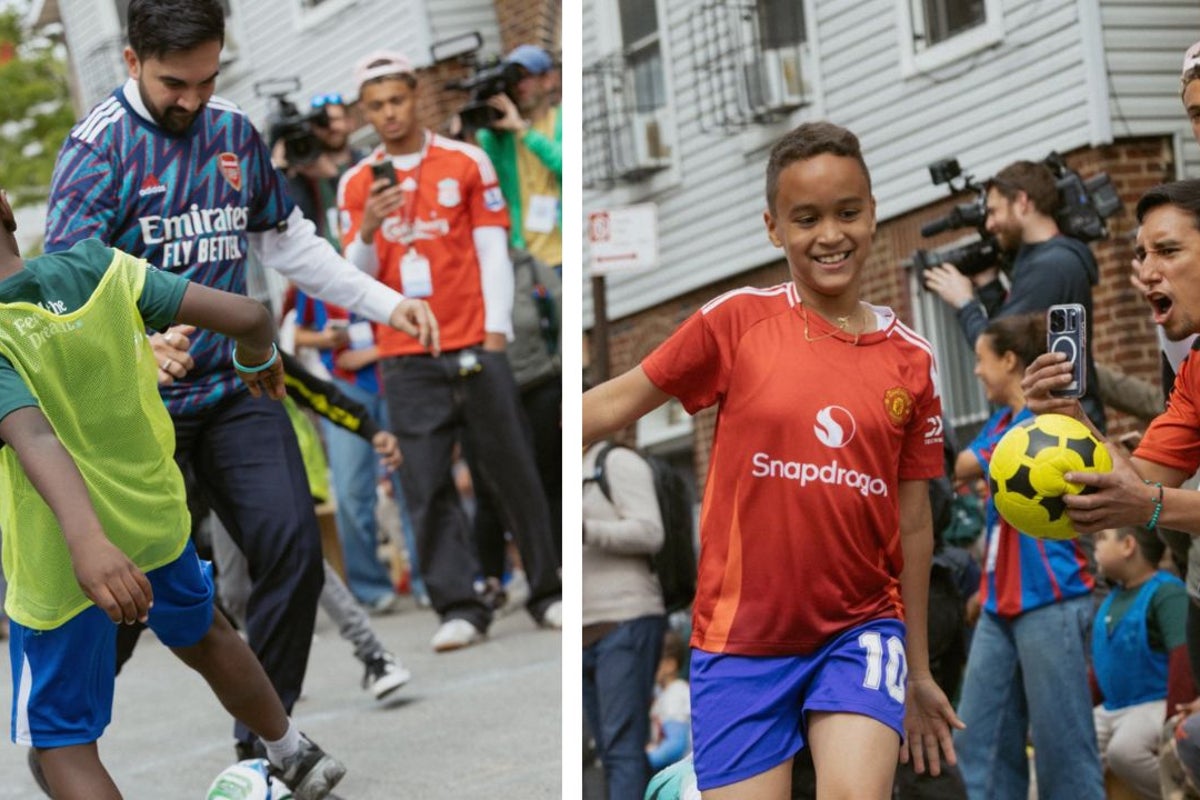
The PR machine is in overdrive. Every time a major tournament looms, we see the same tired script: a politician or a high-profile figure like Zohran Mamdani laces up some sneakers, does three mediocre juggles for a camera crew, and claims they are "reclaiming the roots of the game." It’s a sanitized, corporate-friendly version of "the streets" designed to sell jerseys and distract from the fact that elite soccer has become a closed-circuit playground for billionaires.
Stop falling for it.
The narrative that street soccer acts as a grassroots engine for the World Cup is a romantic myth. In reality, the industry has spent the last two decades systematically killing the very organic play it now tries to use as a marketing backdrop. If you think a photo op in Queens or a pop-up pitch in a parking lot is a sign of a healthy soccer culture, you aren't paying attention to the mechanics of the sport.
The Professionalization Death Spiral
We are told street soccer is the "purest" form of the game. That’s a lie. The "purity" is actually just a lack of resources that the professional scouting world has now commodified. In the past, players like Garrincha or Diego Maradona emerged from unstructured environments because those environments were the only option. Today, the moment a kid shows a flicker of talent on a concrete pitch, they are funneled into a pay-to-play academy system that drills the creativity out of them.
I have spent years watching talent identification programs across three continents. I’ve seen the "battle scars" of the industry: kids who could manipulate a ball like a magician at age ten, but by fourteen, they are robotic "system players" because their academy coaches value positioning over flair.
The "lazy consensus" says that street soccer builds better technical players. It doesn't. It builds different players. But the modern World Cup doesn't want different. It wants predictable. When people like Mamdani promote these events, they are promoting a feeder system that is increasingly broken. We are celebrating the "street" while the industry ensures that no "street" style actually survives into the professional ranks.
The Fallacy of the Urban Pitch
Look at the geography of the modern game. We see "street soccer" initiatives popping up in gentrified neighborhoods where the cost of living ensures that the actual working-class kids—the ones who historically birthed the game’s greatest innovations—are being priced out.
These "urban pitches" aren't for the community. They are billboards. They are aesthetic choices for developers. Real street soccer happens in the cracks of the city, in places where the police might tell you to move along, and on surfaces that aren't perfectly leveled turf. By "promoting" it through official channels, we are effectively domesticating a wild animal. Once you put a fence around it and add a corporate sponsor, it isn't street soccer anymore. It’s just outdoor gym class with a better Instagram filter.
The Physics of the Concrete Lie
Let’s talk about the actual mechanics. Elite soccer is played on high-moisture, short-cut grass. The friction coefficient of a professional pitch is nothing like the asphalt of a city street.
The movement of the ball $V_b$ on a rough surface like concrete involves significantly higher rolling resistance than on a manicured pitch.
$$F_r = C_{rr} N$$
Where $F_r$ is the rolling resistance, $C_{rr}$ is the coefficient of rolling resistance, and $N$ is the normal force. On the street, $C_{rr}$ is high and unpredictable. A player learns to hit the ball harder, to use the sole of the foot more frequently to control erratic bounces, and to play in tight, vertical spaces.
But the modern professional game is obsessed with the "switch"—long, sweeping horizontal passes across 60 yards of grass. The skills learned on the street are becoming irrelevant to the tactical demands of managers like Pep Guardiola or Mikel Arteta. These managers demand "positional play," where a player’s primary job is to stay in a specific zone to provide width. If you try to play "street" in a Champions League final, you get benched.
So why do we pretend these two worlds are connected? Because it’s good for business. It makes the World Cup feel accessible when it is actually more exclusive than ever.
The Scouting Mirage
People often ask: "If street soccer is so great, why aren't scouts just hanging out at local parks?"
The answer is brutal: Because the risk-to-reward ratio is too high for the clubs. It is cheaper and safer for a club to sign a "proven" kid from a Belgian academy who has been tested in a lab for three years than to take a chance on a 17-year-old from a park who has never played 11-a-side on a full-size pitch.
Scouting has shifted from "eye-test" flair to data-driven metrics. They want Expected Goals (xG), progressive carries, and high-intensity sprint counts. Street soccer doesn't produce data. It produces moments. And in the 2026 World Cup era, moments are what you put in the highlight reel, but data is what gets you a contract.
The "Promotion" Trap
When politicians promote street soccer ahead of a World Cup, they are usually looking for a "legacy" project. They want to show that the billion-dollar tournament will benefit the locals.
It’s a distraction.
The real legacy of these tournaments is usually a series of empty stadiums and increased debt. By focusing on a few kids playing soccer in the street, we ignore the massive displacement of local communities and the skyrocketing ticket prices that ensure those same kids will never actually step foot inside the stadium for a match.
If we actually cared about the "roots" of the game, we wouldn't be building $50,000 mini-pitches for photo ops. We would be fighting the predatory nature of youth sports coaching fees. We would be addressing the visa restrictions that prevent young talent from moving freely. We would be acknowledging that the World Cup has become a luxury product, not a global festival.
The Ugly Truth of the "Skill" Showcase
The "skills" shown off at these promotional events—the nutmegs, the around-the-worlds, the flash—are largely useless in a competitive match. Freestyle soccer and competitive soccer are two different sports.
Promoting "street skills" as a precursor to the World Cup is like promoting juggling as a precursor to a weightlifting competition. They both use a ball, but that’s where the similarity ends. By conflating the two, we are lying to young players about what it takes to succeed at the highest level. We are selling them a dream of "flair" while the professional world is looking for "efficiency."
I’ve seen dozens of "street kings" try out for professional sides. They usually last two days. They can’t handle the lack of space. They can’t handle the physical demands of a 90-minute shift. They are experts in a vacuum.
Stop The Romanticization
The contrarian take isn't that street soccer is bad. It’s that street soccer is dying, and the people "promoting" it are the ones holding the pillow over its face.
The industry wants the image of the street without the inconvenience of the street. They want the grit as long as it’s cleaned up for the 6 PM news. They want the soul of the game as long as it can be sold back to us in 15-second clips.
Real soccer culture doesn't need a promotion tour. It needs the space to exist without being scrutinized, scouted, or "activated" by a marketing agency. It needs a world where a kid can play for five hours without a coach screaming about "tactical flexibility."
The next time you see a politician or an executive kicking a ball around a city square to "build excitement" for the World Cup, don’t applaud. Recognize it for what it is: a funeral disguised as a festival. The street didn't ask for your promotion, and the World Cup doesn't care about the street.
Get off the "curated" pitch and look at what’s actually happening to the game. It’s being sold piece by piece, and the "street" is just the latest piece of marketing collateral.
Stop buying the lie. Turn off the cameras and just let the kids play.