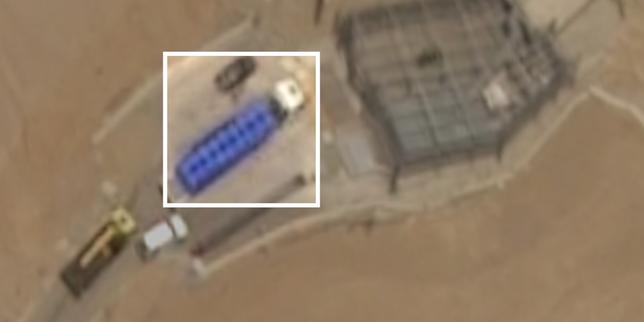
The appearance of an unidentified, large-scale object at Iran’s Isfahan Nuclear Research Center (INRC) on satellite imagery is not a singular event of interest but a data point within a broader pattern of "hardened" infrastructure development. While media speculation often centers on "mystery," a structural analysis of the site’s function—specifically its role in the conversion of uranium ore concentrate (yellowcake) into uranium hexafluoride ($UF_6$)—suggests that this movement represents a deliberate stress test of international surveillance capabilities or a critical logistical phase in the expansion of Iran's fuel cycle.
The Isfahan complex serves as the central node for Iran’s nuclear metallurgy and chemical conversion. Any physical change at this site must be evaluated through three distinct analytical lenses: the Thermal Signature of Industrial Activity, the Logistical Throughput of Shielded Containers, and the Psychological Signal of Visibility. For another view, check out: this related article.
The Logistics of Shielded Displacement
The object identified in recent imagery, characterized by its dimensions and placement near high-security portals, aligns with the physical profile of a transport cask or a specialized modular component for a conversion line. In nuclear logistics, the movement of such objects is rarely accidental. It follows a strict "Chain of Custody" (CoC) protocol.
The presence of this object on the surface, rather than within the subterranean or reinforced structures common at Isfahan, suggests one of two mechanical realities: Similar insight on the subject has been published by The Washington Post.
- Intermediate Transit Staging: The object is too large or too heavy for standard rapid-insertion elevators, requiring it to remain in the open during crane-assisted placement.
- Deliberate Exposure: The placement is intended to be captured by commercial satellite constellations (Maxar, Planet Labs) to signal a change in operational status without the need for an official press release.
From a structural engineering perspective, the Isfahan site has undergone significant underground expansion since 2021. The construction of new tunnels into the mountain range adjacent to the facility indicates a shift toward "Passive Defense" (Padafand-e Gheyr-e Amel). This strategy involves placing critical assets at depths exceeding the kinetic penetration capabilities of standard bunker-busting munitions. Therefore, any object left on the surface is either non-critical, decommissioned, or a decoy designed to draw analytical resources away from the subterranean Boring Machine (TBM) progress.
The Conversion Bottleneck and Chemical Constraints
To understand why a "mysterious shipment" at Isfahan matters, one must look at the chemical stoichiometry of the Iranian nuclear program. Isfahan produces the $UF_6$ gas that is then fed into centrifuges at Natanz or Fordow for enrichment.
The "Conversion Function" can be defined as:
$$P_{uf6} = \int (Y_{in} \cdot E_{eff}) dt$$
Where $P_{uf6}$ is the total production of uranium hexafluoride, $Y_{in}$ is the input of yellowcake, and $E_{eff}$ is the efficiency of the conversion equipment.
If the unidentified object is a new fluorination reactor or a heat-exchange unit, it directly increases $E_{eff}$. This allows Iran to process its domestic uranium stockpiles faster than the International Atomic Energy Agency (IAEA) can monitor through periodic inspections. The bottleneck in Iran’s "breakout time" is often not just the number of centrifuges, but the availability of high-purity feed material. An upgrade at Isfahan is a force multiplier for the enrichment halls hundreds of kilometers away.
The Satellite Intelligence Gap
The reliance on commercial satellite imagery creates a "Temporal Aliasing" problem for analysts. Commercial satellites have specific revisit rates—the time between one pass and the next over the same coordinate.
- Low-Earth Orbit (LEO) Constraints: Most high-resolution imaging occurs during mid-morning sun-synchronous orbits to maximize shadows for depth perception.
- The Shadow Variable: By measuring the length of the shadow cast by the "mysterious" object and knowing the exact time of the satellite pass ($t$), analysts use basic trigonometry ($h = l \cdot \tan(\alpha)$) to determine the height ($h$) of the equipment.
However, static imagery cannot distinguish between a lead-lined container holding radioactive material and an empty steel shell of identical dimensions. This ambiguity is a strategic asset for the Iranian Ministry of Defense. By moving objects of similar geometry to the surface periodically, they create "noise" in the data set. This noise forces Western intelligence agencies to expend "Analytic Man-Hours" (AMH) verifying false positives, thereby masking the actual movement of sensitive materials which may occur during night cycles or under cloud cover using Synthetic Aperture Radar (SAR) resistant shielding.
Strategic Ambiguity as a Deterrent
The "Mystery" at Isfahan is a functional application of Game Theory, specifically the Stag Hunt or Hawk-Dove models. Iran benefits from the perception of progress. If the object looks like a container for enriched material, the international community must react as if it is, even if it is a decoy.
This creates a "Cost of Response" for the observer:
- Diplomatic Capital: Issuing a warning at the IAEA Board of Governors based on unverified imagery risks eroding credibility if the object is later proven to be benign.
- Kinetic Risk: Escalating to sabotage or strike operations against a "mystery" target carries the risk of a disproportionate response for what might have been a shipment of air-scrubbing units.
The site at Isfahan is particularly sensitive because it also houses the Uranium Metal Lab (UML). The production of uranium metal is a dual-use process: it is required for advanced civilian reactor fuel, but it is also a prerequisite for the core of a nuclear weapon. Any shipment entering the UML sector of the Isfahan site carries a significantly higher "Strategic Weight" than a shipment entering the general administrative zones.
The Infrastructure Pivot
The most probable technical explanation for the recent imagery is the installation of new cooling or power-generation hardware required for the expanded underground halls. As Iran increases the number of IR-6 and IR-9 centrifuges—which operate at higher RPMs and generate more heat—the supporting infrastructure at conversion sites must scale accordingly.
We are observing the "Industrialization of Resistance." The transition from makeshift or repurposed facilities to purpose-built, hardened industrial complexes. The Isfahan anomalies are symptoms of a mature nuclear infrastructure that has moved beyond the "R&D phase" into a "Continuous Production phase."
In this phase, the primary risk is not a single shipment, but the Accumulated Operational Capacity. Even if the IAEA maintains cameras on-site, the "blind spots" created by new tunnel entrances allow for a "Parallel Fuel Cycle" that operates outside of documented inventories.
Systematic Verification Requirements
To move beyond speculation, the analytical community requires a multi-modal data fusion approach. Relying on optical imagery alone is insufficient. A rigorous assessment would require:
- Multispectral Analysis: To detect heat signatures (infrared) that indicate whether the "object" or the building it entered is drawing significant power or dissipating heat.
- Vibration Monitoring: Remote sensing of seismic data to differentiate between the movement of heavy machinery and standard transport.
- Open-Source Procurement Tracking: Monitoring the global supply chain for high-end industrial components (e.g., specialized valves, vacuum pumps) that match the dimensions of the observed objects.
The current geopolitical climate ensures that Isfahan remains a "High-Value Target" for both intelligence collection and strategic signaling. The "mysterious shipment" is a reminder that in the realm of nuclear non-proliferation, what is visible is often a distraction from what is being built in the shadows.
The strategic play here is not to react to the object itself, but to increase the frequency and granularity of SAR (Synthetic Aperture Radar) monitoring to track the "Earth Displacement Volume" of the Isfahan mountain tunnels. The true progress of the Iranian nuclear program is measured in the cubic meters of rock removed from the site, not in the occasional crate left on a loading dock for the cameras.
Monitor the exit points of the new Isfahan tunnel complexes for "Tailings Pile" growth; the volume of excavated debris provides a direct mathematical correlation to the internal floor space being created for unmonitored conversion activities.