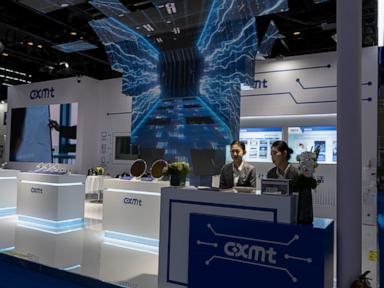
The initial public offering of ChangXin Memory Technologies on the Shanghai Stock Exchange STAR Market raised upwards of $8.6 billion, creating an immediate valuation dislocation that drove shares up 470 percent on debut. This liquidity event represents more than a domestic capital market anomaly. It functions as a direct barometer of state-directed industrial policy navigating foreign trade restrictions. To evaluate the underlying mechanics of this listing, one must deconstruct the financial engineering, the supply chain constraints governing dynamic random-access memory production, and the structural limits facing national semiconductor champions attempting to break an entrenched foreign oligopoly.
The Financial Architecture and Free Float Mechanics
The mechanics of the pricing strategy established a baseline valuation of approximately 579 billion yuan, or $85.5 billion, prior to the open. When trading commenced, the stock encountered an extreme supply-demand imbalance rooted in structural design rather than purely organic market sentiment.
- The Restricted Float Constraint: Only roughly 6.7 percent of the company's total enlarged share capital entered the open market during the initial listing. The remaining majority stayed locked under regulatory mandates and strategic allotments to state-backed entities, including the National Social Security Fund.
- Liquidity Concentration: By restricting the available supply of equities while domestic institutional and retail capital sat oversubscribed by a factor exceeding 200, the opening auction guaranteed extreme upward velocity.
- Valuation Distortion: The resulting intraday capitalization spike pushed the enterprise past 3.3 trillion yuan, briefly positioning it ahead of traditional financial heavyweights on mainland exchanges. This metric reflects the scarcity premium assigned by domestic investors to a sovereign hardware asset rather than a normalized discounted cash flow valuation.
This pricing dynamic exposes a structural divergence. Global competitors such as Micron Technology, SK Hynix, and Samsung Electronics trade on multi-year earnings cycles tied to global enterprise capital expenditure. ChangXin operates within a localized financial greenhouse where domestic capital allocation channels directly back into operational expansion, bypassing standard international debt and equity corridors.
The Cost Function of Memory Localization
The commercial viability of ChangXin rests on navigating a severe technological deficit driven by export controls. Semiconductor fabrication plants requiring sub-nanometer lithography tools face absolute barriers regarding Extreme Ultraviolet systems. Understanding how the enterprise scales output despite these bottlenecks requires analyzing its operational cost function.
- Equipment Deprecation and Yield Penalties: Operating without access to leading-edge lithography forces reliance on older generation deep ultraviolet immersion tools, necessitating multi-patterning techniques. Multi-patterning increases mask counts, extends cycle times, and depresses wafer yield rates, driving up the baseline unit cost per gigabit compared to foreign peers.
- Capital Intensity vs. Subsidy Absorption: The capital expenditure required to scale dynamic random-access memory output is immense. The proceeds from the $8.6 billion float, alongside prior state injections, function as a financial shock absorber. These funds neutralize the near-term margin erosion caused by lower initial manufacturing yields.
- The Revenue Velocity Paradox: Driven by the broader artificial intelligence hardware boom, the firm reported revenue surging to 50.8 billion yuan in the first quarter of the year. This top-line expansion masks the underlying unit economics. Revenue growth is an artifact of high global pricing power resulting from an industry-wide supply deficit rather than structural cost leadership.
Market Share Thresholds and Oligopoly Dynamics
The global market for dynamic random-access memory operates as a tight oligopoly. Historical data indicates that the top three foreign entities control upwards of 85 to 90 percent of global shipments. ChangXin sits outside this tier as a regional challenger, holding an estimated single-digit global shipment share that crossed into the 9 percent range.
Industry analysis points to a distinct structural survival threshold. Operating beneath a 15 percent global market share creates long-term vulnerability to pricing wars initiated by dominant incumbents. When global supply normalizes, established operators with fully amortized fabrication plants can compress prices below the higher marginal cost of secondary producers.
To cross this 15 percent threshold, the enterprise must solve two distinct engineering hurdles:
- High-Bandwidth Memory Development: Current artificial intelligence compute clusters demand high-bandwidth memory architectures stacked vertically to maximize data transfer rates. Western export controls specifically target these advanced packaging technologies. Developing an indigenous, commercially viable alternative determines whether the firm can capture high-margin enterprise data center contracts or remain relegated to commodity consumer electronics.
- Validation Friction: While domestic device manufacturers and emerging domestic artificial intelligence models provide an captive consumer base, securing tier-one validation internationally remains blocked by geopolitical friction and ongoing legal scrutiny regarding intellectual property.
Strategic Capital Deployment and Execution Risks
The primary risk profile centers on the execution of the capital deployment strategy outlined in the initial public offering prospectus. Management faces the dual challenge of expanding physical wafer capacity while simultaneously advancing process nodes under strict technological isolation.
- Capital Drainage: The sheer scale of the listing temporarily strains domestic equity liquidity, forcing regulatory bodies to monitor secondary market knock-on effects across adjacent technology sectors.
- Geopolitical Retaliation: Intensifying legislative pressure from foreign governments seeking to block third-party procurement of ChangXin components introduces severe supply chain friction for ancillary components and chemical inputs.
Deploy capital expenditures exclusively toward scaling mature-node multi-patterning lines to secure immediate cash flow stability, while ring-fencing a dedicated internal division for advanced packaging research to mitigate the structural high-bandwidth memory disadvantage over a thirty-six-month horizon.