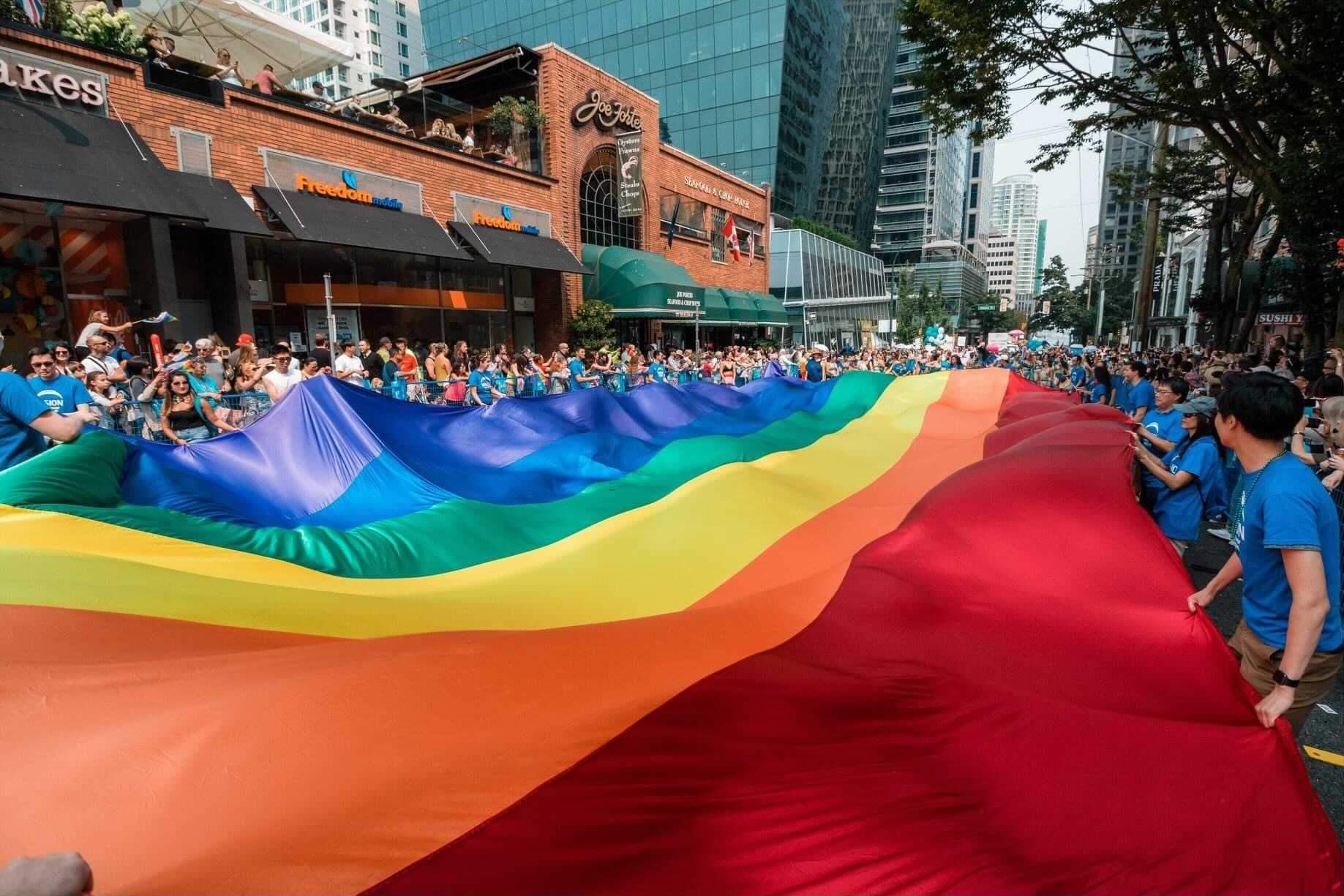
Large-scale civic festivals operate on a fragile tri-party revenue model: corporate sponsorship, municipal-provincial grants, and direct consumer monetization. When corporate diversity, equity, and inclusion (DEI) mandates undergo a structural retreat, this model collapses. The Vancouver Pride Society (VPS) faces a critical capital shortfall that threatens the structural viability of its programming. A $75,000 emergency cash injection from the City of Vancouver provides temporary operational runway, but it fails to address the underlying macroeconomic and political shifts destabilizing public infrastructure events across North America.
To understand why civic festivals are approaching a breaking point, analysts must look past short-term inflation and dissect the systemic decoupling of corporate marketing spend from community-based social initiatives.
The Cost and Revenue Functions of Civic Infrastructure
The financial health of a major public festival can be modeled through an explicit relationship between escalating fixed operational costs and highly volatile variable revenues. The structural deficit observed in Vancouver is driven by a stark divergence between these two forces.
Total Cost = Fixed Infrastructure + Municipal Compliance + Variable Programming + Escalating Security Costs
1. The Fixed Cost Baseline and Regulatory Creep
Unlike ticketed, enclosed venue events, open-access civic festivals incur massive non-recoverable structural costs. Municipal compliance mandates require event organizers to internalize costs that were historically absorbed by cities. These include:
- Geographic Permitting and Physical Barriers: Asset deployment for multi-kilometer parade routes, including vehicle-mitigation barriers and perimeter fencing.
- Logistical Security Overhead: Paid duty police officers, private security contractors, and emergency medical services required by municipal risk-management frameworks to secure un-ticketed spaces.
- Operational Infrastructure Inflation: The cost of essential equipment—tents, staging, portable sanitation, and audio-visual networks—has experienced compound annual growth driven by supply-chain concentration and rising regional labor rates.
2. The Sponsorship Contraction Function
Corporate sponsorship traditionally serves as the primary capital anchor for civic festivals, acting as a high-margin revenue offset to fixed operational costs. However, this capital stream is highly sensitive to shifts in corporate brand-equity strategies.
Over the past five years, corporate participation has shifted from systemic alignment to transactional marketing. As political polarization and localized pushback against DEI initiatives increase across North America, major brands are systematically re-evaluating their public risk profiles. The corporate risk-mitigation function now treats public-facing social advocacy as a potential liability rather than a marketing asset. This has triggered a programmatic pullback from major corporate sponsors like Google, Nissan, and Clorox in comparable markets, a trend directly mirrored in Vancouver where the festival lost nearly half its historical corporate sponsors.
When corporate capital contracts, the revenue mix shifts heavily toward government grants. This creates an immediate operational bottleneck.
The Efficiency Trap of Emergency Discretionary Grants
The City of Vancouver’s unanimous vote to approve a one-time $75,000 grant prevents an immediate reduction in parade route length and activation density. However, relying on ad-hoc municipal interventions introduces profound systemic inefficiencies.
The Operational Capacity Drain
Applying for, securing, and reporting on emergency public funding requires significant administrative overhead. For an organization operating under strict capital constraints, the labor hours diverted to compliance and political advocacy create an operational deficit. Staff resources are consumed by survival mechanics rather than long-term strategic execution or alternative revenue diversification.
Capital Allocation Mismatch
The scale of emergency municipal grants is structurally insufficient to counter macroeconomic headwinds. A $75,000 cash injection solves an immediate accounts-payable crisis for the current fiscal cycle, but it does not scale against a systemic multi-million-dollar national funding gap.
Together with Pride Toronto and Fierté Montréal, the Vancouver Pride Society has pursued a structural intervention: a joint appeal to the federal government for a stable, targeted investment of $9 million over three years ($3 million annually) to decouple cultural festival infrastructure from unpredictable corporate marketing budgets.
Strategic Reconfiguration of the Civic Festival Model
The current trajectory of the Vancouver Pride Society indicates that the traditional open-access, sponsor-funded model is no longer sustainable. Resolving the structural deficit requires moving away from emergency public subsidies and fundamentally redesigning the economic framework of civic events.
Transition to Decentralized Programming
To mitigate the compounding costs of centralized, large-scale street closures, organizers must shift toward a distributed hub network.
- Central Asset Reduction: Shortening the physical footprint of the primary parade reduces the fixed cost of municipal compliance, vehicle-mitigation barriers, and paid-duty policing linearly.
- Micro-Activation Monetization: Shifting attendees toward ticketed, enclosed, or perimeter-controlled sub-venues allows for direct monetization through gate admissions and captive concession revenues, offsetting the loss of corporate sponsorship.
Structural Capital Restructuring
Organizations must transition corporate relationships away from seasonal, activation-based marketing budgets and toward long-term philanthropic or foundational endowments. This insulates the operational baseline from macro DEI rollbacks and quarterly marketing budget adjustments. Corporate partners looking to minimize public exposure while maintaining community investment can shift capital into back-end operational endowments, accessibility infrastructure, or community grants rather than high-visibility, politically sensitive public branding.
The survival of large-scale civic initiatives depends on structural adaptation. Organizations that fail to adjust their cost functions and diversify away from volatile corporate marketing spend will find themselves in a permanent cycle of contraction, forced to reduce their civic presence to match a permanently diminished revenue ceiling. The immediate priority must be the aggressive reduction of fixed operational exposure and the establishment of predictable, multi-year public-private capital frameworks.