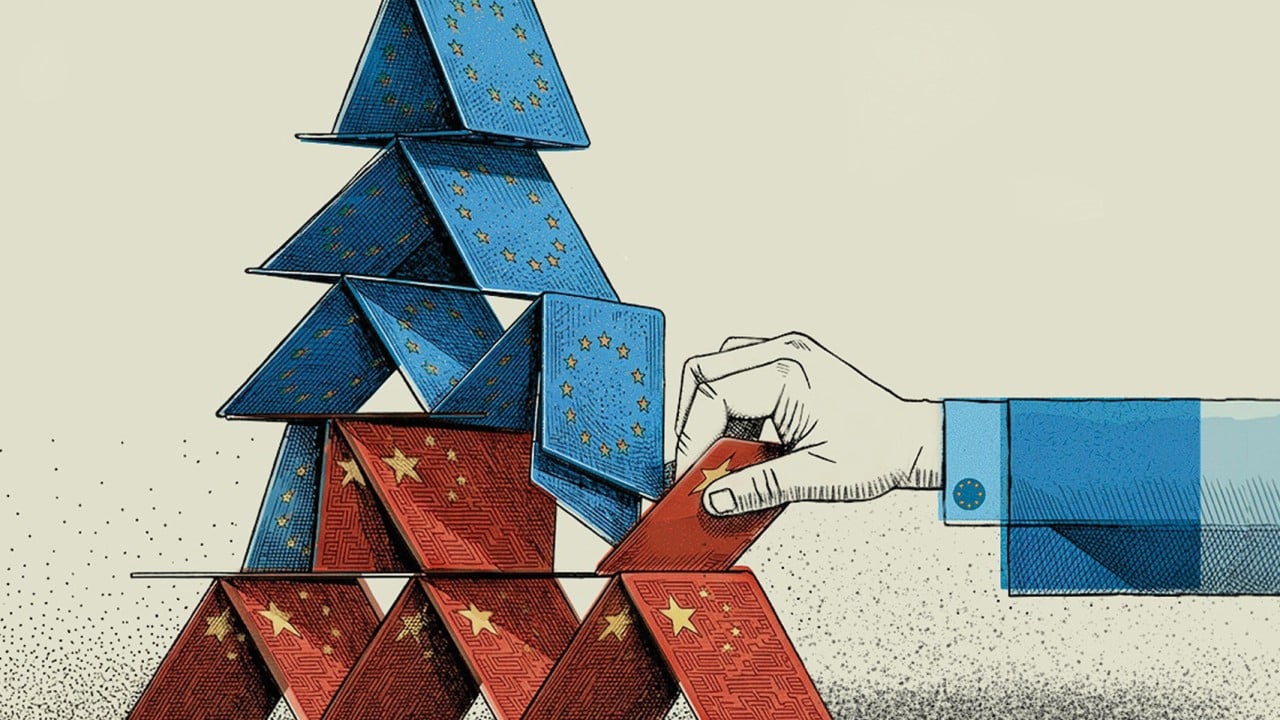
The European Union’s current posture toward the People's Republic of China suffers from a fundamental structural defect: a mismatch between geopolitical risk abatement strategies and underlying macroeconomic dependencies. While Brussels framers champion "de-risking" as a middle path between total economic decoupling and uncritical engagement, the operational execution of this policy exposes severe institutional friction across member states. This strategic incoherence does not merely reduce the EU’s negotiating leverage; it actively exposes internal markets to systemic vulnerabilities, strategic retaliation, and unilateral economic attrition.
Evaluating the viability of European foreign policy requires discarding moralizing political rhetoric and quantifying the real mechanisms driving economic interdependency, regulatory fragmentation, and industrial risk concentration.
The Trilemma of European Economic Statecraft
European policy toward China is constrained by three inherently conflicting objectives. A state or regional bloc can simultaneously optimize for at most two of these variables, creating a persistent structural trilemma:
- Strategic Autonomy: Reducing critical supply chain dependencies on foreign authoritarian states.
- Industrial Competitiveness: Maintaining low input costs and high export market access for core manufacturing sectors.
- Internal Regulatory Harmony: Preserving single-market cohesion without imposing centralized fiscal transfers or forcing member-state industrial winners and losers.
       Strategic Autonomy
            /        \
           /          \
          /   Policy   \
         /   Trilemma   \
        /                \
Industrial  -------------- Internal Regulatory
Competitiveness              Harmony
Attempts to pursue all three simultaneously yield systemic policy paralysis.
When the European Commission pushes for aggressive de-risking, it forces export-reliant economies like Germany to trade away short-term Industrial Competitiveness for long-term Strategic Autonomy. Conversely, when individual member states strike bilateral commercial deals with Beijing to preserve domestic industrial margins, they dismantle Internal Regulatory Harmony.
This institutional design failure permits external superpowers to exploit internal divisions using target-specific economic coercion and selective market access incentives.
Mechanisms of Asymmetric Exposure
The economic relationship between Europe and China is characterized by asymmetric dependencies spread unequally across industrial sectors and geographical sub-regions.
Supply Chain Bottlenecks in Critical Minerals and Green Tech
The European green transition relies heavily on supply chains where processing capacity is highly concentrated in Chinese markets. De-risking strategies frequently focus on finished goods while ignoring fundamental upstream vulnerabilities.
- Rare Earth Elements: Processing capacity for heavy rare earths remains over 80% concentrated in Chinese refining facilities, creating an absolute bottleneck for European wind turbine manufacturing and electric motor production.
- Photovoltaic Inverters and Wafers: Upstream polysilicon synthesis and wafer production remain dominant in mainland facilities, rendering downstream European solar deployment mandates dependent on foreign supply continuity.
- Lithium-ion Battery Chemistry: While European battery gigafactories are operational, raw material refining (precursor cathode materials, synthetic graphite, refined lithium salts) remains localized in East Asia.
The core vulnerability is not just direct finished-goods import volumes, but intermediate input substitution costs. Replacing a localized supplier of complex chemical precursors requires multi-year capital expenditures, regulatory approvals, and environmental permitting processes that European frameworks are ill-equipped to execute rapidly.
Export Market Exposure and Capital Imbalances
The exposure mechanism functions through asymmetric capital allocation. Major European automotive, chemical, and industrial machinery enterprises have committed substantial capital assets inside mainland China. This generates a corporate hostage problem:
- Capital commitments inside foreign jurisdictions act as effective collateral against home-country trade sanctions.
- Corporate revenues generated within the Chinese domestic market are increasingly reinvested locally to bypass tariffs, effectively decoupling European corporate profitability from domestic European employment and GDP growth.
- Small-to-Medium Enterprises (SMEs) across Southern and Eastern Europe do not share this market access, creating divergent corporate lobby priorities between multinational conglomerates and regional suppliers.
The Failure of Regulatory Instruments
To manage this asymmetric exposure, the European Commission developed a suite of trade defense instruments: the Anti-Subsidies Regulation, the Foreign Subsidies Regulation (FSR), and the Carbon Border Adjustment Mechanism (CBAM). While theoretically sound, these mechanisms contain operational design flaws that weaken their strategic utility.
Defensive Tit-for-Tat and Escalation Cycles
Imposing anti-subsidy duties on state-backed imports assumes the target nation will accept the cost to maintain rule-based market access. In practice, centralized state-capitalist economies counter regulatory friction using targeted, non-tariff retaliatory actions:
[EU Imposes FSR/Tariffs]
         │
         ▼
[Target Nation Imposes Dual-Use Export Restrictions]
         │
         ▼
[Upstream Supply Bottlenecks for European Manufacturers]
         │
         ▼
[Margin Compression in High-Value European Exports]
- Targeted Administrative Delays: Increasing customs clearing times for perishable agricultural goods or high-margin luxury products originating from specific advocating member states.
- Dual-Use Export Restrictions: Applying licensing requirements on key raw materials (e.g., gallium, germanium, antimony), directly inflating input costs for European semiconductor and defense manufacturers.
- Bilateral Arbitrage: Offering preferential market conditions or foreign direct investment packages to skeptical member states, effectively buying veto power within the European Council's unanimity and qualified majority voting structures.
The Enforcement Capability Deficit
Enforcing complex trade defense mechanisms requires granular visibility into state-owned enterprise balance sheets, indirect subsidies, and multi-tier supply chain provenance. European regulatory authorities operate with significant information asymmetry compared to foreign state planners. Assessing whether a third-country enterprise benefits from non-market financial interventions demands extensive access to internal financial audits—access that non-cooperative sovereign states routinely deny or obfuscate behind national security legislation.
Divergent National Interests as an Inhibitor of Cohesion
The fundamental driver of European strategic incoherence is not a lack of analytical capability in Brussels, but the divergent national economic models of member states.
The Export-Driven Industrial Core
Nations with deep manufacturing bases depend on high-volume capital goods exports and continuous raw material imports. For these economies, abrupt trade barriers mean immediate revenue contraction, factory idling, and political instability. Consequently, their policy preference skews toward pragmatic, transactional bilateral engagement, regardless of macro-level strategic directives.
The Service and Agrarian Periphery
States centered on tourism, service industries, or agriculture face a different incentive matrix. They are often more susceptible to targeted foreign direct investment in logistics infrastructure, ports, and real estate. These investments yield immediate domestic political capital with low operational downside for national industrial champions, creating structural incentives to break European consensus on security-focused trade interventions.
The Security-First Eastern Flank
Member states bordering strategic military flashpoints view economic relationships through the lens of hard security guarantees. For these nations, alignment with external security partners takes absolute precedence over domestic commercial access to East Asian consumer markets. This produces a stark internal policy divide within the EU council chambers, preventing the formation of a unified grand strategy.
Strategic Realignment Strategies
Resolving this strategic incoherence requires moving away from reactive trade sanctions toward a structurally sound industrial strategy.
Upstream Capital Deployment
Instead of levying downstream tariffs that inflate consumer costs and trigger retaliatory supply shocks, capital allocation must shift upstream. Strategic reserves of refined critical minerals must be funded at the bloc level through joint debt issuance or dedicated sovereign funds, removing the immediate leverage of unilateral export controls.
Re-architecting the Voting Mechanism
The current reliance on consensus or high-threshold qualified majority voting for strategic trade interventions invites foreign divide-and-rule tactics. Transitioning foreign policy and strategic economic governance to streamlined decision structures would reduce the capacity of external actors to neutralize EU policy by lobbying individual member states.
Reciprocal Market Access Standards
De-risking must be reframed from a passive defense mechanism into a strict requirement for market entry. Third-country firms seeking access to the European single market should be required to execute joint-venture structures, transfer technical IP, and adhere to localized processing mandates within the EU, mirroring the exact regulatory frameworks historically imposed on Western capital entering emerging markets.
Establishing an operational industrial strategy requires accepting that strategic autonomy has a direct financial cost. Lowering systemic vulnerability demands accepting higher baseline input costs, reallocating capital from short-term consumption to long-term supply chain redundancy, and enforcing strict regulatory discipline over short-term corporate profit margins. Until European policy explicitly codifies these trade-offs, its foreign posture will remain vulnerable to external fragmentation.