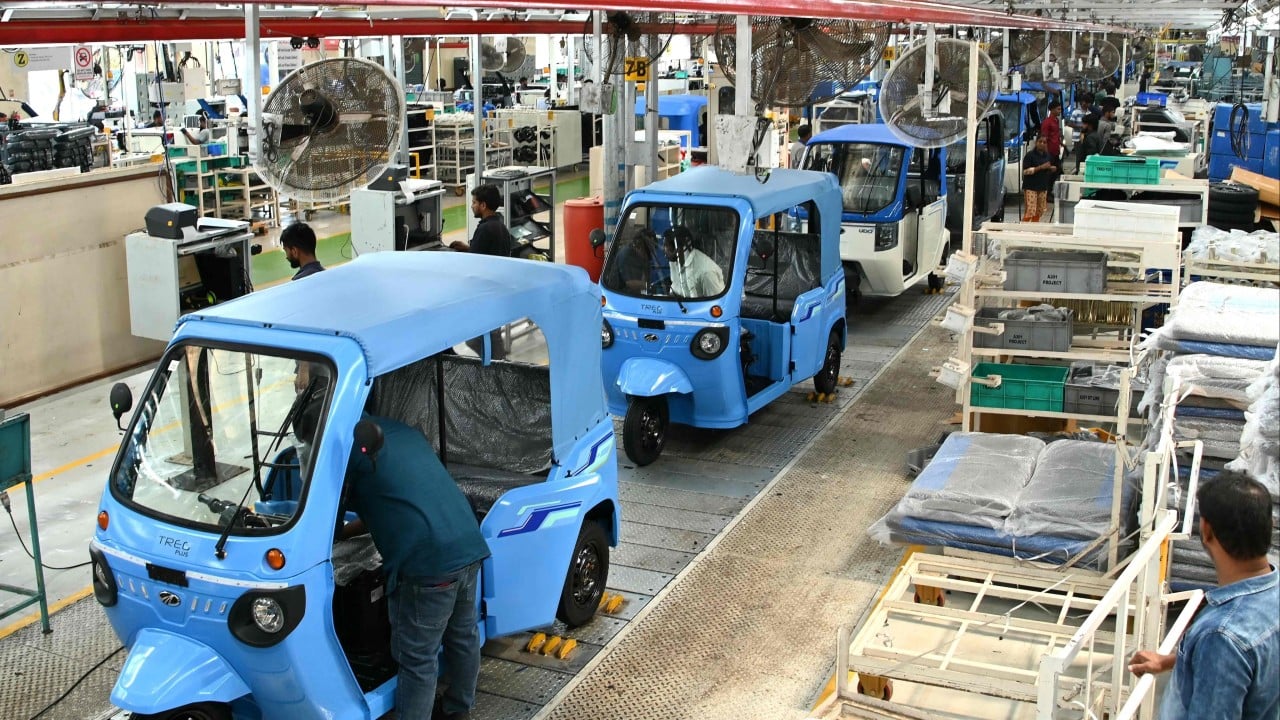
India did not merely miss a temporal window in the 1980s; it bypassed an entire developmental phase of factor-market liberalization that allowed China to absorb global labor-intensive assembly. Catching up to China today is not a linear race along the same track, because the global production function has shifted from low-cost labor arbitrage to automated, scale-intensive supply chain ecosystems. To capture global market share in the current decade, India must execute a dual-track industrial strategy: resolving domestic factor-market distortions while integrating into fragmented "China Plus One" value chains at the sub-assembly tier rather than attempting immediate full-stack replication.
The Anatomy of the 1980s Divergence
Standard economic commentary frames the China-India divergence as a simple timing error. This explanation mistakes the symptom for the root cause. In the late 1970s and 1980s, both economies possessed massive reserves of underemployed agrarian labor, yet their institutional mechanisms for reallocating that labor into industrial output differed fundamentally.
China’s post-1978 reforms operated through decentralized economic experimentation, spearheaded by Special Economic Zones (SEZs) like Shenzhen. These zones functioned as regulatory enclaves that bypassed mainland bureaucratic friction, offering foreign direct investment (FDI) tariff-free intermediate imports, streamlined customs clearance, and flexible labor contracts. Crucially, the Chinese state retained monopoly ownership over urban land, allowing municipal governments to subsidize industrial land prices while capturing fiscal upside through rapid urbanization and infrastructure appreciation.
India’s 1991 balance-of-payments crisis triggered significant trade and industrial delicensing, dismantling the overt "License Raj" in product markets. However, India left its factor markets—land, labor, and capital—largely unreformed. This asymmetry created a structural distortion. By liberalizing capital-intensive sectors and services while maintaining rigid labor regulations and fragmented land acquisition laws, India incentivized firms to substitute capital for labor.
The resulting economic trajectory violated the classic Lewis turning point model of structural transformation, in which surplus agricultural labor is absorbed into low-skill manufacturing before an economy transitions to high-value services. India leaped directly from an agrarian base to skill-intensive services—such as IT outsourcing, pharmaceuticals, and financial back-offices—leaving its manufacturing share of GDP stagnant between 14% and 17% for over three decades.
The Three Structural Bottlenecks in Indian Factor Markets
To evaluate whether India can absorb the manufacturing capacity currently migrating out of East Asia, analysts must isolate the three primary cost functions that govern industrial competitiveness: land assembly, labor rigidity, and logistics friction.
1. Land Acquisition and Spatial Fragmentation
Industrial scale requires contiguous tracts of land with pre-approved environmental clearances and utility hookups. In India, land titles are often presumptive rather than conclusive, leading to protracted litigation. Under the Right to Fair Compensation and Transparency in Land Acquisition, Rehabilitation and Resettlement Act of 2013, acquiring private land requires high compensation multiples and multi-stage social impact assessments.
This creates a severe capital-allocation bottleneck. A mid-sized electronics assembly plant requires between 50 and 100 acres to house the primary facility, component suppliers, and worker dormitories. While Chinese municipal authorities can allocate and grade such a parcel within months, Indian developers frequently spend three to five years aggregating plots from dozens of smallholders. The resulting delay inflates upfront capital expenditure and erodes the internal rate of return (IRR) for greenfield projects before a single unit is produced.
2. The Missing Middle and Labor Thresholds
For decades, India’s Industrial Disputes Act mandated that firms employing more than 100 workers obtain explicit government permission before laying off staff or closing a unit. Although recent consolidation into four national labor codes raised this threshold to 300 workers—and several states have introduced localized exemptions—the historical legacy remains embedded in India's industrial firm-size distribution.
This regulatory cliff produced the "missing middle" phenomenon. Rational business owners artificially capped headcount below statutory thresholds, operating dozens of small, suboptimal workshops rather than scaling into single, capital-efficient factories. Small firms lack the balance-sheet capacity to invest in automated quality control, worker training, or research and development. Without scale, Indian manufacturers cannot achieve the unit-cost reductions dictated by Wright’s Law, which states that cumulative production volume drives predictable percentage declines in manufacturing costs.
3. Logistics and Inter-State Friction
The implementation of the Goods and Services Tax (GST) in 2017 eliminated internal octroi checkpoints and unified India’s domestic market fiscally. Physical logistics, however, remain a drag on export competitiveness. Logistics costs in India historically hovered around 13% to 14% of GDP, compared to 8% to 9% in advanced manufacturing economies.
This gap stems from an imbalanced modal freight mix. Over 60% of Indian freight moves by road, compared to less than 30% by rail. Dedicated Freight Corridors (DFCs) are actively correcting this imbalance by separating passenger and cargo rail traffic, reducing transit times from northern industrial hubs to western ports like Mundra and Jawaharlal Nehru Port Trust. Yet last-mile port turnaround times and customs clearance procedures still lag behind East Asian benchmarks, increasing working capital requirements for exporters who must hold higher buffer inventories.
The Shift in the Global Production Function
Even if India eliminated its domestic factor-market distortions overnight, the external environment of the 2020s bears little resemblance to the 1980s or 1990s. The macroeconomic variables that enabled China’s rise have structurally inverted.
Automation vs. Labor Arbitrage
In the 1990s, manufacturing competitiveness was heavily weighted toward the cost of manual assembly. Today, industrial robotics, computer numerical control (CNC) machining, and automated optical inspection have compressed the labor share of total manufacturing cost across sectors ranging from textiles to consumer electronics.
Having a vast demographic dividend—a large working-age population—is no longer a sufficient condition for attracting factories. Modern manufacturing demands a specific subset of human capital: technicians capable of maintaining automated lines, supply chain engineers, and floor supervisors versed in Six Sigma quality control. If low wages are accompanied by low labor productivity and high defect rates, the fully loaded unit cost remains uncompetitive against automated plants in China, Vietnam, or even the reshoring hubs of North America.
The Agglomeration Effect and Ecosystem Depth
China’s primary moat is no longer cheap labor; it is agglomeration economics. In the Pearl River Delta or the Yangtze River Delta, an original equipment manufacturer (OEM) can source printed circuit boards, injection-molded plastics, specialized fasteners, and precision glass within a 50-kilometer radius.
This geographic concentration slashes transaction costs, accelerates prototyping cycles from months to days, and eliminates cross-border tariff friction on intermediate goods. When multinational corporations attempt to relocate final assembly to India, they encounter an ecosystem deficit. Because India lacks a deep tier-two and tier-three supplier base, assembly plants must import up to 70% or 80% of their bill of materials (BoM) from China, South Korea, and Taiwan.
Importing components incurs freight costs, working capital lockup, and import duties. Until local value addition rises above 35% to 40%, India functions primarily as a "screwdriver economy"—performing final knock-down assembly while capturing only a thin margin of the total product value.
Geopolitical Fragmentation and Trade Protectionism
China scaled its export machine during the zenith of hyper-globalization, culminating in its 2001 accession to the World Trade Organization (WTO). Tariffs were falling globally, and Western consumers prioritized deflationary goods over supply chain resilience.
The current trade regime is characterized by industrial policy, friend-shoring, and carbon border adjustments. The United States and the European Union are actively subsidizing domestic capacity in semiconductors, batteries, and clean energy hardware through instruments like the CHIPS Act and the Inflation Reduction Act. Simultaneously, India itself has raised average applied tariffs over the past decade to protect domestic producers, which inadvertently penalizes exporters who rely on imported intermediate inputs. Navigating this environment requires granular compliance with rules-of-origin criteria rather than simple low-cost mass production.
Deconstructing India's Current Industrial Policy
To overcome these structural headwinds, the Indian government has deployed a targeted intervention framework centered on fiscal incentives and infrastructure front-loading. Evaluating these policies requires separating headline announcements from operational reality.
The Production-Linked Incentive (PLI) Mechanism
Launched across 14 strategic sectors—including mobile phones, pharmaceuticals, solar photovoltaic modules, and specialty steel—the PLI scheme departs from traditional input-based subsidies. Instead of offering upfront tax holidays or cheap credit regardless of output, PLI disburses direct cash subsidies calculated as a percentage (typically 4% to 6%) of incremental sales over a base year, contingent upon meeting strict capital expenditure thresholds.
The operational logic of PLI is sound: it transfers execution risk to the private sector while offsetting the "disability cost" of operating in India—specifically higher power tariffs, logistics friction, and cost of capital. In mobile phone manufacturing, this mechanism successfully catalyzed assembly scale, transforming India from a net importer of handsets into a major exporter within five years, anchored by Apple’s contract manufacturers (Foxconn, Pegatron, Tata Electronics) and Samsung.
However, the PLI model exposes two structural vulnerabilities when applied to sectors with longer gestation periods or deeper technological complexity:
- The Subsidy Cliff: A five-year incentive window is sufficient to establish low-capex final assembly, but it is inadequate for capital-intensive component manufacturing, such as semiconductor fabrication or display glass, where payback periods span eight to twelve years. If local supply chains do not achieve self-sustaining scale before the subsidies expire, assembly operations risk migrating to lower-cost jurisdictions.
- Import Substitution vs. Export Competitiveness: In sectors like solar modules and white goods, domestic demand is protected by high basic customs duties and non-tariff barriers (such as Approved Lists of Models and Manufacturers). While this boosts domestic production numbers, it risks creating uncompetitive domestic champions that survive on tariff protection rather than global export efficiency.
Capital Expenditure Front-Loading and the China Plus One Window
Recognizing that private corporate capital expenditure lags without public infrastructure, the Indian central government has tripled its annual capital expenditure allocation over the past several years, focusing heavily on highways, railways, and port modernization.
Concurrently, global firms are executing "China Plus One" diversification strategies to mitigate geopolitical risk and tariff exposure. This creates a narrow, high-stakes window for India. Multinationals are not looking to abandon their Chinese manufacturing bases entirely; they are seeking a secondary hedge capable of absorbing 15% to 25% of global capacity.
India’s primary competitors for this incremental capacity are Vietnam, Mexico, and Indonesia. Vietnam offers superior trade integration via free trade agreements (such as the CPTPP and EU-Vietnam FTA) and geographic proximity to Chinese component hubs in Guangxi and Guangdong. Mexico offers nearshoring access to the US market under the USMCA framework. India’s unique value proposition is the combination of a massive, growing domestic consumer market and a deep pool of engineering talent—an advantage smaller Southeast Asian economies cannot match.
Operational Roadmap for Capturing Global Value Chains
India cannot—and should not—attempt to replicate China’s 20th-century industrial model across every vertical. Attempting to dominate low-margin, hyper-competitive commodities like basic apparel or standard plastics ignores the reality of regional competition from Bangladesh and Vietnam. Instead, industrial strategy must target specific nodes where India’s structural advantages align with global supply chain vulnerabilities.
Step 1: Invert the Tariff Structure to Favor Value-Chain Integration
Policymakers must systematically reduce import duties on intermediate components, raw materials, and capital machinery. High tariffs on inputs act as an implicit tax on exports. By adopting a zero-to-low tariff regime on sub-assemblies while maintaining competitive corporate tax rates (currently 15% for new manufacturing entities), India can lower the entry barrier for global component suppliers to co-locate alongside final assemblers.
Step 2: Transition from Final Assembly to Sub-Assembly Ecosystems
Industrial incentives must shift aggressively from final assembly toward tier-two component manufacturing—specifically precision tooling, printed circuit board assemblies (PCBA), lithium-ion battery cells, and specialized chemical intermediates. True supply chain stickiness occurs when the component ecosystem is localized. Once tier-two suppliers establish sunk capital in Indian industrial clusters, the switching costs for OEMs become prohibitively high, insulating the ecosystem from the eventual expiration of PLI subsidies.
Step 3: Establish Plug-and-Play Industrial Corridors with State-Level Competition
Central government policy can set macro direction, but manufacturing execution occurs at the state level. States like Tamil Nadu, Gujarat, Maharashtra, and Karnataka must standardize the provision of "plug-and-play" industrial parks—pre-zoned, dispute-free land banks equipped with uninterrupted industrial power, effluent treatment plants, and on-site worker housing. Standardizing factory building codes and enabling 24/7 three-shift operations, particularly by removing restrictions on female night-shift labor, is essential to maximize asset utilization rates.
Step 4: Anchor Competitiveness in Engineering-Led Manufacturing
India’s highest probability of outperforming peers lies in sectors that blend physical manufacturing with software, chemistry, and engineering design. This includes active pharmaceutical ingredients (APIs) and biologics, automotive components (especially electric vehicle powertrains), aerospace sub-systems, and industrial machinery. In these verticals, R&D intensity and intellectual property protection matter more than raw labor arbitrage, allowing India to leverage its existing base of STEM graduates and global capability centers (GCCs) to capture higher margins up the smile curve of value creation.
Strategic Forecast and Final Play:
India will not replicate China’s dominance as the monolithic "factory of the world" because the macroeconomic conditions that enabled single-country manufacturing hegemony no longer exist. Over the next decade, India’s realistic ceiling is to capture 10% to 15% of the global incremental shift in electronics, pharmaceuticals, and engineering goods, lifting its manufacturing share of GDP from 15% toward 20%.
For corporate strategists and capital allocators, the optimal entry play into Indian manufacturing is not standalone greenfield final assembly aimed solely at exports. Instead, deploy capital into tier-two component manufacturing and contract engineering joint ventures structured to serve both India’s expanding domestic demand and regional export hubs. Anchor operations in southern or western coastal states with established port infrastructure, utilize the 15% new-manufacturing corporate tax regime rather than relying on temporary PLI cash flows for unit-economic viability, and build local supplier development programs from day one to mitigate import dependency.