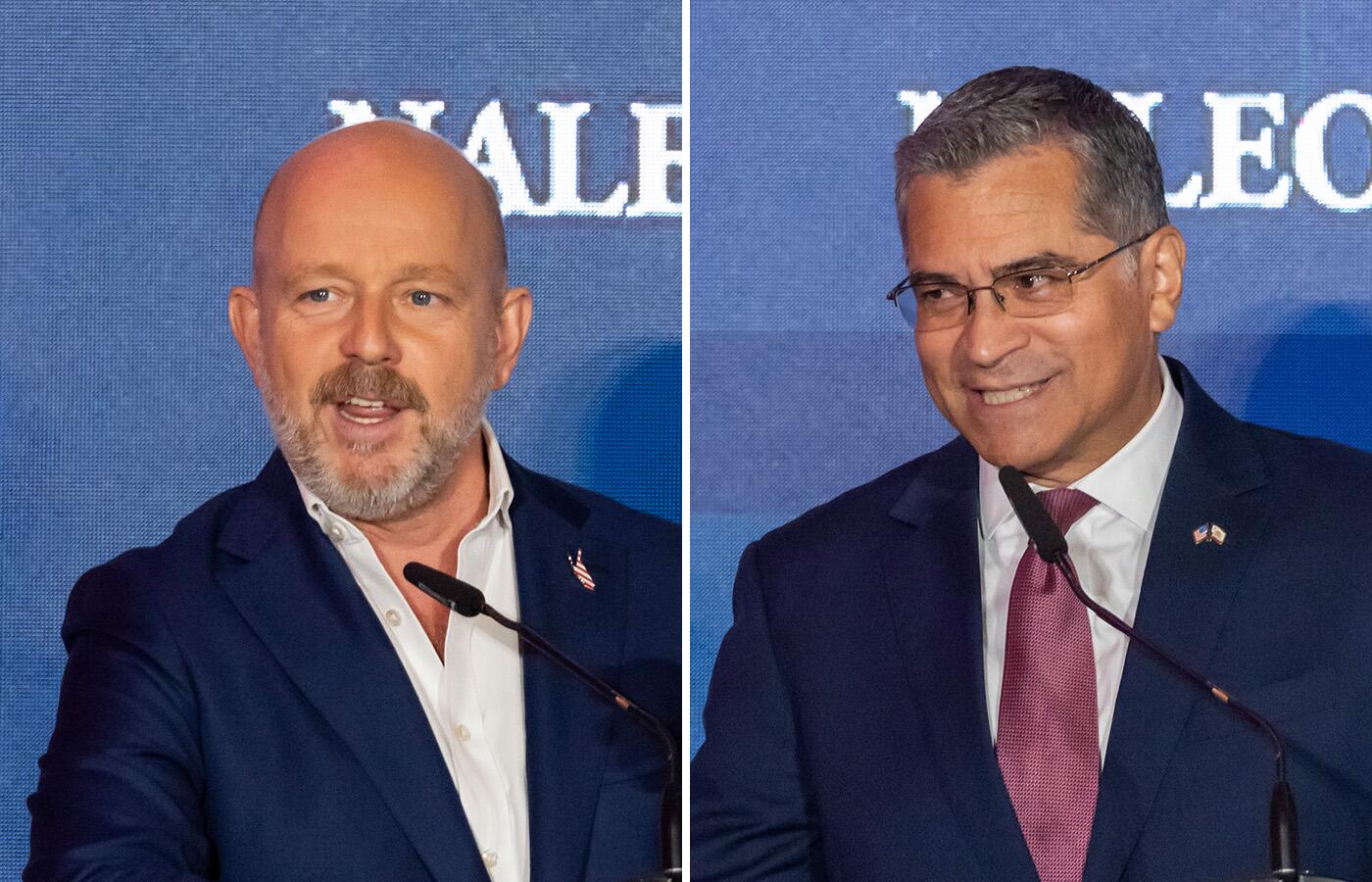
The November general election for California governor between Democrat Xavier Becerra and Republican Steve Hilton presents a stark structural divergence in state political economy. Rather than a contest of marginal policy adjustments, the electorate faces two mutually exclusive models for managing state expenditures, regulatory overhead, and federal-state fiscal friction. Becerra relies on administrative institutionalism, framing government programs as non-negotiable baselines that require targeted, incremental tax increases to sustain. Hilton proposes a supply-side shock model, seeking to force operational contraction in Sacramento through direct reductions in marginal tax rates and statutory deregulation.
Navigating this electoral juncture requires evaluating the mechanical constraints of California's state budget, the mathematical limits of the candidates' revenue proposals, and the operational friction created by federal mandates.
Fiscal Models and Budgetary Compression Mechanics
The central point of divergence lies in the structural handling of the state's general fund revenue engine. California relies heavily on personal income tax (PIT), which accounts for roughly two-thirds of state general fund revenues. Because the state's progressive tax architecture leans on top earners—where the top 1% of tax filers generate nearly half of all PIT receipts—the state budget experiences systemic volatility tied directly to financial markets and capital gains realizations.
+-----------------------------------------------------------------------------------+
|                            CALIFORNIA FISCAL PARADIGMS                            |
+------------------------------------+----------------------------------------------+
| Becerra Model: System Expansion    | Hilton Model: Supply-Side Compression        |
+------------------------------------+----------------------------------------------+
| • Fixed baseline entitlement costs | • 100% tax exemption on income < $100,000    |
| • Corporate / top-earner tax increases | • Flat tax rate on income > $100,000      |
| • Mandated risk-pooling (Medi-Cal) | • 33% mandatory reduction in state spending  |
| • Federal compliance alignment     | • Regulatory rollback & fossil fuel push     |
+------------------------------------+----------------------------------------------+
The Hilton Flat Tax and Expenditure Cut Equation
Hilton's economic platform centres on a statutory overhaul of the personal income tax structure: eliminating income tax on earnings up to $100,000 and establishing a flat tax rate above that threshold.
This restructuring creates an immediate fiscal baseline reduction. Excluding the first $100,000 of income from taxation yields a radical contraction in revenue from lower- and middle-income tax brackets. To offset this structural yield drop, the proposal relies on two dynamic mechanisms:
- Absorbing a mandatory 33% cut in overall state agency spending.
- Inducing secondary economic activity via increased disposable income and capital retention.
The primary systemic bottleneck in this approach is the constraint imposed by Proposition 98. Enacted in 1988, Proposition 98 guarantees a minimum funding level for K-14 education, consuming approximately 38% to 40% of the state general fund. Because constitutional mandates ring-fence K-14 spending, debt service, and specific pension obligations, the actual burden of a 33% top-line budget reduction compresses entirely into non-guaranteed categories: higher education, environmental protection, health care administration, and public safety. Mathematically, slashing total spending by one-third while preserving constitutionally protected allocations requires an operational reduction of 50% to 65% across unprotected state agencies.
The Becerra Preservation and Dedicated Revenue Strategy
Becerra operates from a framework that views entitlement programs and social safety net expenditures as fixed systemic baselines. His platform avoids broad systemic restructuring, proposing instead to maintain expenditure levels by capturing targeted revenue streams.
Becerra advocates for elevating corporate tax rates on high-yield firms and introducing targeted surcharges on top-bracket earners to buffer the general fund against revenue shortfalls. However, this model faces the law of diminishing marginal returns: higher top-bracket taxes compound tax-base mobility risks. When state income tax rates approach maximum elasticity, high-net-worth individuals and corporate entities use state-tax arbitrage, relocating residency or operational centers to zero-income-tax jurisdictions (such as Texas, Nevada, or Florida). This base erosion introduces systemic vulnerability to long-term revenue projections.
The Cost Function of Healthcare Risk-Pooling
The candidates present opposing strategies regarding Medi-Cal coverage parameters, specifically the allocation of state funds to low-income residents without legal immigration status.
                +-------------------------------------------------+
                |      IMMIGRANT HEALTHCARE RISK ALLOCATION       |
                +-------------------------------------------------+
                                         |
         +-------------------------------+-------------------------------+
         |                                                               |
         v                                                               v
  [ BECERRA MODEL ]                                              [ HILTON MODEL ]
  Preventive Access Strategy                                    Coverage Termination Strategy
  - Fund outpatient primary care                                - Direct savings via program removal
  - Reduce uncompensated ER visits                              - Shift uncompensated care to hospitals
  - Long-term cost smoothing                                    - Higher emergency room cost-shifting
The Cost-Shifting Mechanisms of Coverage Elimination
Hilton's proposal to dismantle state-funded Medi-Cal coverage for residents lacking legal status is structured as a direct spending reduction. The fiscal logic assumes immediate line-item savings within the Department of Health Care Services budget.
However, removing individuals from primary care coverage alters the delivery mechanism rather than eliminating the underlying healthcare burden. Under the federal Emergency Medical Treatment and Labor Act (EMTALA), emergency rooms are legally required to stabilize and treat any individual presenting with acute medical condition regardless of legal status or ability to pay.
When uninsured populations are removed from preventive care, healthcare utilization shifts from low-cost outpatient clinics to high-cost hospital emergency rooms. This mechanism yields three distinct secondary costs:
- Hospital Cost-Shifting: Emergency departments absorb uncompensated care costs and pass them to commercial insurance pools, elevating private health insurance premiums for California businesses and insured residents.
- County Indigent Health Burden: Pursuant to Welfare and Institutions Code Section 17000, California counties serve as the safety net of last resort. Cutting state-funded Medi-Cal pushes indigent care responsibilities back onto county administration budgets, shifting fiscal liabilities rather than eliminating them.
- Systemic Outbreak Vulnerability: Removing communicable disease monitoring and routine vaccinations from undocumented cohorts increases baseline public health risks, elevating systemic expenditure during regional health emergencies.
Managed Risk-Pooling and Budget Volatility
Becerra defends universal Medi-Cal access through a cost-containment model. Managing risk via early intervention, outpatient medical management, and pharmaceutical access lowers the frequency of acute, emergency-level events.
The constraint in Becerra's approach lies in immediate fiscal sustainability during periods of state tax contraction. During economic downturns, state tax receipts contract precisely when enrollment in safety-net programs surges. If the governor refuses to adjust enrollment eligibility during budget deficits, health expenditures function as an expanding liability that swallows surplus cash reserves, forcing emergency draws on the state's Rainy Day Fund or necessitating immediate tax hikes.
Energy Arbitrage and Statutory Deregulation
California carries some of the highest residential and commercial energy tariffs in the continental United States. The strategic debate centers on whether to accelerate the state's statutory climate mandates or force an immediate energy supply expansion through deregulation.
                 +-----------------------------------------------+
                 |        ENERGY TARIFF DRIVERS & STRATEGIES     |
                 +-----------------------------------------------+
                                         |
         +-------------------------------+-------------------------------+
         |                                                               |
         v                                                               v
  [ BECERRA RETAIL CAP ]                                        [ HILTON DEREGULATION ]
  - Executive rate freezing                                     - Suspension of CEQA constraints
  - Utility profit caps                                         - Permitting expansion for fossil fuel extraction
  - Utility capital cost absorption                             - Immediate wholesale supply increase
Hilton's Supply-Side Deregulation Thesis
Hilton's strategy targets the regulatory cost drivers embedded within California's energy pricing structure:
- Suspending or rolling back California Environmental Quality Act (CEQA) requirements for utility infrastructure and industrial housing developments.
- Approving expanded state permits for in-state fossil fuel extraction and refining.
- Modifying state greenhouse gas mandates that mandate utility purchases of higher-cost clean power.
By lifting extraction restrictions and streamlining infrastructure permitting, this model seeks to reduce wholesale energy procurement costs. The primary risk stems from capital allocation lag. Energy infrastructure projects require multi-year financing and construction cycles. Lowering regulatory hurdles does not instantly create new refining capacity or transmission line throughput, leaving retail energy rates tied to national commodity cycles in the short term.
Becerra's Executive Rate-Freezing and Utility Oversight Model
Becerra advocates for direct regulatory intervention, floating executive rate caps and stricter oversight of investor-owned utilities (IOUs) like Pacific Gas & Electric (PG&E).
This framework assumes high utility bills are primarily driven by corporate margin extraction and inefficient capital spend rather than regulatory compliance costs. By clamping down on allowed return-on-equity rates through the California Public Utilities Commission (CPUC), this strategy aims to insulate consumers from further rate shocks.
The structural vulnerability of administrative price controls is capital flight. Investor-owned utilities must continually raise private capital markets debt and equity to fund wildfire mitigation, grid modernization, and clean energy storage transition. Direct rate intervention lowers utility credit ratings, increasing their cost of capital. This extra interest burden is ultimately pushed back onto rate-payers or requires state bailouts if utility credit positions deteriorate.
Operational Playbook for November Strategy
The outcome of the general election depends on which candidate successfully controls the cost-of-living narrative. To secure electoral leverage, both campaigns must pivot away from broad political talking points and deploy targeted operational messaging aimed at specific demographic pressure points.
Strategic Play for the Hilton Campaign
- Isolate Indigent Safety Net Expenditures: Quantify the per-taxpayer liability of expanded public services. Frame structural budget deficits around non-citizen health coverage to appeal directly to middle-class suburban voters feeling squeezed by tax burdens.
- Leverage Energy Tariff Metrics: Anchor energy messaging around total residential utility bills rather than broad climate goals. Contrast California's utility rates against national averages to frame current state policies as a tax on basic household operations.
- Focus on Unprotected Budget Compression: Emphasize that a flat tax offers immediate tax relief for workers under $100k, shifting the burden of proof to critics to demonstrate why state spending levels should remain frozen.
Strategic Play for the Becerra Campaign
- Highlight the Uncompensated Emergency Care Backlash: Frame the elimination of Medi-Cal eligibility as an immediate hidden tax on middle-class healthcare. Demonstrate how uncompensated emergency department usage increases hospital operational costs and elevates private insurance premiums.
- Quantify Federal Resistance Leverage: Position his executive and federal experience as necessary legal defense against federal interventions, framing institutional familiarity as a stabilizing force for state enterprise.
- Detail Unprotected Budget Cuts: Pressure the opponent to itemize specific spending reductions. Force the debate onto clear trade-offs, such as cuts to public safety grants, highway maintenance, or state university subsidies.
The contest will not be decided by standard campaign hyperbole. It will hinge on which candidate presents a more credible model for managing state expenditures, balancing structural liabilities, and navigating the economic realities of California's volatile fiscal engine.
For a visual breakdown of the debate mechanics and campaign dynamics shaping this race, watch this detailed analysis on Steve Hilton's debate challenge to Xavier Becerra. This video provides critical context on how both candidates are framing affordability and public debate strategies leading into the November general election.