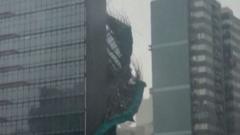
Urban vulnerability during severe convective meteorological events is fundamentally a function of aerodynamic drag, structural anchoring failure, and the spatial density of temporary construction infrastructure. When Typhoon Noul approached the South China Coast, bringing wind gusts exceeding 110 kilometers per hour to urban districts, it exposed the mechanical tolerances of high-rise temporary works. The structural failure of multi-story scaffolding along dense thoroughfares like Cheung Sha Wan Road offers a clear case study in how transient loads interact with permanent urban morphology. To understand why exterior temporary structures collapse under cyclonic forces, one must deconstruct the aerodynamic load function, the mechanics of anchorage fatigue, and the propagation velocity of localized structural shedding.
The primary driver of temporary structure failure during tropical cyclones is the amplification of dynamic pressure. As wind velocity increases, the force exerted on an object scales exponentially rather than linearly. The relationship is governed by the aerodynamic drag equation, where pressure is proportional to the square of the velocity multiplied by the drag coefficient and the surface area of the exposed structure. In the case of high-rise construction, scaffolding acts as an imperfect, porous bluff body. Outer rainbands and shifting pressure differentials create turbulent eddies that impose cyclic fatigue on vertical load-bearing standards and horizontal ledgers.
When Typhoon Noul's outer bands reached coastal districts, the wind profile shifted from steady-state boundary layer flow to erratic, high-frequency gusts. These gusts generate localized vortex shedding, a phenomenon where alternating low-pressure vortices detach from the sides of the structure. If the frequency of these vortices matches the natural frequency of the scaffolding assembly, resonance occurs. Eyewitness accounts detailing how a massive scaffolding frame shook for seconds before total structural uncoupling indicate a classic fluid-structure interaction failure. The kinetic energy transferred from the moving airmass simply exceeded the shear and tensile capacity of the wall ties anchoring the system to the reinforced concrete core of the host building.
Urban environments compound these mechanical forces through the Venturi effect. High-density urban corridors bounded by parallel high-rises compress oncoming wind vectors, accelerating local airflow beyond the ambient velocity recorded by regional weather observatories. A general regional wind speed of 80 kilometers per hour can accelerate significantly when funneling through street canyons. This localized amplification explains why structural shedding often occurs before the official issuance of peak warning signals, catching site operators mid-mitigation.
Mitigating high-rise temporary works failure requires shifting from a reactive protocol dependent on storm signal triggers to an anticipatory structural threshold model. Construction engineering management must incorporate wind-tunnel simulations calibrated for specific urban canyons rather than relying on flat-plane regional wind velocity charts. Furthermore, the installation of permeable mesh screens on scaffolding, designed to reduce dust and debris fallout during normal operations, frequently transforms temporary structures into solid sails during high-wind events. Project managers face a direct trade-off: minimizing environmental particulate dispersion increases the effective surface area, thereby maximizing wind load vulnerability.
Operational resilience in high-density typhoon zones demands a strict parameter for netting deflation and tier-by-tier dismantling once sustained wind thresholds cross critical engineering limits. Engineers must calculate the maximum allowable drag area per square meter of facade anchorage, treating temporary scaffolding not as an ad-hoc utility, but as a temporary high-drag building component requiring the same rigorous wind-tunnel verification as the permanent structure it encases.