Evaluating the transition of municipal leadership in Los Angeles requires stripping away the emotional sentiment of "guarded optimism" and replacing it with an operational audit of city governance. When voters or commentators express cautious hope regarding Nithya Raman assuming the role of Mayor of Los Angeles, they are implicitly acknowledging a massive gap between progressive policy ambition and the rigid, decentralized architecture of the Los Angeles City Charter. To understand the actual probability of success for a Raman administration, one must analyze the mechanics of executive authority in a weak-mayor system, the capital allocation bottlenecks in housing production, and the fiscal drag of municipal labor contracts.
The Structural Friction of the Weak-Mayor System
Public commentary surrounding Los Angeles mayoral transitions consistently overestimates the unilateral power of the office. Unlike New York City, where a strong-mayor framework centralizes budgetary and administrative control, Los Angeles operates under a hybrid system heavily skewed toward the 15-member City Council.
The Legislative Veto and Council District Autonomy
In Los Angeles, individual councilmembers operate as de facto executives within their respective geographic boundaries. Historically, the unwritten rule of "councilmanic prerogative" dictated that the full Council would defer to the local representative on all land-use, zoning, and street-level infrastructure decisions within their district.
For Nithya Raman—whose political ascent from Council District 4 was built on challenging entrenched real estate and status-quo governance norms—moving from one of 15 legislators to the chief executive alters her operational constraints entirely. As a councilmember, dissent is a viable political tool; as mayor, dissent without a legislative coalition results in policy paralysis.
- Budgetary Initiation vs. Appropriation: The mayor proposes the annual city budget, setting the initial strategic priorities. However, the City Council holds the power to amend, reallocate, and override mayoral vetoes with a two-thirds vote (10 members).
- Commission Appointments: The mayor appoints commissioners to critical oversight boards, such as the Board of Police Commissioners and the Department of Water and Power (LADWP). While this grants indirect regulatory influence, the confirmation process remains tethered to Council approval, creating an immediate bargaining cost for radical personnel shifts.
- Charter Reform Dependencies: Meaningful structural change—such as expanding the size of the City Council to dilute individual fiefdoms or stripping Council control over routine land-use appeals—cannot be achieved by executive order. It requires ballot measures approved by the electorate, a multi-year process vulnerable to well-funded opposition campaigns.
The "guarded" nature of any observer's optimism is rooted in this institutional reality. A progressive mandate at the ballot box does not automatically rewrite the procedural rules of City Hall.
Deconstructing the Housing and Homelessness Cost Function
The central metric by which any Los Angeles mayor is judged is the reduction of unsheltered homelessness and the stabilization of housing costs. Standard political discourse frames this as a question of compassion versus enforcement. From an operational standpoint, it is a supply-chain and capital-efficiency problem governed by strict economic constraints.
The Capital-to-Unit Conversion Bottleneck
Los Angeles has repeatedly demonstrated the capacity to raise capital for homelessness interventions, notably through Measures HHH and ULA. The failure point lies in the conversion of that capital into physical housing units.
- Land Acquisition and Soft Costs: High land values combined with lengthy environmental review processes (CEQA) and prevailing wage mandates drive per-unit construction costs for permanent supportive housing above $600,000, and frequently past $800,000. At this unit cost, public funds are mathematically incapable of scaling to meet a deficit of tens of thousands of units.
- The Sequencing Problem: Moving individuals from encampments into interim shelter without a functional exit pipeline to permanent housing creates a clogged system. When interim beds remain occupied for years rather than months, the marginal cost of street outreach spikes while visible street homelessness remains static.
- Regulatory Friction: Raman’s platform has historically emphasized tenant protections and the preservation of affordable stock. While rent stabilization and just-cause eviction ordinances prevent immediate displacement of existing tenants, economic theory dictates that strict price controls without corresponding supply-side deregulation reduce private capital inflow for new multifamily construction.
To outperform her predecessors, a Raman administration cannot rely solely on tenant-side interventions. It must aggressively compress the permitting timeline within the Department of Building and Safety (LADBS) and the Planning Department. If the executive branch cannot reduce the soft-cost overhead of building mid-rise infill housing by at least 20 to 30 percent through administrative streamlining, supply will remain artificially constrained regardless of executive rhetoric.
Fiscal Drag and Municipal Labor Dynamics
A comprehensive evaluation of a new administration must account for the city's balance sheet. Los Angeles faces a structural deficit driven by rising liability payouts, deferred infrastructure maintenance, and escalating personnel costs.
The Zero-Sum Budgetary Equation
Personnel expenditures—salaries, pensions, and healthcare—consume the vast majority of the city's General Fund. Multi-year labor agreements negotiated with the Los Angeles Police Protective League (LAPPL) and civilian unions like SEIU Local 721 lock in baseline spending increases that frequently outpace organic tax revenue growth.
- The LAPD Sworn Officer Paradox: Public safety remains a primary concern for Los Angeles voters. Raman’s past advocacy for reallocating funds from traditional policing toward unarmed crisis response models places her in direct tension with both the police union and moderate constituents. However, due to attrition and recruitment bottlenecks, LAPD staffing levels have already contracted naturally. The operational challenge is no longer about theoretical defunding; it is about managing response times and overtime expenditures with a smaller sworn force while scaling alternative response programs (such as CIRCLE) from pilot phases to citywide reliability.
- Liability Payouts: The city routinely pays out hundreds of millions of dollars annually in legal settlements stemming from police conduct and dangerous street conditions (e.g., broken sidewalks). These unplanned expenditures act as a direct tax on discretionary spending, cannibalizing funds intended for parks, sanitation, and housing initiatives.
Guarded optimism in this context reflects the tension between progressive spending priorities and austere fiscal realities. Without an unexpected surge in municipal tax receipts—such as transfer taxes, business taxes, or transient occupancy taxes—every dollar allocated to social infrastructure must be extracted from existing departmental baselines.
The Execution Gap: Bureaucratic Inertia vs. Executive Will
The defining failure mode of modern urban governance is not a lack of policy innovation, but an inability to execute basic municipal services at scale. Los Angeles suffers from severe bureaucratic fragmentation across dozens of semi-autonomous departments.
Siloed Operations and Information Asymmetry
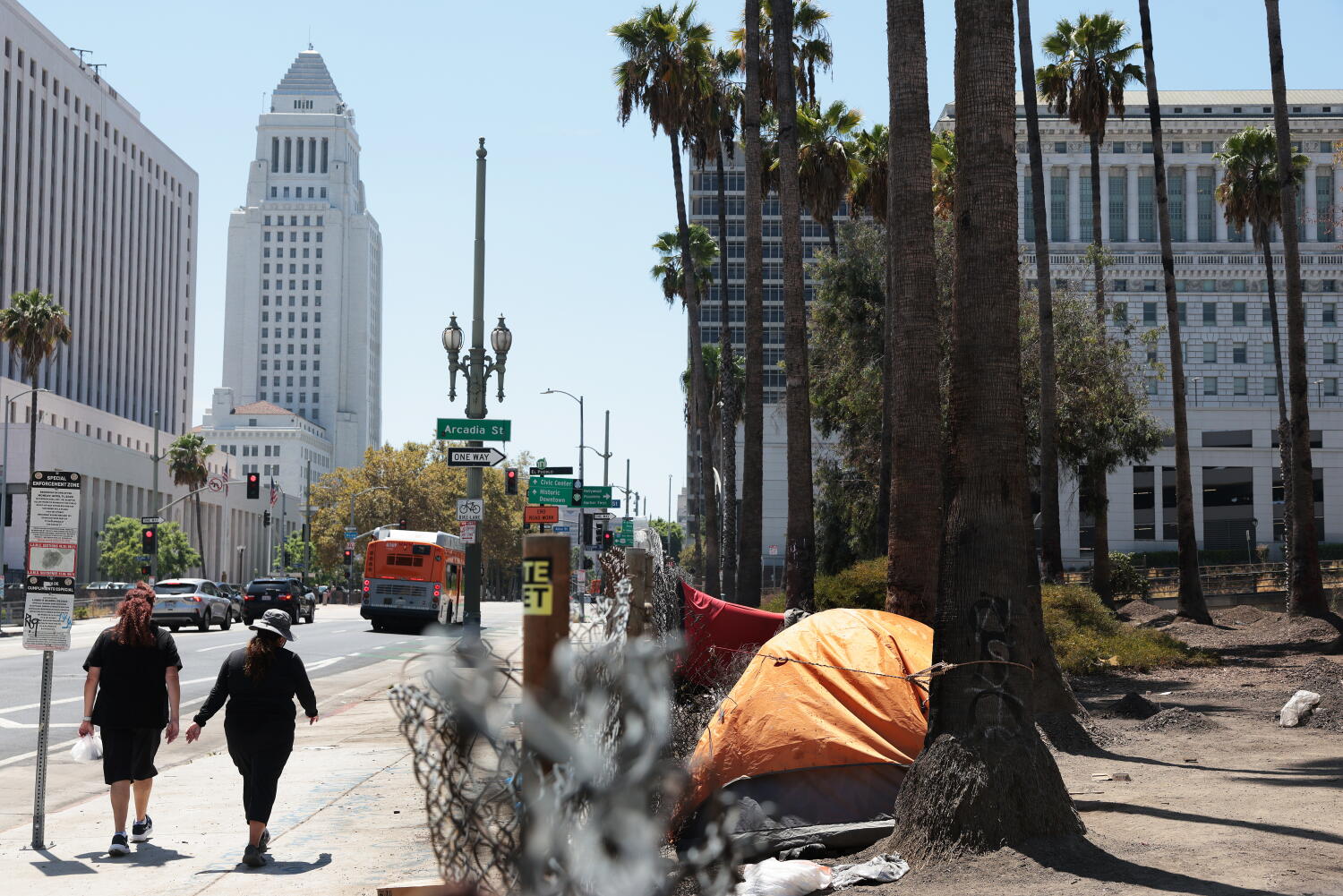
When a street-level issue arises—such as an encampment blocking a sidewalk adjacent to a broken streetlight and an overflowing storm drain—solving it requires coordination across the Los Angeles Homeless Services Authority (LAHSA), the Bureau of Sanitation (LASAN), the Bureau of Street Lighting, and the LAPD.
Currently, these entities operate with misaligned incentives, incompatible data systems, and distinct chains of command. LAHSA, being a joint powers authority shared between the City and County of Los Angeles, diffuses accountability even further. When metrics stall, city officials blame county health services, and county officials blame city zoning and shelter availability.
For a Raman administration to validate the optimism of its supporters, it must treat executive management as an exercise in systems integration. Issuing executive directives—such as Mayor Karen Bass’s Inside Safe initiative—provides temporary political momentum, yet executive orders do not permanently rewire civil service workflows. Civil servants protected by strong union rules outlast mayors; if middle management within LADBS, LASAN, and the Housing Department resists procedural changes, executive mandates will stall in committee and administrative review.
Operational Limitations of the Progressive Playbook
Objective analysis requires acknowledging the inherent trade-offs and limitations of the ideological framework Raman represents. No urban governance model is immune to second-order consequences.
- Capital Flight and Tax Sensitivity: Policies that heavily tax high-value real estate transactions (like Measure ULA) or increase regulatory burdens on commercial property owners can depress overall transaction volume. When transaction volume drops, total tax revenue collected can fall below projections, starving the very social programs the taxes were designed to fund.
- The Coalition Fragility: The political coalition that elects a progressive mayor in Los Angeles is heterogeneous. It includes ideological activists demanding immediate, uncompromising systemic overhauls alongside pragmatic homeowners and renters who primarily want clean sidewalks, functional transit, and predictable public safety. Governing inevitably forces choices that alienate one wing of this coalition. Prioritizing encampment clearances to appease neighborhood groups triggers backlash from unhoused advocates; refusing to clear encampments erodes general public confidence and invites recall threats or primary challenges.
- The Limits of Localism: Macroeconomic variables—interest rates set by the Federal Reserve, global supply chain costs for construction materials, and state-level insurance market contractions—exert far greater influence over Los Angeles housing affordability than any municipal ordinance. A mayor controls the local regulatory friction, not the macroeconomic environment.
The Strategic Imperative for the Incoming Administration
The transition from guarded optimism to measurable urban recovery depends entirely on how the administration deploys its political capital during its first 180 days. Broad ideological campaigns will fail against the structural inertia of the Los Angeles City Charter.
To succeed, the administration must execute a precise, three-part operational sequence:
- Centralize Housing Permitting Under Direct Executive Audit: Bypass piecemeal zoning reform by establishing a centralized, metrics-driven task force within the Mayor's Office with the authority to track and publicly report permitting bottlenecks across LADBS, Planning, and DWP. Make the reduction of total approval days for multifamily and supportive housing the primary performance metric for department general managers.
- Restructure LAHSA Accountability via Contractual Clawbacks: Rather than continuing to fund joint-powers bureaucracy without clear return on investment, tie municipal funding allocations to strict, auditable outcomes—specifically, the transition rate from interim shelter to permanent housing and the cost-per-placement—redirecting capital away from underperforming non-profit contractors toward direct municipal acquisition and master-leasing models.
- Establish a Data-Driven Alternative Response Standard: Move unarmed crisis response out of fragmented pilot programs by integrating it directly into the 911 dispatch triage system, using empirical response-time and call-resolution data to justify the reallocation of vacant LAPD sworn positions into specialized civilian response teams.
If the administration prioritizes bureaucratic throughput and measurable unit economics over rhetorical alignment, it will break the cycle of Los Angeles governance stagnation. If it treats the mayoralty as an extension of legislative advocacy, the structural constraints of the city will absorb its momentum within a single budget cycle.