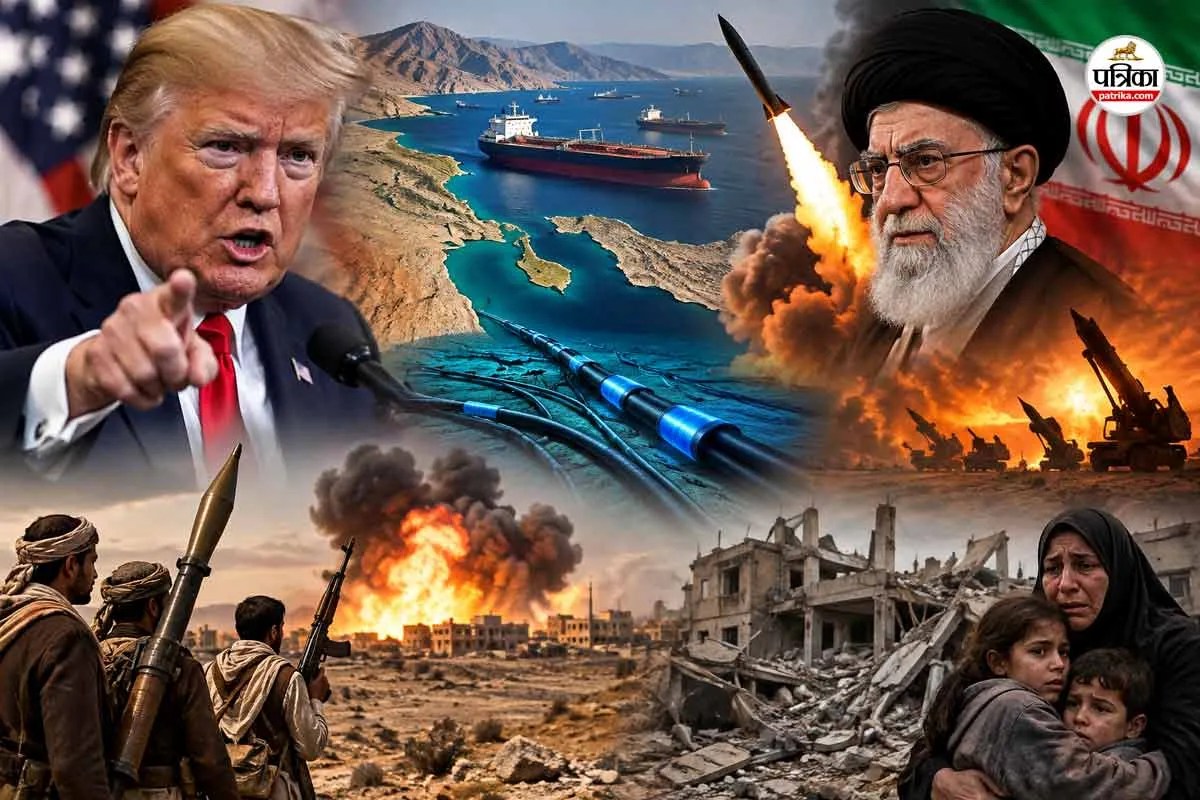
Headline news coverage of Middle Eastern escalation routinely treats maritime infrastructure threats, commercial shipping disruption, and fighting in Yemen and Gaza as parallel headlines rather than coupled operational systems. A rigorous strategic model requires separating known operational facts from educated hypotheses, mapping the physical choke points of submarine communications cables and maritime corridors, and tracing how strikes in Yemen and Gaza alter escalation incentives across the Gulf and Red Sea.
Deconstructing Headline Reporting and Rebuilding the Analytical Frame
Typical breaking-news reports on the Iran-United States confrontation group disparate developments—warnings regarding undersea fiber-optic cables, shipping hazards near maritime straits, and lethal strikes in Yemen and Gaza—into a single chronological feed. That structure creates a false equivalence between immediate kinetic casualties on the ground and contingent or asymmetric infrastructure threats at sea.
In October 2026, reporting indicated that senior Iranian security officials warned of plans to target undersea communications cables in the Gulf if hostilities with the United States and Israel resumed, alongside warnings regarding U.S.-linked data centers and artificial intelligence facilities in the region. Simultaneously, maritime security reporting highlighted heightened risks to commercial vessels in Gulf and Red Sea corridors, while reporting on Yemen and Gaza documented ongoing lethal strikes and severe humanitarian displacement.
To analyze these dynamics without conflating rumor, doctrine, and execution, three analytical pillars structure the problem:
- The Asymmetric Chokepoint Framework: Evaluating how geographically constrained sea lanes and undersea cable corridors multiply the strategic impact of low-signature or deniable actions compared to conventional naval engagements.
- The Repair-Time Cost Function: Measuring disruption not merely by physical severance, but by the operational, diplomatic, and security friction required to deploy specialized cable ships and restore capacity.
- The Multi-Theater Escalation Loop: Tracing how kinetic operations in Gaza and Yemen shift proxy posture, maritime risk tolerances, and state-level signaling without assuming a single centralized command chain.
Known Facts Versus Educated Hypotheses
A disciplined assessment separates verified public reporting and physical network mechanics from unconfirmed operational capabilities.
Known facts include the physical architecture of global telecommunications—where subsea fiber-optic cables carry the vast majority of intercontinental data traffic—and public warnings from Iranian officials regarding Gulf undersea cables and regional cloud or AI infrastructure in the event of renewed war. It is also a documented reality that commercial shipping in the Gulf and Red Sea faces persistent hazards, and that strikes in Gaza and Yemen continue to cause fatalities and mass displacement.
Educated hypotheses concern execution mechanics, timing, and cross-theater coordination. While analysts assess that cable strikes or maritime interdiction could impose outsized economic and operational friction, exact technical methods, target prioritization, and the degree of operational synchronization between state forces in Tehran and regional aligned actors such as the Houthis remain only partially visible in open sources. Treating a stated contingency plan as a guaranteed capability—or assuming that every strike in Gaza or Yemen automatically triggers a specific maritime cable attack—overstates what can be verified.
The Three Pillars of Maritime and Digital Chokepoint Risk
Maritime corridors and undersea cable routes intersect in narrow waterways where geography concentrates both commercial shipping and digital transit. Understanding why this intersection matters requires examining three distinct mechanisms rather than relying on broad generalizations about "cyber" or "naval" warfare.
Physical Concentration Versus Logical Redundancy
Undersea cables rely on physical glass fibers housed in protective armoring that varies by water depth and seabed composition. In shallow coastal approaches and narrow straits, cables sit closer to vessel traffic, anchoring zones, and seabed hazards than in deep ocean basins.
Network operators mitigate single-cable outages through diverse routing and capacity re-balancing, shifting traffic onto surviving subsea paths or terrestrial links when a segment goes dark. However, redundancy is an engineering property of paths, not a guarantee of equal latency or equivalent throughput. When multiple cables share a narrow geographic corridor—such as the Strait of Hormuz or key Red Sea transit lanes—a localized physical event can degrade multiple routes simultaneously.
Consider a regional enterprise or cloud workload relying on low-latency links between Gulf data hubs, Europe, and South Asia. Even if traffic fails over to an alternate route, rerouted packets may travel longer physical distances, encounter congestion on secondary links, or expose latency-sensitive financial, industrial, and cloud operations to degraded performance.
The Cost Function of Subsea Cable Repair
The true economic cost of a cable fault is governed less by the initial severance than by the time-to-repair under hostile or contested conditions. Restoring a damaged undersea cable is a specialized maritime engineering operation rather than a rapid software patch.
The cost function of repair depends on four operational variables:
- Vessel Availability and Positioning: Cable repair ships are scarce assets stationed in specific regions; transit time to the fault site sets a hard floor on recovery speed.
- Permitting and Jurisdiction: Operating inside territorial waters or exclusive economic zones requires coastal-state clearances and coordination with network consortia, which can stall in active crises.
- Station-Keeping Vulnerability: A repair ship grappling for a cable and splicing it on deck must hold position or move slowly, creating a predictable target profile if maritime threat levels are high.
- Threat Obstruction: Explicit warnings or active hazards against repair operations extend outage durations from days or weeks into prolonged operational uncertainty.
The second operational constraint in this function is insurance and force protection. Commercial or contracted repair crews will not operate inside an active engagement envelope without clear risk mitigation, turning a physical break into a diplomatic and security standoff.
Maritime Shipping Pressure Without Full Closure
Naval analysts frequently frame Gulf and Red Sea escalation around a binary question: whether a strait is open or closed. In practice, sustained friction often operates below full closure by raising transaction costs rather than imposing a total blockade.
Targeting vessel propulsion or engine rooms, deploying mines or unmanned surface and aerial systems, and issuing exclusion warnings raise hull and war-risk insurance premiums, force rerouting or speed reductions, and slow transit schedules. Even without halting every ship, elevated risk compresses margins across energy, manufacturing, and container supply chains.
Cause-and-Effect Chains Across Yemen, Gaza, and Maritime Corridors
Articles linking the Iran-U.S. confrontation to maritime communications threats and lethal strikes in Yemen and Gaza often imply a direct domino sequence. A clearer analytical model maps causal pathways alongside friction points that can accelerate or dampen escalation.
How Ground Escalation in Gaza and Yemen Shifts Maritime Risk
Lethal strikes in Gaza and Yemen operate directly on human populations, local governance, and regional political legitimacy, while also reshaping how regional actors calibrate deterrence elsewhere. In Yemen, intensified conflict and large-scale displacement interact with Houthi maritime operations in the Red Sea and adjacent waters, where anti-ship campaigns and rhetoric around infrastructure threats raise the stakes for regional states and global shipping.
When fighting escalates in Gaza or Yemen, three causal mechanisms tend to activate across maritime theaters:
- Deterrence Signaling: Actors facing pressure or seeking to impose costs on adversaries and their regional partners look for asymmetric levers in maritime domains where attribution can be contested or costs can be distributed across third-party commerce.
- Coalition and Force Strain: Naval air-defense interceptors, intelligence surveillance platforms, and diplomatic bandwidth expended responding to strikes and maritime threats in one corridor reduce slack capacity across the wider region.
- Economic Spillover: Sustained instability in Yemen and maritime corridors increases fiscal and trade pressure on neighboring Gulf economies, altering their risk calculus toward de-escalation or defensive hardening.
Why Parallel Headlines Do Not Equal Single-Command Execution
A critical analytical error is assuming that simultaneous events in Gaza, Yemen, and Gulf cable warnings reflect a single master timetable. Operational realities on the ground in Gaza involve distinct tactical dynamics, local command structures, and immediate humanitarian impacts that do not map one-to-one onto subsea cable planning in the Gulf.
Similarly, while open-source reporting points to discussions or allegations regarding coordination between Tehran and aligned groups on maritime or cable risks, independent operational incentives also matter. Regional actors pursue domestic political standing, local territorial or military objectives, and autonomous escalation thresholds. Misreading parallel headlines as unified execution risks both over-interpreting routine rhetoric and underestimating sudden, localized flare-ups.
Operational Playbook for Infrastructure and Risk Leaders
Organizations exposed to Middle Eastern maritime corridors, Gulf digital hubs, or supply chains linked to Red Sea and Gulf transit cannot rely on generic crisis monitoring. A practical risk-management sequence focuses on concrete dependencies before an outage occurs.
Step 1: Map Physical Dependencies Beyond Carrier Labels
Inventory every critical application, payment flow, cloud region, and logistics route touching the Gulf, Red Sea, or Eastern Mediterranean. Identify the physical cable systems and terrestrial backhaul paths underlying those circuits rather than relying solely on primary carrier contracts, and flag workloads sensitive to latency spikes or packet loss during rerouting.
Step 2: Stress-Test Failover and Repair Windows
Run tabletop and technical failover exercises assuming a multi-link degradation in a single maritime corridor lasting days rather than minutes. Test whether terrestrial routes, alternative subsea paths, or satellite links can absorb peak traffic without degrading authentication, industrial telemetry, or financial settlement, and model what happens if cable repair vessels face access delays.
Step 3: Separate Kinetic Headlines From Operational Triggers
Establish explicit escalation thresholds tied to verified infrastructure telemetry—such as BGP route shifts, optical power-loss alarms, war-risk advisory changes, and confirmed maritime incidents—rather than reacting to unverified social media claims or broad diplomatic rhetoric. Align communications with regional teams and customers so status updates reflect measured service impact rather than speculation.
Limitations of These Measures
No technical or operational control eliminates exposure entirely. Rerouted network traffic can face capacity bottlenecks on secondary corridors, satellite capacity has bandwidth and latency constraints compared to high-capacity fiber, and physical strikes on coastal landing stations or regional data facilities can affect infrastructure regardless of offshore cable routing. Likewise, commercial shipping and supply chains cannot bypass geography without paying higher freight, insurance, or transit-time costs.
Strategic Play for Navigating Prolonged Multi-Theater Friction
Treat maritime communications resilience, Gulf cloud and transit exposure, and kinetic escalation in Gaza and Yemen as an enduring multi-year operating environment rather than a brief news cycle. The decisive strategic move for enterprise and policy leaders is to engineer graceful degradation across both digital and physical supply chains—pre-allocating diverse routing capacity, hardening regional service architectures against single-corridor chokepoints, and calibrating operational posture to verified infrastructure telemetry so that localized shocks do not cascade into systemic failure.
Iran warns of Gulf undersea cable attacks if war resumes coverage
This video directly addresses the warnings around Gulf undersea communications cables and regional escalation near the Strait of Hormuz examined in the analysis.