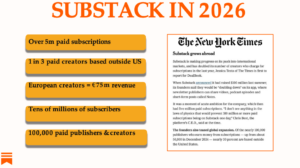
Traditional media organizations are quietly moving their top talent onto newsletter platforms to recapture audiences that have abandoned standard news sites. This shift is not about experimenting with a new format. It is a desperate bid to reclaim the direct reader relationship that social media algorithms dismantled over the last decade. By using newsletter ecosystems, publishers are trying to bypass the tech giants that controlled their distribution for years, turning casual website visitors into dedicated subscribers.
The media industry is bleeding out, and everyone in it knows why. For years, major publishers relied on a flawed bargain. They handed over their distribution to social media platforms, hoping for traffic. Instead, they got algorithmic whiplash. Recently making news recently: Naval Surface Radar Procurement Economics and the Saab Multi-System Acquisition.
When those platforms changed their code, traffic collapsed.
Now, publishers are realizing that the only audience that matters is the one they own directly. Enter the subscription newsletter model. What started as a haven for independent journalists has become the latest corporate survival strategy. More details into this topic are covered by The Next Web.
The Illusion of the Owned Audience
Publishers used to think their homepages were their castles. They were wrong. As social platforms choked off external links, media companies saw their referral traffic plummet. The rush to newsletters is an admission of defeat in the open web race.
When a reader lands on a standard news site, they are a ghost. They click an article, skim it, and leave. The publisher learns almost nothing about them. A newsletter changes the power dynamic completely. An email address is a permanent digital passport. It allows a media brand to land directly in a user’s inbox, free from the whims of a third-party algorithm.
But this transition is exposing a deep structural flaw within legacy newsrooms. For decades, media companies built brands around the masthead. They expected readers to be loyal to the publication itself. The subscription era has proven that audiences are loyal to individuals, not corporations.
The Talent Trap and the Creator Dilemma
This reality creates a dangerous paradox for media executives. To make a newsletter successful, a publisher must elevate an individual voice. They need a writer with a distinct point of view, a sharp tone, and a personal connection with the readership.
Yet, the moment a writer becomes that valuable, they realize they might not need the publisher anymore.
The economics of the newsletter market make independent operations incredibly attractive. A high-profile journalist with a loyal following can launch their own solo venture and keep a massive percentage of the subscription revenue. Legacy outlets are essentially funding the incubation of creators who may eventually outgrow them.
To combat this, savvy media companies are restructuring their contracts. They are offering writers revenue-share models, intellectual property ownership, and editorial freedom that would have been unthinkable a generation ago. It is a fragile compromise. The publisher provides legal backing, editing resources, and marketing muscle. The writer provides the human connection that keeps subscribers paying month after month.
Data Control Over Banner Ads
The financial engine behind this shift is fundamentally different from the old media playbook. The programmatic advertising model is dying. Intrusive banner ads and auto-playing videos have alienated readers and yield fractions of a cent per view.
Newsletters offer two distinct financial lifelines: high-value sponsorships and direct subscriptions.
Traditional Web Model:
Mass Traffic -> Low-Value Programmatic Ads -> High Churn

Newsletter Model:
Direct Inbox Access -> First-Party Data -> Premium Sponsorships & Subscriptions
Advertisers are tired of buying blind ad space through tech networks. They want targeted, attentive audiences. A newsletter dedicated to a specific niche offers exactly that. When a reader opens an email every morning, they show a level of intent that a random web surfer never replicates. Publishers can sell these slots at a premium because the engagement is measurable and real.
More importantly, newsletters generate clean, first-party data. Publishers know exactly who is opening the email, what links they click, and how long they stay engaged. In a world where privacy regulations are killing third-party tracking cookies, this data is gold. It allows media companies to build highly detailed user profiles, which can then be used to market other products, from events to premium paid tiers.
The Growth Engine Within the Network
The real secret weapon of modern newsletter platforms is not the email delivery system. It is the built-in recommendation engine.
When a user signs up for one newsletter, the platform immediately suggests other, similar publications. This creates a powerful network effect. Publishers are joining these ecosystems because it allows them to poach readers from other writers effortlessly.
The Illusion of Free Scale
It sounds perfect on paper. In reality, it introduces a new form of platform dependency. Media companies are fleeing the algorithms of social giants only to hook themselves to the recommendation engines of newsletter tech. If a platform decides to alter how its recommendation network functions, a publisher’s growth trajectory can flatten overnight.
The Content Overload Problem
There is also a strict limit to human attention. A person might visit fifty websites a week, but they will not read fifty newsletters a day. The inbox is a sacred, stressful space. It is where people receive work emails, bills, and urgent messages from family.
When a publisher enters that space, they are competing with a reader's actual life. The moment a newsletter becomes boring, repetitive, or too frequent, it gets deleted. Worse, the reader hits unsubscribe.
Operational Realities of the Email Shift
Managing an enterprise-grade newsletter operation requires entirely different infrastructure than running a traditional content management system. Editorial workflows must adapt to a format that cannot be edited once it is sent. A typo on a webpage can be fixed in seconds. A typo sent to half a million inboxes is permanent.
This requires rigorous quality control processes that many fast-paced digital newsrooms are not built to handle. It also demands a deep understanding of email deliverability. If a publisher sends too many emails that get marked as spam, internet service providers will blacklist their entire domain. Suddenly, the direct line to the audience vanishes.
The most successful media companies are treating newsletters as distinct products rather than just automated RSS feeds of their website content. They are hiring dedicated product managers, data analysts, and email strategists. It turns out that sending mail is a highly technical discipline.
The Subscription Ceiling
The ultimate test for this strategy is the wallet capacity of the average reader. We are approaching a point of subscription fatigue. Between streaming services, software utilities, and news sites, consumers are looking closely at their monthly credit card statements.
A reader might pay for one or two general news sources and maybe one hyper-specific industry newsletter. They will not pay for five different media newsletters. The competition for that paid slot is brutal.
This means the current gold rush will inevitably face a consolidation phase. Outlets that rushed into the space without a clear, differentiated voice will find their subscription numbers stalling. The platforms will remain, but the corporate gold rush will clear out the tourist publications, leaving only the creators who actually understand how to talk to human beings without sounding like a corporate press release.
Publishers cannot fix a broken business model merely by changing the delivery mechanism. If the journalism is weak, moving it from a webpage to an inbox will not save it. The email format forces honesty. You are either worth a reader's time, or you are clutter.