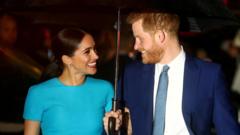
The narrative surrounding Prince Harry and Meghan Markle has long been fueled by the friction between global exposure and the pursuit of privacy. This week, that tension manifests in a definitive change of scenery. After six years in California, the Duke and Duchess of Sussex are relocating their family to the United Kingdom. This move is not a return to the public stage of royal duty, nor is it a surrender to the life they fled in 2020. Instead, it represents a calculated recalibration of their existence, moving away from the high-stakes celebrity environment of Montecito toward a quieter, more insulated life in the British countryside.
For the casual observer, the announcement might appear as a reversal of their departure. Beneath the surface, however, the logistics suggest a deliberate attempt to manage public perception while prioritizing domestic stability. They remain non-working royals, a status that preserves their autonomy while keeping them outside the orbit of official Windsor functions. The children, Prince Archie and Princess Lilibet, are set to begin school in Britain this September. This decision effectively grounds the family in the UK, signaling that their relocation is intended as a long-term adjustment rather than a fleeting retreat.
The question of security has been the shadow cast over every potential visit since the couple stepped back from their roles. Harry’s protracted legal battles against the UK government regarding his eligibility for state-funded protection have been well-documented and ultimately unsuccessful. By choosing to settle in a private residence—not a royal property—the Sussexes are bypassing the immediate logistical headaches of occupying palace-adjacent grounds. They are, for all intents and purposes, opting for the profile of private citizens who happen to carry the weight of global fame.
Financial realities also frame this move. The couple’s transition to the private sector has been met with mixed results. While Harry’s memoir reached massive commercial success, other media ventures encountered significant obstacles. The end of their podcast partnership and the discontinuation of Meghan’s lifestyle series on Netflix indicate that the gold rush of content creation has cooled significantly. In the demanding economy of American celebrity, maintaining the level of visibility required to sustain their previous momentum often proved as exhausting as it was profitable. Returning to the UK allows them to shift their focus from the volatility of Hollywood production back toward the quiet work of their charitable foundations, specifically the Invictus Games scheduled for Birmingham in 2027.
Public sentiment in Britain remains complex. Polls indicate that the Prince and Princess of Wales retain high favorability, while the Sussexes continue to navigate a deeply polarized reception. Moving back does not erase the friction caused by past interviews or legal disputes, but it does alter the nature of the engagement. As private residents, their interactions with the broader public will likely be reduced to controlled, high-level appearances. This scarcity of exposure could, over time, act as a stabilizing agent, potentially softening the adversarial dynamic that has defined their relationship with the national press for years.
The King’s reaction to this relocation adds another layer to the shifting royal dynamic. While he was reportedly informed of the move only days before it became public, the prospect of having his grandchildren closer offers a tangible bridge to reconciliation. Private family time, removed from the scrutiny of the working royal schedule, provides a neutral ground that was impossible to maintain in the chaos of their initial exit. It is a fragile bridge, however. The legal bills stemming from Harry’s recent failed litigation against tabloid publishers remain a substantial financial and emotional burden, ensuring that his relationship with the British media will remain litigious and wary even from within the borders of the country.
One must consider the possibility that this move is less about a total retreat and more about managing the inevitable decline of their novelty. Celebrity is a finite resource. When it is exhausted, the most effective survival strategy is often a transition into a more durable, less volatile form of existence. By settling into the British countryside, Harry and Meghan are essentially trading the unpredictability of a California-based media empire for the predictability of a life defined by proximity to the throne, yet shielded by the walls of a private home.
There is no guarantee that this experiment will succeed without further turbulence. If the public and the press continue to treat the couple as representatives of an institution they have effectively left, the cycle of grievance and counter-narrative will likely persist. Privacy is rarely granted to those who have built a brand on its opposite. Yet, by rooting themselves in a setting where they are no longer the primary protagonists of the daily news cycle, they have engineered their best chance to redefine their purpose on their own terms.
The transition remains a high-wire act. They have secured a home, enrolled their children, and signaled a departure from the intense, commercialized pace of their US residency. Whether this brings the desired tranquility or simply shifts the venue of their conflict depends entirely on how they manage the quiet. The spectacle is over, and now begins the far more difficult work of maintaining a life that, for the first time in six years, is not being performed for an audience.