The global industrial order is currently defined by a paradox of aggressive decoupling and forced architectural integration. While the Trump administration maneuvers through a "managed trade" doctrine, Chinese technological entities are fundamentally resetting the unit economics of intelligence and mobility. This is not a cyclical cooling of relations but a structural re-ordering of three critical verticals: diplomatic gatekeeping, the compute-cost curve of artificial intelligence, and the consolidation of the New Energy Vehicle (NEV) market.
The Daines Pre-Positioning: Strategic Pathfinding for the May Summit
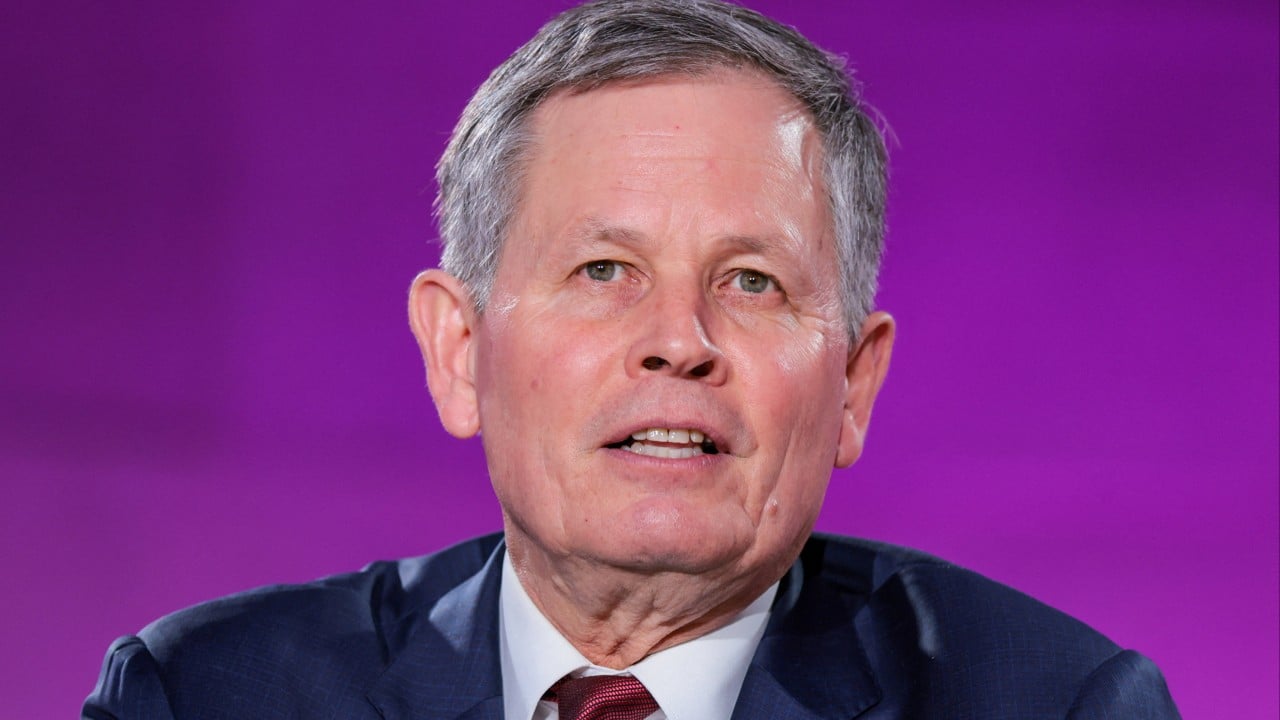
The upcoming visit of Senator Steve Daines to Shanghai and Beijing on May 1, 2026, serves as a high-stakes reconnaissance mission. Daines operates as the "China whisperer" within the Trump orbit—a role bolstered by his historical tenure as an executive in China. His primary objective is to pressure-test Chinese concessions ahead of the Trump-Xi summit scheduled for mid-May.
The logic of this visit follows a Dual-Track Diplomacy Framework:
- Verification of "Managed Trade" Compliance: Daines is tasked with auditing China’s willingness to sustain the 32% reduction in the U.S. goods trade deficit observed in 2025. This involves securing commitments on agricultural imports (notably American beef) while simultaneously upholding the 145% tariff baseline on critical electronics.
- Technological Benchmarking: By touring China’s "innovation ecosystem" and utilizing the high-speed rail network, the delegation aims to quantify the widening infrastructure gap. This creates a feedback loop for the White House Office of Science and Technology Policy (OSTP), which recently labeled Chinese access to frontier AI as a primary national security threat.
The risk remains that Trump’s transactional style—bartering Taiwan weapons sales for trade concessions—erodes the long-term consistency required to manage a peer competitor. This inconsistency creates a Credibility Discount, where Beijing anticipates that any aggressive U.S. policy can be neutralized through tactical, short-term economic offerings.
DeepSeek V4 and the Erosion of the Compute Moat
The release of DeepSeek V4 (Pro and Flash) on April 24, 2026, represents a definitive break from the "brute force" scaling laws that have defined Western AI development. By optimizing for non-Nvidia hardware—specifically the Huawei Ascend infrastructure—DeepSeek has achieved a competitive frontier model (1.6 trillion parameters) at a fraction of the traditional training cost.
The Efficiency Stack: Three Core Innovations
The V4 architecture succeeds by solving the Memory-Compute Bottleneck through three specific mechanisms:
- Compressed Sparse Attention (CSA): Standard Transformers suffer from quadratic scaling in memory requirements as context windows grow. CSA reduces the KV cache to 10% of its previous size, enabling a 1-million-token context window that is economically viable for enterprise-scale document retrieval.
- Manifold-Constrained Hyper-Connections (mHC): To prevent training divergence at the 1.6T parameter scale, DeepSeek constrained residual connections to the Birkhoff Polytope. This mathematical stabilizer limited signal amplification to 1.6x (down from 3,000x in early tests), allowing for stable convergence across 33 trillion tokens.
- The Muon Optimizer: By replacing standard AdamW with Muon, the training team achieved faster convergence, effectively "de-risking" the training run against the gradient collapse common in massive Mixture-of-Experts (MoE) models.
The economic result is a 97% cost reduction compared to Western models like GPT-5.4. While GPT-5.4 maintains a marginal lead in complex mathematical reasoning and real-world factual recall, the V4 Pro’s $0.28 per million tokens pricing creates an "Economic Reset." For developers, the choice shifts from "highest possible intelligence" to "sufficient intelligence at massive scale."
NEV Market Consolidation: The End of the Price War?
The Chinese EV market is transitioning from a period of hyper-competitive fragmentation to a "Survivor’s Consolidation." While BYD maintains its dominance through vertical integration—holding a 17% global share of the battery market via its FinDreams subsidiary—the broader sector is grappling with the Diminishing Returns of Price Cutting.
The Shift from Pricing to Premium Features
In Q1 2026, we observed a strategic pivot among Tier-1 manufacturers (Nio, Li Auto, and Xiaomi) away from the 2025 price wars. The new battleground is defined by:
- Extended-Life Infrastructure: Nio and CATL’s partnership on 15-year batteries targets the secondary market's greatest fear: residual value collapse.
- Intelligence as a Differentiator: Tesla’s recent data-security clearance in China, following Elon Musk’s April visit, has allowed for the rollout of Full Self-Driving (FSD). This has forced domestic rivals like Xpeng to accelerate their "smart driving" features to avoid being commoditized.
- Managed Global Expansion: With the EU-China tariff consensus setting price floors, Chinese manufacturers are being forced to compete on brand reputation and technological sophistication rather than raw subsidy-driven pricing.
Strategic Forecast: The Bifurcated Value Chain
The convergence of these events suggests a global economy that is not "de-coupling" so much as it is "re-platforming."
The second half of 2026 will be characterized by the Architectural Divergence of the East and West. The U.S. will likely double down on high-margin, proprietary "Black Box" AI and premium hardware, while China builds the global "Intelligence Utility"—cheap, efficient, and deeply integrated into the physical world (EVs, rail, and manufacturing).
For global enterprises, the strategic imperative is no longer to pick a side, but to build for Dual-Stack Interoperability. You must develop software that is model-agnostic to leverage DeepSeek’s cost advantages while maintaining compliance with U.S.-led security protocols. The "moat" has shifted from having the most data to having the most efficient inference architecture.
Immediate action requires auditing all internal AI workflows for "Token Waste." If you are paying GPT-5.4 prices for 1M-token context windows that V4 Pro can handle for 3% of the cost, your operating margin is a sitting target. Focus on the Inference-to-Revenue Ratio; in 2026, efficiency is the only sustainable form of alpha.