A young programmer in Phnom Penh sits at a desk that wobbles whenever the city's heavy afternoon rain hits the tin roof. Her name is Sophy. She is brilliant, self-taught, and entirely locked out.
Every time she tries to access the premier proprietary artificial intelligence models engineered in Silicon Valley, she is met with a digital wall. Her credit card is from the wrong country. Her IP address is flagged. The advanced tools that could help her optimize agricultural yields for her family's failing rice farm are treated like munitions, locked behind the high, glossy walls of a geopolitical fortress.
To Sophy, the grand debates about technology in Washington and Brussels do not sound like ethical stewardship. They sound like a velvet rope.
This is the silent friction of the modern world. While a handful of wealthy nations debate how to lock down the future to keep it safe, the rest of the planet is left asking a simpler, more desperate question: Safe for whom?
The Shanghai Alternative
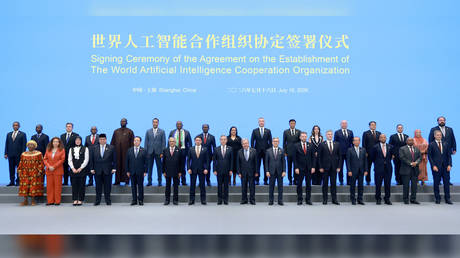
Under the soaring ceilings of the World Artificial Intelligence Conference in Shanghai, Chinese President Xi Jinping stepped to the podium to offer a different script.
He spoke of a "symphony."
It is a clever piece of theater, but one that plays to a deeply receptive audience. Xi stood before leaders from Kazakhstan, Cambodia, Thailand, and the United Nations, presenting China not as a distant hegemon, but as the partner that will hand over the keys to the kingdom.
Consider the mechanics of the offer. Over the next five years, Beijing is promising 5,000 training opportunities on artificial intelligence to developing nations. It is pledging to open the doors of its laboratories to thirty countries in the Global South. This is not just philanthropy; it is a calculated, structural realignment of global technological dependence.
By framing American-led export controls and security restrictions as "overstretching the concept of national security," China is positioning itself as the champion of the locked-out.
The strategy is brilliant because it leverages a real, raw frustration. For a country in Southeast Asia or the African Union, the American approach to AI feels like a "Pax Silica"—a peace maintained by keeping everyone else too weak to fight. When the United States limits access to cutting-edge chips and proprietary systems, it expects the world to understand that it is doing so to prevent catastrophe.
But from a desk in Phnom Penh, or an office in Nairobi, that restriction looks less like safety and more like a brand-new flavor of historical injustice.
The Illusion of the Vault
There is a fundamental tension at the heart of the code.
To the engineers in San Francisco, an AI model is a dangerous spark that must be contained inside a secure vault. They believe that if the weights of these massive neural networks are leaked or shared too freely, they will be weaponized by bad actors to build cyber-weapons or disrupt financial markets.
To China, however, the vault itself is the weapon.
In Shanghai, Xi championed open-source technology as a global public good. The message was clear: China will help you build your own systems, rather than forcing you to rent them from a handful of monopoly corporations in California.
Just hours before Xi spoke, a Beijing-based startup called Moonshot AI unveiled Kimi K3, currently the world’s largest open-weight AI model. It was a pointed, physical manifestation of the Chinese argument. While American companies are pulling back behind proprietary walls, China is releasing massive, highly capable models into the wild, inviting the rest of the world to build on their foundations.
But this generosity is not without its own gravity.
When a developing nation adopts Chinese open-source architectures, integrates Chinese cloud infrastructure, and trains its public servants in Beijing, it is not merely adopting a tool. It is adopting an ecosystem. It is signing up for a digital silk road where the underlying standards, the security protocols, and the very definitions of truth are quietly calibrated in Beijing.
The Real Stakes of the Symphony
It is easy to get lost in the high-stakes chess match between Washington and Beijing. But the real story is not happening in the White House or the Great Hall of the People.
The real story is happening in the places that have been ignored.
For decades, the developing world has been told to wait. Wait for the infrastructure to trickle down. Wait for the legacy systems to become affordable. With artificial intelligence, there is a collective refusal to wait. These nations see a technology that can leapfrog generations of development—systems that can diagnose diseases in rural clinics without doctors, optimize power grids in cities with crumbling infrastructure, and translate languages instantly to bridge ancient divides.
If the West offers them nothing but warnings and restrictions, they will go where the doors are open.
This is the vulnerability that China is counting on. It is a soft-power play of unprecedented scale. By offering training, access, and open code, Beijing is building a coalition of the willing. They are constructing an international bloc that will eventually vote on global standards, adopt Chinese security frameworks, and cement a technological alliance that could last for the next century.
But we must also look closely at the fine print of this Chinese partnership.
Xi spoke of keeping AI systems under human control and establishing early-warning systems to manage risks. It is a rare admission of vulnerability from a leader who usually projects absolute control. Even as Beijing pitches itself as the open partner to the world, it is deeply terrified of the chaos that unregulated, untamed algorithms could unleash within its own borders.
The tension is clear. China wants to lead the global rules-making body, but it also wants to keep its own domestic internet tightly inside a digital cage. It is a paradox that many developing nations, particularly those with their own authoritarian tendencies, find deeply appealing rather than hypocritical.
The Final Chord
The rain in Phnom Penh eventually stops. Sophy turns back to her screen.
She has found an open-source model, built on a foundation released by a Chinese tech giant, adapted by a developer in Singapore, and hosted on a regional server. It isn't perfect. It lacks some of the polished, intuitive brilliance of the locked-up Western models. But it is here. It is free. And it works.
As she begins to write her code, she is not thinking about the geopolitical chessboard. She is not thinking about the South China Sea, or export controls, or the balance of power in Asia. She is simply trying to solve a problem.
But with every line of code she writes, with every query she sends into that network, she is quietly, unconsciously voting on the future of human governance. And she is voting for the hand that was reached out to her, while the other hand was busy pulling up the drawbridge.