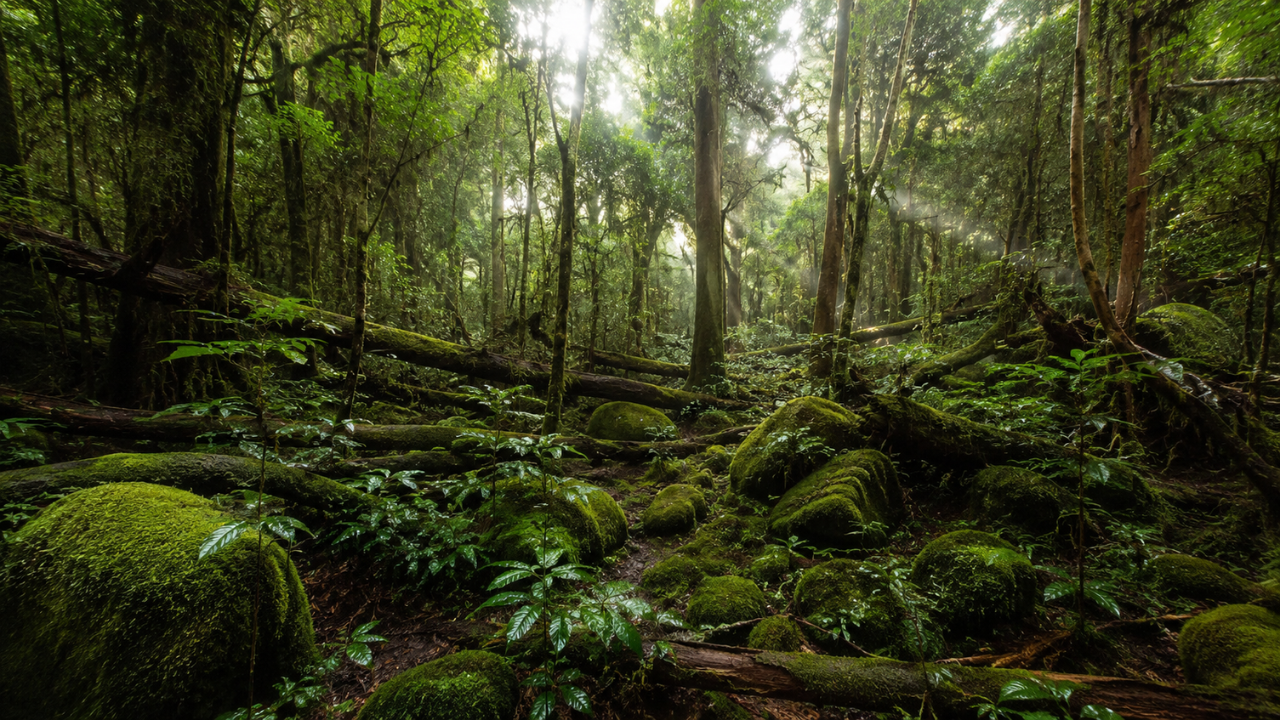
You wouldn't expect an island the size of Switzerland to hide living columns taller than a 25-story building. Yet, deep inside Taiwan’s rugged interior, a hidden forest contains some of the most colossal trees in East Asia. For years, these ancient giants remained practically invisible, shielded by sheer cliffs, deep valleys, and a landscape so vertical it breaks modern mapping tools.
An interdisciplinary group known as the Taiwan Tree Seekers spent a decade changing that. Bringing together professional tree climbers, ecologists, geologists, and remote sensing specialists, they tracked down the island's botanical royalty. Their efforts culminated in the verification of an 84.1-meter-tall (276-foot) Taiwania fir (Taiwania cryptomerioides) named the "Heaven Sword," currently crowned the tallest tree in East Asia.
The Geography Behind the Giants
Why do trees grow so massive here? It comes down to a freak combination of intense topography and heavy moisture. Although Taiwan covers just 36,000 square kilometers, it boasts 258 peaks rising above 3,000 meters. This extreme elevation change creates a stack of distinct climate zones, ranging from humid tropical environments to alpine cold.
Roughly 60 percent of the island remains forested, holding an estimated 950 million trees. While historical industrial logging heavily stripped lower-altitude primary forests between 1912 and 1991, the steepness of the high mountains acted as a natural shield. Logging crews simply couldn't reach the deepest ravines. In these protected pockets, ancient conifers survived for centuries, undisturbed by human expansion.
Indigenous Rukai communities have long called these immense specimens "the tree that hits the moon". Botanists view them as living relics of an earlier geological era, with ancestry stretching back over 100 million years.
How Scientists Found a Lost World
Finding a tree taller than 80 meters in a dense, multi-layered canopy sounds easy with modern technology, but the reality on the ground is messy. The research team, led by Dr. Rebecca Chia-Chun Hsu from the Taiwan Forestry Research Institute, initially used airborne LiDAR to scan the landscape. Laser pulses fired from aircraft mapped out 57,065 candidate trees across the island.
That is when things got complicated. Steep mountain cliffs created rampant false positives. A modest 25-meter tree sitting on the edge of a sheer precipice often registered as a 90-meter monster because the laser measured the distance to the canyon floor below.
To sift through tens of thousands of data points, the team enlisted 372 online citizen science volunteers to examine profile images manually, narrowing the list down to 4,736 serious targets. Ground expeditions required days of grueling hiking through remote wilderness, carrying heavy gear near sacred locations like Great Ghost Lake.
When professional climbers finally scaled the champions, they dropped tape measures straight from the crown to verify heights. Standing at the top of a Taiwania fir reveals a micro-ecosystem. Branches grow nearly as thick as the trunks of ordinary trees, cushioned by heavy humidity and thick blankets of epiphytes.
Why These Forests Matter for the Planet
These old-growth stands do more than look impressive. They function as absolute vaults for carbon storage. Forests with the tallest trees consistently hold massive aboveground carbon stocks, sequestering greenhouse gases that would otherwise warm the atmosphere. A single giant tree handles a disproportionate share of environmental stabilization compared to an entire stand of mid-sized replacements.
Despite growing in remote zones, these ecosystems face mounting pressures. Climate change is pushing cloud bases higher up the mountains, starving cloud forests of the exact moisture they need to thrive. At the same time, regional typhoon intensity has jumped significantly over recent decades, triggering destructive floods and landslides in the steep river valleys where these giants live. Field researchers have also documented illegal poaching of old-growth timber, proving that official protected status alone isn't enough without active human oversight.
Protecting these landscapes requires continued field mapping and robust community engagement. If you want to support or track modern ecological conservation efforts, start by following institutions like the Taiwan Forestry Research Institute or supporting global old-growth mapping initiatives that use open-access geographical data.