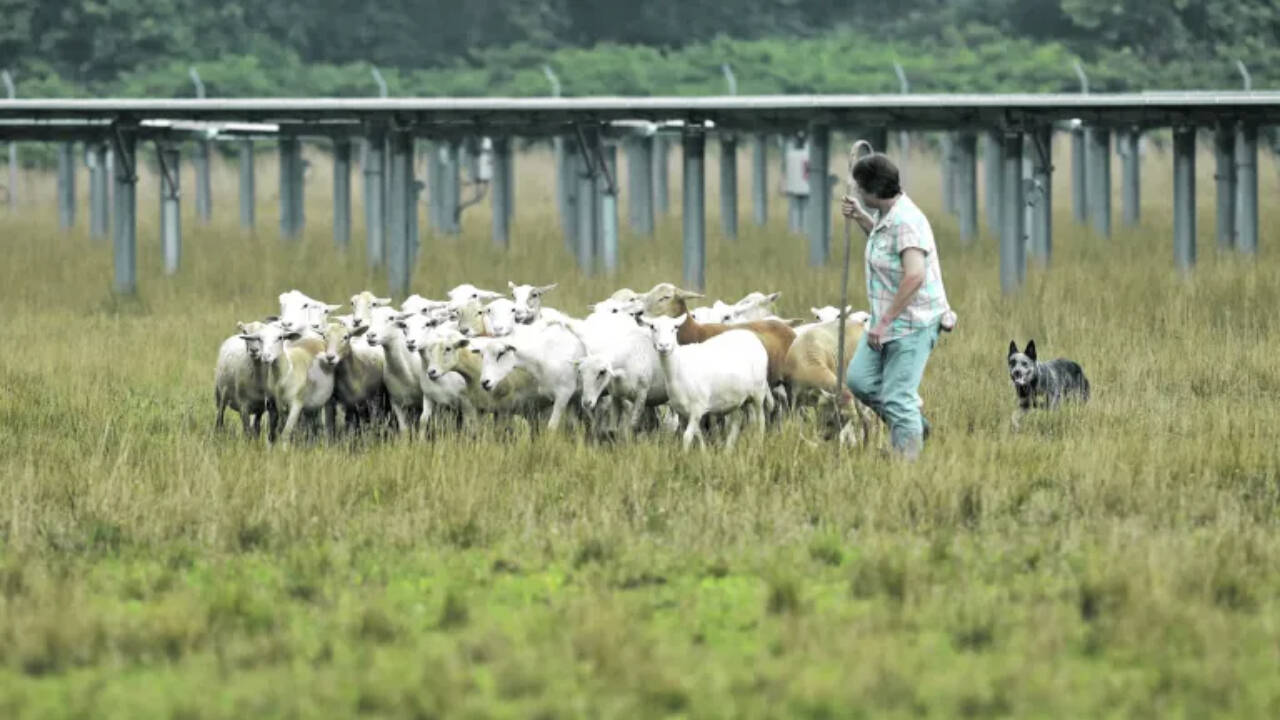
The classroom smelled of damp wool, cedar chips, and the sharp, metallic tang of an autumn morning that refused to stay polite. Outside the window, acres of glass panels tilted toward the pale New Jersey sun, catching the light and throwing back a blinding glare. Most people looked at those solar fields and saw efficiency. A geography teacher named Steve saw an endless supply of weeds.
He did not see panels. He saw shadow.
Beneath thousands of photovoltaic cells stretching across the flat New Jersey earth, shade pooled like water. Where shade is, weeds follow. Tall, stubborn, aggressive stalks of grass and local flora reach upward, seeking whatever light manages to slip past the gleaming silicon overhead. Left unchecked, those weeds climb. They cast shadows of their own. They choke the equipment, block the output, and threaten millions of dollars in clean energy infrastructure.
For years, the standard remedy was mechanical. Diesel engines roared to life. Metal blades whined against stone and stem. Exhaust plumed into the air above the green energy installation. Men in heavy boots spent grueling days wrestling weed-whackers around delicate wiring harnesses, sweating through thick work shirts, risking a stray rock flying into a multimillion-dollar inverter.
It was loud. It was expensive. It reeked of fossil fuels.
Steve watched the mowers come and go. He watched the budget shrink. He looked out at the rolling panels and then down at his hands, chalk-stained and tired. Then, he thought about sheep.
The Logic Of The Flock
Not lawnmowers. Not chemicals. Animals.
Sheep do not need spark plugs. They do not leak motor oil. They do not require a union contract or a safety briefing on high-voltage alternating current. They possess an ancient, relentless instinct: graze, move, digest, repeat.
When Steve first brought a handful of sheep to a commercial solar site, people laughed. Property managers raised eyebrows. Engineers crossed their arms and waited for disaster. They imagined woolly projectiles smashing into tempered glass. They pictured tangled legs snapping in grounding wires. They envisioned a logistical nightmare of runaway livestock roaming suburban New Jersey highways.
Instead, something quiet happened.
The sheep stepped through the security gate and went to work. They did not look up at the towering monoliths of human ingenuity. They looked down. They found the tender shoots hiding in the cool shelter of the steel frames. They chewed methodically, their jaws moving in a steady, rhythmic cadence that sounded like the ticking of an old clock.
A single sheep eats about three to four pounds of dry matter a day. Multiply that by a few dozen, and you have a living, breathing maintenance crew that fertilizes the soil as it works, dropping rich organic matter back into the depleted earth.
Physics meets biology. The grass vanishes. The panels stay clean. The carbon footprint shrinks twice over.
Scaling Up
One sheep becomes ten. Ten become fifty. Fifty become four hundred and fifty.
Managing four hundred and fifty living creatures across industrial energy grids is not a pastoral painting by a nineteenth-century master. It is an exercise in complex logistics. It requires mobile water tanks, portable electric fencing, veterinary checks, parasite management, and a deep, unromantic understanding of animal husbandry.
Steve had to learn the language of the flock. He learned to read the shift in an ewe's ears when a storm front rolled in off the Atlantic. He learned the frantic, high-pitched bleat of a lost lamb tangled in perimeter netting. He learned that animals do not care about corporate quarterly reports or state renewable energy targets. They care about salt blocks, fresh water, and the shade of a twenty-foot solar array when the July heat bakes the asphalt access roads.
The transformation was gradual, then sudden.
Local utility companies noticed the difference. The ground beneath the panels looked healthier. Microbial activity in the soil increased because the soil wasn't being repeatedly scorched by chemical weed killers or pulverized by heavy tractor tires. Native pollinators returned. Wildflowers, kept from growing too tall by the grazing, bloomed in patches around the perimeter.
The teacher became a shepherd. The classroom expanded from four walls to twenty acres of humming metal and soft, woolly bodies.
The Economics Of Eating Grass
We like to think of progress as a straight line upward, ascending on graphs of silicon chips and algorithmic code. We imagine the future as smooth, cold, and entirely digital.
Yet sometimes the sharpest innovation looks backward.
Consider the economics. Traditional vegetation management on a commercial solar farm is a recurring capital drain. Crews must be hired. Fuel must be bought. Equipment breaks down. When you deploy grazing livestock, the economics flip. The property owner pays for a service—vegetation control—by leasing the pasture. The shepherd makes money from the grazing fees and, later, from wool and meat.
Zero fossil fuels consumed for mowing. Zero chemical runoff into local watersheds.
It is a closed loop. The sun powers the panels. The panels create shade. The shade grows grass. The grass feeds the sheep. The sheep clear the panels. The cycle turns without a single gallon of gasoline burning in a weed-whacker.
Critics often ask about the risks. What about chewing on the cables? It is a fair question. High-voltage DC cables carry serious current. But solar installations are built to industrial standards, encased in heavy-gauge steel conduits well out of reach of inquisitive teeth. The sheep have no interest in armored conduit when thousands of square feet of fresh clover sit right beside it.
A Different Kind Of Classroom
On a Tuesday afternoon, students from Steve's old school occasionally visit the site. They don't come to look at the inverters or take notes on solar conversion rates. They come to watch the lambs.
They drop their backpacks in the gravel and run their fingers through lanolin-heavy wool. They ask questions about ear tags and rotational grazing. They see a living system at work. They realize that technology and nature are not locked in permanent combat; they can be woven together if someone is stubborn enough to try.
The teacher stands near the edge of the fence, watching the massive expanse of glass stretch toward the horizon. The panels hum with invisible electricity, invisible power moving silently across the grid to light homes fifty miles away. Right below them, four hundred and fifty sheep drift across the landscape like moving clouds, their soft, steady chewing the only sound cutting through the hum of the modern world.