Dhaka is officially the slowest city on earth. If you have ever sat in a car there, watching a pedestrian outpace you while the heat radiating off the asphalt melts your patience, you don't need a study to tell you that. But a study from the US National Bureau of Economic Research confirmed it anyway. The average speed in Bangladesh’s capital crawls at a pathetic 4.8 kilometers per hour. That is slower than a casual walking pace.
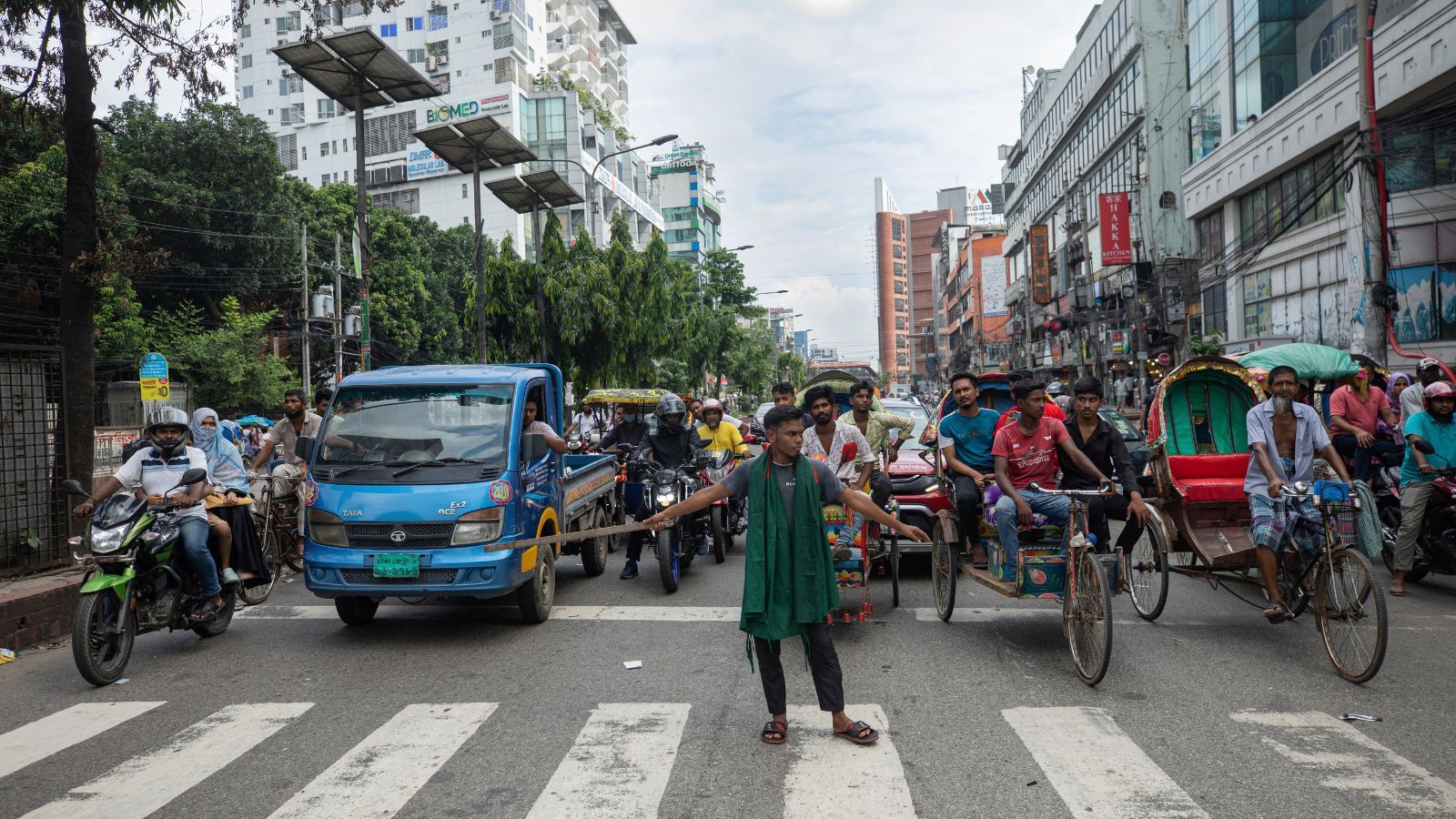
For decades, the city of 22 million people managed this absolute gridlock with ropes and raw human muscle. Traffic police officers literally stretched thick ropes across major intersections to block cars, buses, and pedal rickshaws because drivers treated standard traffic lights as mere suggestions. It was chaotic, exhausting, and highly confrontational.
Now, the Dhaka Metropolitan Police (DMP) are trying something radically different. They are turning to automation. In May 2026, Dhaka officially rolled out an intelligent, automated traffic enforcement system driven by computer vision and artificial intelligence.
The immediate question is obvious. Can a city notorious for feral driving habits, where lane lines are essentially invisible and seven different types of vehicles fight for the same patch of tarmac, really be tamed by an algorithm?
The short answer is that it is already changing how people behave. But the longer, more realistic answer is that technology is only half the battle.
How Dhaka's Automated Surveillance Actually Works
This is not just a handful of speed cameras. The DMP Traffic Technical Unit deployed advanced Pan-Tilt-Zoom (PTZ) cameras capable of a full 360-degree rotation. These aren't passive recorders. They are linked directly to specialized violation detection software that evaluates live feeds against specific operational logics.
Right now, the system actively scans for six specific traffic offenses:
- Running red lights and skipping signals
- Breaching designated stop lines at intersections
- Driving the wrong way down a one-way street
- Illegal lane changes and weaving
- Blocking the left turn lane or occupying pedestrian zebra crossings
- Unauthorized passenger pickup and drop-off by commercial buses
When a vehicle breaks one of these rules at a monitored intersection, like Bijoy Sarani, Karwan Bazar, or Shahbagh, the camera tracks the vehicle, zooms in, and extracts the license plate number. The system then queries the central server of the Bangladesh Road Transport Authority (BRTA).
Within seconds, the system matches the plate to the registered owner’s National Identity (NID) data and mobile number. The software automatically logs a digital case under the Road Transport Act 2018. The owner gets a text message alert, and an official paper notice is sent via registered mail using the city's e-traffic prosecution platform.
The fine for a standard offense, like running a red light, is 2,000 taka (roughly 16 US dollars). That might sound minor to an international observer, but for a local hired driver or a small business owner, it is a significant financial hit.
The Immediate Psychology of Automatic Fines
The biggest victory of this rollout is not the tech itself, but how it removes the human friction from law enforcement.
Before this system went live, traffic cops had to use paper slips or hand-held POS machines. To fine a driver, an officer had to physically step into the chaotic flow of traffic, wave the vehicle down, and endure an immediate, aggressive argument. Drivers routinely refused to comply, arguments blocked whole lanes, and officers were occasionally struck by fleeing vehicles.
Now, the confrontation is gone. A driver named Hannan Rahman Jibon recently ran a red light while driving his employer's car. He didn't get pulled over. No cop yelled at him. Instead, the car owner sitting at home received an immediate text alert detailing the exact violation. Jibon publically admitted that the sudden, silent accuracy of the system completely changed how he drives. He is terrified of the cameras now.
You can see this psychological shift playing out at major junctions. At the Sonargaon Hotel intersection, cars and motorcycles are actually stopping cleanly behind the white stop lines. Zebra crossings are suddenly clear of vehicles. Why? Because drivers know the camera does not negotiate, does not accept bribes, and does not care who your uncle is. In the first few weeks of operation, the system racked up hundreds of automated cases, proving that the tech can identify offenders at scale.
The Massive Blind Spots the Tech Can't See
It is easy to get swept up in the optimism of a digital transformation, but Dhaka’s infrastructure presents challenges that standard software simply isn't built to handle.
First, consider the sheer variety of transport. Dhaka's streets are filled with human-powered pedal rickshaws. They don't have registered license plates. They don't have digital profiles in the BRTA database. They don't care about a PTZ camera. If a massive percentage of the vehicles causing gridlock cannot be tracked by the software, the system's ability to clear the roads is severely bottlenecked.
Second, the system relies entirely on clear license plates. The DMP has already run into massive issues with faded, modified, covered, or completely missing license plates. If the software cannot read the plate, it cannot pull the BRTA data, and the violation record goes nowhere.
Then there is the physical reality of the roads. Dhaka suffers from a severe deficit of actual tarmac. A functional city requires roughly 20% to 25% of its total area to be dedicated to roads. Dhaka has less than 8%. On top of that, the existing roads are constantly choked by unauthorized street markets, poorly planned construction, and legal bottlenecks where five lanes abruptly merge into one narrow bottleneck.
An algorithm can optimize traffic light timings and penalize reckless drivers, but it cannot magically spawn new lanes or dissolve a physical bottleneck.
What Needs to Happen Next
If you are an urban planner, a tech provider, or a city official looking at Dhaka as a test case for smart city tech in developing nations, the takeaways are clear. Technology without structural reform is just an expensive band-aid.
For this system to actually fix the world's slowest traffic, the city needs to take immediate, practical steps:
- Enforce Mandatory Plate Standardization: The police must launch an aggressive campaign to penalize vehicles with obscured or non-standard license plates. If the cameras can't read the data, the system fails.
- Integrate Non-Motorized Transport: City planners need to physically segregate rickshaws into dedicated lanes so they don't disrupt the flow of motorized traffic monitored by AI.
- End the Bus Anarchy: A major cause of Dhaka's gridlock is competing private buses stopping dead in the middle of intersections to scramble for passengers. The automated system must consistently levy maximum fines on bus owners until fleet behavior changes permanently.
- Maintain the Tech Infrastructure: Historically, Dhaka has spent millions on automated traffic lights that fell into disrepair within years because nobody maintained them. The city must fund a dedicated technical team to keep these 360-degree cameras calibrated and operational.
The early data proves that automation can force compliance in a city once thought to be completely lawless. The drivers are paying attention because their wallets are taking the hit. But don't expect the average speed to jump past walking pace until the city addresses the physical, structural messes that a camera simply cannot fix.