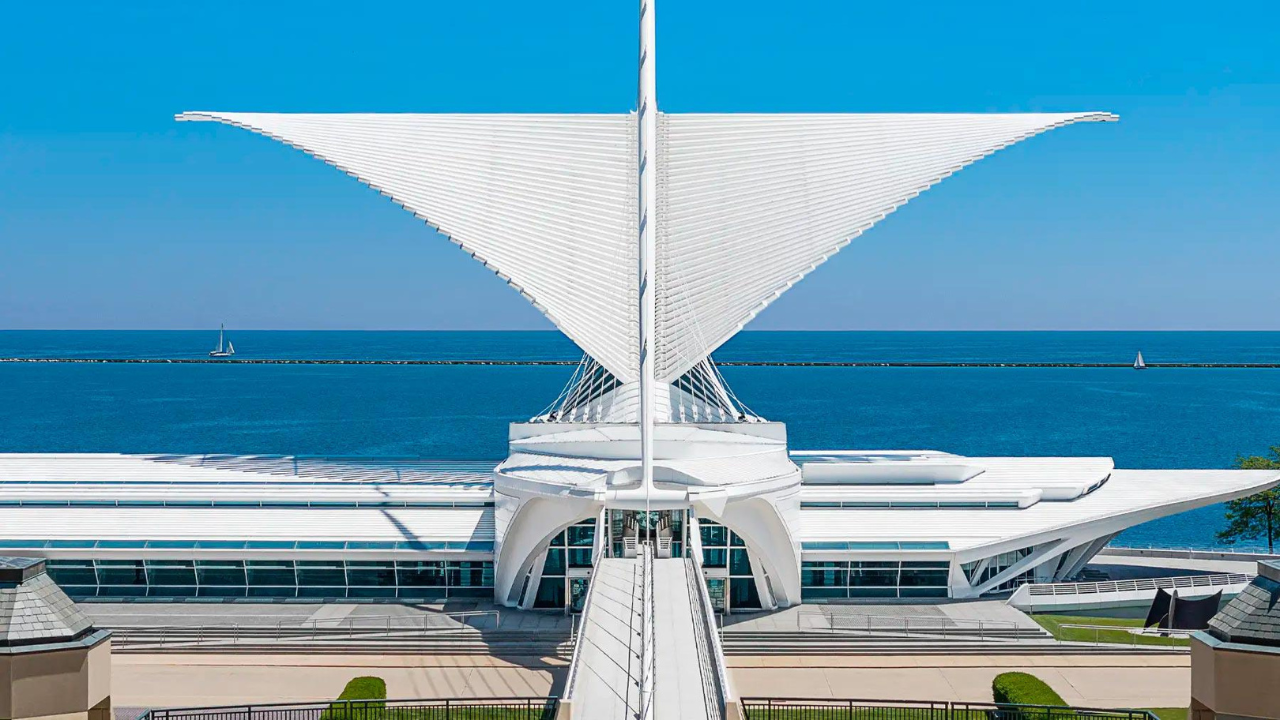
A $10 million philanthropic pledge from a Wisconsin family has arrived to rescue the iconic moving wings of the Milwaukee Art Museum from an accelerating cycle of mechanical wear and deferred maintenance. Specifically, the gift establishes a dedicated endowment and capital reserve aimed at overhauling the hydraulic systems, structural steel tendons, and weather-monitoring sensors that allow the Burke Brise Soleil to open and close over Lake Michigan. While local press releases frame the donation as a straightforward civic triumph, the reality behind the architecture reveals a far more complicated financial and engineering struggle that haunts monumental public buildings across the country.
Architecture critics love a spectacle. Donors love a ribbon-cutting. Nobody wants to pay for hydraulic fluid, custom-machined steel pins, and the specialized marine-grade coatings required to stop Lake Michigan from eating a kinetic sculpture alive. For more than two decades, the Quadracci Pavilion—designed by Spanish architect Santiago Calatrava and opened in 2001—has served as the undisputed visual shorthand for Milwaukee. Its 217-foot wingspan folds and unfolds twice a day, weather permitting, transforming a static concrete-and-glass structure into something closer to a living organism. Yet from the very beginning, that mechanical grace came with an astronomical maintenance tab that traditional museum operating budgets were never built to absorb.
The Physics of a Kinetic Landmark
To understand why a single architectural feature requires a ten-million-dollar lifeline, you have to look at what happens when fine art meets industrial maritime engineering. The Burke Brise Soleil is not an ornamental facade. It is a massive, moving machine exposed to some of the harshest freshwater weather conditions in North America.
The structure consists of 72 steel fins ranging in length from 26 to 105 feet, weighing roughly 90 tons in total. These fins are mounted on two angled spines that pivot using a complex network of 22 hydraulic cylinders. When wind speeds exceed 23 miles per hour for more than three consecutive seconds, automated ultrasonic anemometers trigger an emergency closure sequence to prevent the wings from acting like giant sails and tearing themselves off the pavilion roof.
Consider the stresses involved in that daily cycle:
- Thermal Expansion and Contraction: Milwaukee temperatures routinely swing from below zero in January to above 90 degrees in July. Steel expands and contracts with every shift, placing relentless strain on joints, seals, and alignment tolerances.
- Moisture and Freeze-Thaw Cycles: Lake-effect humidity penetrates microscopic fissures in protective coatings. When temperatures drop, trapped water freezes, expands, and pops paint and sealants off the structural steel, inviting rapid oxidation.
- Hydraulic Fatigue: High-pressure hydraulic lines, valves, and seals degrade over time. A single leak or pressure drop does not just halt the daily show; it risks uneven loading across the spines, which can warp structural components if not caught immediately by telemetry systems.
- Custom Part Obsolescence: Because Calatrava’s designs rely on bespoke engineering rather than off-the-shelf industrial components, replacing a failed actuator or sensor often requires custom fabrication, specialized rigging crews, and months of lead time.
Early in the pavilion’s history, the wings became infamous for getting stuck. Mechanical glitches, sensor calibration errors, and hydraulic failures frequently left the brise soleil frozen mid-flap or locked shut during prime tourist seasons. Engineers eventually stabilized daily operations through rigorous preventative maintenance schedules, but keeping a 90-ton kinetic sculpture operational over a quarter-century inevitably pushes major subsystems past their original design lifespan.
Why Cultural Institutions Struggle to Fund Maintenance
The financial dilemma facing the Milwaukee Art Museum is hardly unique, though the moving wings make it unusually visible. Across the United States, museums, symphony halls, and universities spent the late 1990s and 2000s chasing "starchitect" commissions—bold, sculptural buildings intended to spark urban regeneration, a phenomenon widely known as the Bilbao Effect.
Boards of trustees found it relatively easy to raise tens of millions of dollars for construction. Naming rights on a dramatic atrium or a cantilevered wing carry immense social prestige. Raising money for an endowment dedicated strictly to replacing aging chillers, resealing roofs, or rebuilding hydraulic pumps is an entirely different proposition. Donors rarely ask to have their family name engraved on a preventative maintenance ledger.
As a result, cultural institutions frequently fall into a predictable capital trap:
- Construction Cost Overruns: The Quadracci Pavilion itself originally carried a price tag around $25 million when conceived in the mid-1990s, eventually ballooning to roughly $120 million by the time it opened in 2001. When construction costs escalate, institutions often raid planned maintenance reserves just to get the doors open.
- Deferred Capital Expenditures: Faced with flat ticket revenues, rising insurance premiums, and inflationary pressures on staffing, museum administrators routinely push major mechanical overhauls down the road by three, five, or ten years.
- The Aesthetic Penalty: Unlike a failing boiler hidden in a sub-basement, a mechanical failure on the Quadracci Pavilion happens in full view of the entire city. If the wings stop moving, the museum’s primary brand identity visibly breaks down.
By stepping forward with $10 million specifically earmarked for the preservation and ongoing operation of the wings, this Wisconsin family is addressing the exact blind spot that cripples most major architectural landmarks. Rather than funding a flashy new addition that would only add more square footage to heat, cool, and insure, the pledge targets the long-term solvency of the museum's most recognizable asset.
Calatrava’s Legacy and the Cost of Architectural Ambition
Any honest assessment of the Quadracci Pavilion’s upkeep requires looking at the broader track record of its creator. Santiago Calatrava is one of the most celebrated structural artists of the modern era, famous for white, skeletal forms inspired by anatomy and natural motion. He is also one of the most polarizing figures in municipal finance and construction management.
From the World Trade Center Transportation Hub in New York—which soared past $4 billion and suffered persistent roof leaks—to the City of Arts and Sciences in Valencia, Spain, Calatrava’s projects have repeatedly tested the financial limits of their host cities. His designs push structural engineering to the edge of what materials can tolerate, prioritizing sculptural purity over modular simplicity or easy serviceability.
In Milwaukee, that architectural ambition delivered undeniable dividends. The Quadracci Pavilion instantly put the city on the international design map, drove tourism, and gave the community a civic symbol rivaling the Gateway Arch in St. Louis or the Space Needle in Seattle. You cannot put a simple dollar value on a structure that single-handedly modernized a city's global image.
Yet the engineering trade-offs remain baked into the steel. Standard commercial buildings are designed with redundancy, flat surfaces, and accessible mechanical chases so technicians can swap out failing parts in an afternoon. A sculptural roof composed of tapering, cantilevered steel louvers suspended over an active waterfront requires specialized access equipment, marine-grade corrosion protocols, and engineering oversight every time a major component needs servicing. The $10 million pledge buys time and stability, but it does not alter the underlying physics of the building.
What Ten Million Dollars Actually Buys
In the world of heavy structural maintenance and institutional endowments, $10 million sounds massive to the average taxpayer, yet its purchasing power depends entirely on how the funds are structured between immediate capital repairs and long-term investment returns.
If the entire sum were placed into a traditional museum endowment—where annual spending rules typically cap withdrawals at 4 to 5 percent to preserve principal against inflation—the gift would generate roughly $400,000 to $500,000 per year. For a standard building, half a million dollars annually is a healthy maintenance budget. For a custom 90-ton kinetic roof exposed to Great Lakes winters, that figure covers routine inspections, hydraulic fluid replacements, sensor calibrations, and minor paint touch-ups, with very little left over for major structural rebuilds.
Because major overhauls—such as stripping and recoating all 72 steel fins or replacing primary hydraulic actuators—can easily run into the low millions for a single campaign, institutional gifts of this size are typically split into two buckets:
- Immediate Capital Reserves: Liquid funds set aside to pay for overdue mechanical upgrades, updated control software, structural steel remediation, and modern weather-telemetry hardware over the next 24 to 60 months.
- Restricted Endowment Principal: Invested capital designed to throw off reliable annual cash flow in perpetuity, insulating the wings' operating budget from future downturns in museum attendance or municipal arts funding.
Even with both mechanisms working in tandem, museum leadership will still face strict engineering discipline. Inflation in specialized industrial labor and custom steel fabrication has outpaced general consumer inflation for years. A gearbox or custom cylinder that cost $80,000 to fabricate in 2005 can easily command $200,000 or more today, assuming the original specialty vendors are still in business.
The Hidden Vulnerability of Control Systems
When the public looks at the Burke Brise Soleil, they see steel and glass. Engineers look at the software and sensors telling that steel when to move.
A kinetic structure built at the turn of the millennium relies on programmable logic controllers, wind sensors, position encoders, and safety interlocks that were cutting-edge in 1999 and are museum pieces themselves today. In industrial automation, electronic control systems age far faster than structural steel. Circuit boards fail, proprietary communication protocols become unsupported, and replacement sensors no longer match the voltage or data architecture of legacy control cabinets.
Modernizing the wings is therefore as much a digital overhaul as a mechanical one. Updating the control architecture allows engineers to install predictive diagnostics—sensors that measure vibration, hydraulic fluid viscosity, and motor current draw in real time. Instead of waiting for a seal to blow or a fin to lag behind its neighbors, technicians can spot subtle resistance spikes weeks before an actual failure occurs.
A Blueprint for Aging Architectural Icons
The Milwaukee pledge arrives at a critical inflection point for American civic architecture. Dozens of high-profile museums, performing arts centers, and libraries built during the architectural boom between 1995 and 2010 are now hitting the 20-to-30-year mark. That is the exact window when original roofs, custom curtain walls, bespoke HVAC plants, and kinetic facades reach the end of their first major lifecycle.
Cities across the country are quietly confronting the bill for two decades of architectural bravado. Without private donors willing to fund unglamorous infrastructure—or municipalities willing to backstop rising capital budgets—many of these landmarks face a slow decline into tarnished, non-functional versions of their original designs.
Milwaukee got lucky. A local family understood that preserving a civic icon means funding the machinery inside it, not just admiring its silhouette from the lakefront. Whether other cities can convince their wealthiest patrons to fall in love with preventative maintenance before their own landmarks seize up remains an open question.