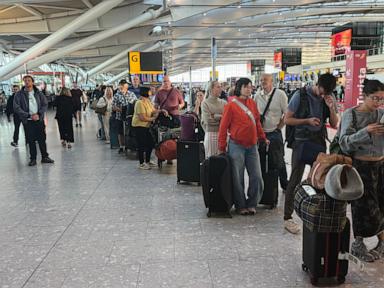
The coffee in Terminal 5 was lukewarm, tasting faintly of burnt cardboard and institutional desperation. It was 4:14 in the morning when the departure board blinked. Not with the frantic, clacking rhythm of a normal rush hour, but with a sudden, synchronized dying gasp. Destinations across Europe—Rome, Frankfurt, Barcelona, Edinburgh—did not vanish. They simply turned red. Then, they dissolved into dashes.
Across the United Kingdom, from the cavernous halls of Heathrow to the windswept tarmac at Manchester, an invisible machinery stalled. Meanwhile, you can read similar events here: The Afternoon the Sky Went Quiet.
Air traffic control is a ghost industry. When it works, it is entirely imperceptible. Millions of passengers move through the upper atmosphere every single day, suspended in thin air inside aluminum tubes traveling at five hundred miles per hour, trusting their lives to people they will never see. We look out the window at the cotton-ball clouds and think of freedom. We do not think of the invisible gridlines drawn across the sky, or the men and women hunched over radar screens in darkened rooms in Swanwick and Prestwick, staring at green blips that represent thousands of beating hearts.
Then the system chokes. To see the full picture, we recommend the recent article by Condé Nast Traveler.
Consider what happens next. It is not just a delay. It is an immediate, localized compression of human anxiety.
Take Elena, a hypothetical traveler whose reality mirrors thousands across the tarmac that morning. She was heading to Lisbon for her sister’s wedding, clutching a garment bag containing a dress that had taken months to fit. When the air traffic control glitch struck—a sudden data processing failure that blinded computers to flight plan updates—Elena’s plane was already pushed back from the gate. They sat on the asphalt. Ten minutes became an hour. An hour became four.
The captain’s voice crackled over the intercom, dripping with the strained cheerfulness unique to aviation professionals who are just as trapped as you are. “Ladies and gentlemen, we are currently experiencing a UK-wide technical restriction. Air Traffic Control has limited our flow rate to zero.”
Zero.
It is a terrifying word when applied to the sky. On the ground, you can pull over. You can walk into a diner, buy a paper, wait it out. In the air, or on the precipice of it, zero means paralysis.
The technical failure itself was prosaic, as most technological catastrophes are. A piece of data entered the system that the flight planning software could not digest. It choked. Instead of rejecting the rogue input safely, the architecture locked up to prevent navigational errors. It was a digital thrombus in the artery of British aviation. The safety protocols worked, which is the cruelest irony of the situation. The system chose safety over movement, grounding flights to prevent planes from sharing the same patch of sky without proper guidance.
Safety is correct. But safety does not warm your coffee. Safety does not find your lost checked luggage. Safety leaves you sitting on a cramped Boeing 737 for six hours watching a flight attendant ration out miniature bags of pretzels like they are survival biscuits on a life raft.
By noon, the ripple effect had metastasized. A delayed plane in Manchester means a stranded crew in Glasgow, which means a canceled holiday for a family in Bristol. Aviation is a domino game played at Mach 0.8. When one piece refuses to fall, the entire pattern shatters.
We forget how fragile our modern choreography really is. We treat global travel like a bus ride. We book tight connections, trusting that millions of moving parts will synchronize down to the microsecond. When a software glitch freezes the National Air Traffic Services computers, the illusion evaporates. We are reminded that we are hairless apes hurtling through the stratosphere, dependent entirely on fragile wires and the steady hands of controllers who suddenly find themselves staring at blank screens.
Elena never made it to Lisbon in time for the rehearsal dinner. She watched the ceremony via a pixelated FaceTime call on her phone while sitting on a sticky vinyl bench in the baggage reclaim area, surrounded by three hundred other dispossessed souls. Her garment bag was somewhere in the belly of a grounded aircraft three terminals over, completely inaccessible.
Yet, as the evening shadows lengthened across the tarmac and the emergency automated announcements droned on in five different languages, something strange happened in the terminal. People began to share phone chargers. A businessman split a packet of shortbread with a crying toddler. Strangers formed spontaneous support groups, trading rumors about replacement buses and hotel vouchers that may or may not exist.
The glitch proved that our infrastructure is terrifyingly vulnerable. But it also proved something else about the people who inhabit it. We break easily, but we also lean on each other when the sky falls down.
The screens above Terminal 5 eventually flickered back to life, green text spilling downward like digital rain, signaling the slow, agonizing resumption of the delicate dance above the clouds.