Gravity doesn't care about intentions. It doesn't care if a man meant to scare you or kill you, whether the plan was a signature on a ledger or a scream into a courtyard below, whether the fingers holding your ankles were trembling with adrenaline or cold with calculation.
When someone dangles a human being out of an upper-story window to make a point, they are making a grotesque bet on physics and human strength. They assume they are the authors of the scene. They assume the theater belongs to them, that the script has a clean second act where the victim signs, pays, apologizes, or whispers a name, and then gets pulled back over the sill with a racing heart and a ruined suit.
Except hands slip. Sweat turns skin slick. Panic makes a grown man heavy in a way no one ever feels until the weight is suddenly vertical and pulling downward with the quiet certainty of stone.
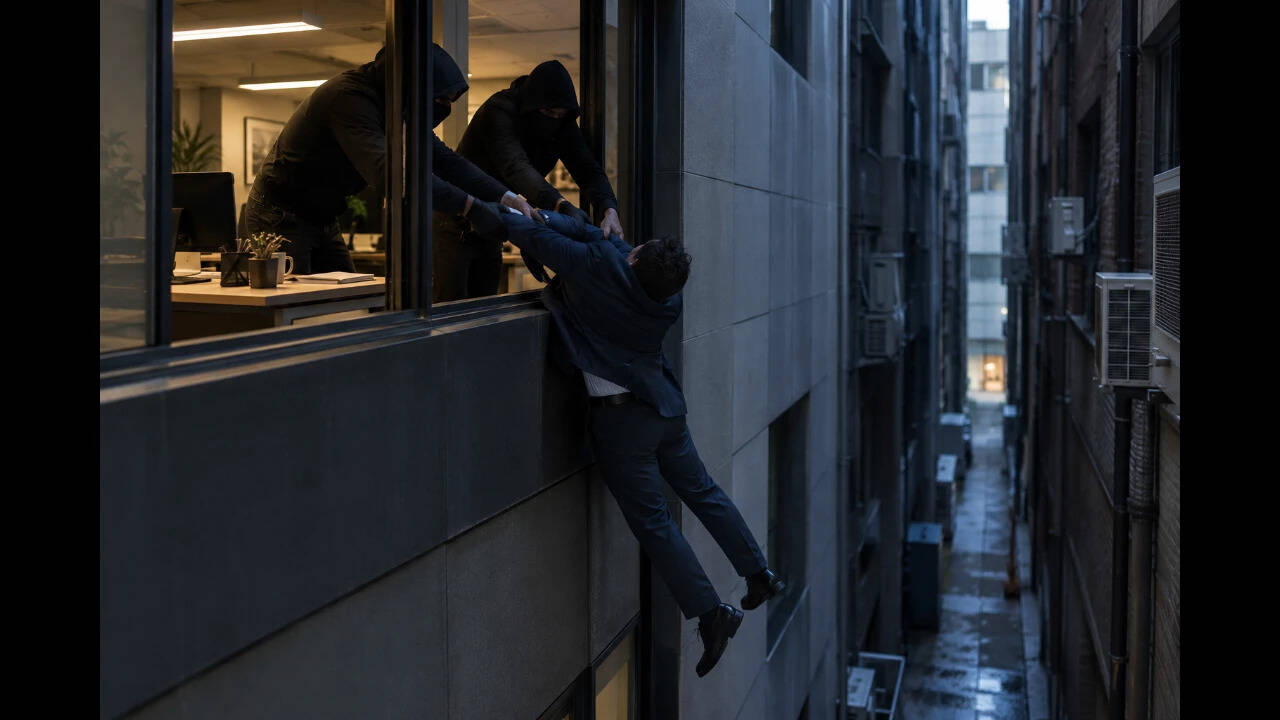
A banker in Italy died that way according to the premise before us—dropped to his death by mistake when thugs dangled him out of his office window only to threaten him. Even before we look at the cold mechanics of extortion, coercion, or street-level intimidation, that single phrase—by mistake—should stop every reader dead in their tracks. Because "by mistake" is the most dangerous alibi in human cruelty. It tries to split violence into two neat categories: real murder and theater. In reality, once you put a human life over empty air as leverage, you have already surrendered control of the outcome.
I have sat in rooms where people talked about fear as if it were a precise instrument. Years ago, watching how intimidation plays out inside high-pressure disputes—whether over money, turf, or silence—I learned something unsettling about human nature. People who use fear almost always overestimate their precision and underestimate their own fragility. They think they are holding a scalpel. Usually, they are holding a brick over glass.
Let's be honest about what makes a story like this so haunting. It isn't just the shock of an office window or the word "thugs" or the sterile title of a financial professional. It is the collision of two worlds that people tend to keep separate in their heads: the quiet, paper-and-screen world of banking and debt, and the raw, physical brutality of people willing to put a body on the ledge to force a result.
To see why that collision happens—and why "only to threaten" is so often a lie people tell themselves right up until the moment something gives—let's build a hypothetical scenario to trace the mechanics of how a scare turns fatal. (Note: What follows is a hypothetical reconstruction designed to illustrate how extortion escalates, not a claim of specific events in any particular case.)
Picture a mid-sized office on a weekday afternoon. Outside, the city hums with ordinary errands: delivery scooters weaving through traffic, espresso cups clinking on saucers, a florist trimming stems by a doorway. Inside, the air smells faintly of dry paper, floor wax, and stale coffee. A man in his forties or fifties—someone whose days are measured in numbers, deadlines, calls, and quiet compromises—is standing where he never expected to stand: past the glass, past the curtain, suspended above pavement that looks smaller and harder by the second.
The people holding him aren't philosophers. They have a goal. Maybe they want money moved. Maybe they want a loan forgiven, a project stalled, a ledger altered, or a warning delivered to someone higher up. In their minds, the window is a shortcut. Why spend weeks leaning on someone, watching routines, waiting for leverage, when you can compress a month of pressure into thirty seconds of pure terror?
That is the seduction of extreme intimidation. Speed.
When a threat escalates to physical peril, the intimidator believes they have found a master key. No lawyer can draft a counter-argument while your shoes are brushing open air. No spreadsheet can defend you when the only metric that matters is whether the fabric of your shirt or the grip on your wrist holds for five more seconds.
Yet every shortcut has a hidden tax.
Terror floods the body with adrenaline. Adrenaline narrows vision, spikes heart rate, tightens forearms until muscles cramp, and turns fine motor control into something clumsy and jerky. The very chemical surge that makes an attacker feel dominant also makes their grip unreliable. Meanwhile, the person suspended in mid-air isn't a mannequin. They twist. They kick. They grab blindly at anything solid—a wrist, a forearm, a window frame—trying to haul themselves back toward safety. Two bodies thrashing at the edge of a drop create torque, momentum, and shear force.
One slip. One shift in balance. One moment where the person holding on realizes their knuckles are burning and their footing on polished tile or linoleum is going.
And then the "mistake" happens.
People ask how something like that can be called an accident when someone deliberately put another human being in mortal danger. That question gets to the heart of the moral and legal tension in cases of fatal intimidation. Was it murder if the goal was only to frighten? Or is calling it a mistake a way of letting cowards hide behind incompetence?
In law and in common sense, intent and recklessness aren't the same thing, though people constantly blur them. If someone points a loaded gun at your chest to make you hand over your wallet and the trigger catches on a seam, they may claim they didn't mean to pull it. Maybe they even mean that part. The bullet still kills you. The law looks at whether a reasonable person knew that pointing a loaded weapon at a chest created a grave risk of death. Dangling someone out of an office window clears that bar without breaking a sweat. Everyone knows what happens when a human body falls from height. There is no mystery there.
Still, when headlines use words like dropped to his death by mistake, they are usually echoing a defense, a witness account, or an investigator's early framing of how the fall occurred rather than endorsing the idea that no crime was committed. Even if no one wanted a corpse on the sidewalk, creating the condition where a single slip equals death is an act of extreme violence.
Why do people resort to such crude, catastrophic methods in the first place?
To understand that, we have to look at the darker corners where finance, informal enforcement, and desperation overlap. Modern economies run on trust, contracts, courts, and credit. Most disputes—even bitter, expensive ones—stay inside those guardrails. People sue. Banks restructure. Assets get seized through paperwork rather than crowbars.
Step outside those guardrails, however, and the rules change overnight.
Sometimes a dispute involves illicit money, off-the-books deals, or debtors who cannot—or will not—pay through normal channels. Sometimes organized pressure groups move into financial or commercial territory, treating professionals like pressure valves they can twist until cash or compliance comes out. And sometimes a person in a position of financial responsibility gets caught between demands they cannot satisfy legally and threats from people who treat fear as their primary currency.
I won't pretend I have all the answers to why human beings cross that line. Honestly, the more I've studied high-stakes coercion, the more confusing and unsettling the psychology becomes. You see people who look ordinary in a hallway, who eat lunch, who joke about traffic, suddenly acting as if another human life is just a lever with a handle. It is scary because there is no neat monster mask on them beforehand. The capacity to go too far often hides behind routines that look mundane until the exact second they turn lethal.
Consider what happens next in the aftermath of a tragedy like this.
The noise stops. The sirens fade. The window gets closed, or taped off, or photographed from a dozen angles while detectives trace phone records, security footage, entry logs, and alibis. Suddenly, the people who thought they were being clever—who thought a dramatic scare would solve their problem cleanly—are staring at charges far heavier than whatever debt or dispute started the whole thing. A threat that might have been a shaking-down or an extortion play turns into a homicide investigation.
And for the victim's family, there is no comfort in "by mistake."
Grief doesn't care about nuance. If your father, brother, husband, or partner went to work on a normal day and never came home because someone decided to use terror as a negotiation tactic, the word mistake feels like salt rubbed into an open wound. It suggests carelessness with something irreplaceable. A life isn't a glass on a bar counter that you can wipe up with a towel if your elbow bumps it.
Let's pause and look at the broader pattern here, because stories like this echo beyond a single city or a single profession.
Historically, whenever power or money is contested outside transparent rules, intimidation escalates in predictable stages. First come the words—insults, warnings, veiled hints about what could go wrong if someone doesn't cooperate. If words don't bend the other person fast enough, pressure moves to property, reputation, or livelihood. When even that hits a wall, desperate or ruthless actors reach for physical shock, believing that raw bodily fear overrides every calculation.
Yet history shows a recurring flaw in that strategy: escalation breeds loss of control. Once you raise the stakes to survival, the other person has nothing left to lose in that moment except their life, and the margin for error shrinks to zero. What looks like total control from the inside of a room is often a hair-trigger disaster waiting for one sweaty palm.
You might wonder why someone in a white-collar or financial role wouldn't just walk away, report the pressure immediately, or refuse to engage.
In hindsight, that sounds simple. In real life, traps rarely announce themselves all at once. They tighten gradually. Maybe a favor is asked. Maybe a risky arrangement is already underway. Maybe someone tells themselves they can manage the situation quietly without dragging their family, their firm, or their reputation into a public storm. Shame keeps a lot of people silent longer than fear does. By the time the threat stops being theoretical and becomes physical, the room has already narrowed.
That is the invisible stake running underneath a headline like this. It isn't just about crime statistics or street violence. It is about how easily pressure can curdle into lethality when people treat human beings as instruments rather than ends in themselves.
Every time a story like this surfaces, it forces a hard look at the line between leverage and destruction. People love to talk about "sending a message." The trouble with sending a message through terror is that messages get misread, dropped, or blown out of proportion. You cannot fine-tune an earthquake. You cannot gently nudge someone off a ledge and expect them to stay put.
Think about the sheer absurdity of the premise: only to threaten.
As if a threat were a feather. As if holding someone over empty space were a polite conversation with a sharper punctuation mark. The moment you put a life in jeopardy to get your way, you have already crossed into territory where no one is truly safe—not the victim, not the bystanders below, and not even the people holding on, whose lives and freedom are hanging by the same thread.
Down on the street, a shadow falls across the concrete. A breeze moves through an open window, stirring a curtain that has no idea what just happened. Above it, an empty frame looks out over the city—quiet, indifferent, and final.