Bangkok has fallen in love with a comforting fairy tale. The story goes like this: Chinese manufacturers like DJI and XAG own the airframes, the motors, and the batteries, so Thailand should cede the hardware and build high-margin local artificial intelligence on top of imported Chinese metal.
That is not a strategy. It is a slow-motion surrender disguised as industrial policy.
Every few months, a fresh wave of cheerleading hits the regional press celebrating Thailand's US$260 million drone market. Pundits point to an aging farm workforce, a looming super El Niño threatening sugar cane and late rice harvests, and Bangkok's push to build "physical AI" software for farming, flood mapping, and industrial inspections. They treat the split between Chinese hardware and Thai software as a clever division of labor.
It is the exact opposite. Building proprietary software on top of a rival's closed hardware ecosystem is how you become a digital sharecropper. I have watched telecom integrators, enterprise robotics startups, and agri-tech ventures across Southeast Asia burn through millions of dollars building "localized AI layers" on foreign platforms, only to get wiped out the moment the hardware vendor pushed a firmware update or bundled the exact same analytics into its native app for free.
If Thailand wants a real stake in autonomous aviation, it needs to stop treating software as a magical escape hatch from manufacturing reality.
The Myth of the Hardware-Software Split
The lazy consensus in Bangkok's tech circles rests on a basic misunderstanding of how modern unmanned aerial vehicles actually work. Commentators talk about a drone as if it were a 1998 desktop PC—buy a generic beige box from Shenzhen, install your own operating system, and sell the bundle to local buyers.
Modern commercial drones do not work that way.
Companies like Shenzhen-based DJI and Guangzhou-based XAG do not sell dumb flying aluminum. They sell vertically integrated sensor-to-cloud stacks. When a farmer or industrial contractor buys a heavy-lift agricultural drone or an enterprise inspection airframe, the flight controller, obstacle-avoidance radar, multispectral camera calibration, variable-rate spray nozzles, and telemetry pipelines are tightly coupled at the silicon level.
Here is what happens in the real world when a local Thai software shop tries to insert its own "home-grown AI" into that stack:
- The API Tax: Third-party developers are restricted to whatever Software Development Kits (SDKs) the manufacturer chooses to expose. You do not get raw sensor fusion data; you get sanitized, rate-limited outputs.
- The Latency Trap: True "physical AI"—the kind that lets a drone adjust spray droplet size in real time against a sudden crosswind or dodge an unmarked power line over a flooded paddy—must run at the edge on the aircraft's onboard neural processing unit (NPU). Chinese vendors lock down their onboard compute to protect flight safety and intellectual property.
- The Feature Sherlocking: Once a local software company proves that crop-stress detection for durian orchards or flood-depth modeling in the Chao Phraya basin is profitable, the hardware giant simply trains its own model on millions of flight logs collected globally and includes the feature in its next subscription tier.
Calling this "building local AI" is generous. In practice, it is glorified systems integration with a custom user interface.
Why Steep Hardware Costs Are Not the Real Bottleneck
Mainstream coverage repeatedly claims that steep Chinese hardware costs limit wider drone adoption among Thai farmers, and that local AI will somehow unlock the market by proving the data is worth the upfront investment.
Ask any agricultural drone operator in Nakhon Sawan or Suphan Buri, and they will laugh at that diagnosis.
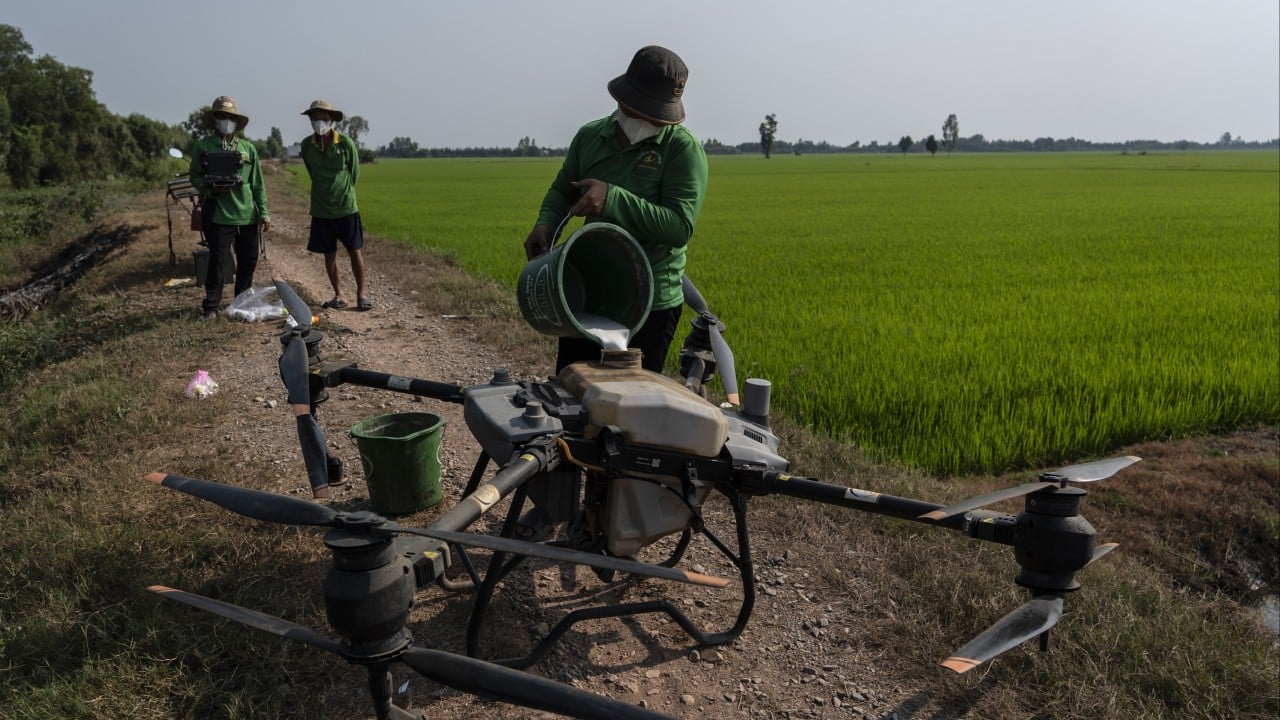
A single smallholder farmer with three hectares of rice does not buy a US$15,000 spraying drone—nor should they. Thailand's agricultural drone boom has never been driven by individual farm ownership; it is driven by drone-as-a-service contractors. Independent operators buy two or three heavy-duty rigs, load them into the back of a pickup truck, and charge farmers by the rai to spray fertilizer and pesticides.
The real bottleneck crushing these operators is not the sticker price of the airframe. It is unit economics and operational friction:
- Battery Degradation and Logistics: In tropical heat exceeding 38°C, lithium-polymer flight batteries degrade rapidly. Operators spend more capital on mobile generators, cooling rigs, and replacement battery packs than they ever spend on software subscriptions.
- Regulatory Chokepoints: Navigating airframe registration and pilot licensing between the Civil Aviation Authority of Thailand (CAAT) and the National Broadcasting and Telecommunications Commission (NBTC) creates weeks of dead time. A grounded drone earns zero baht.
- Chemical Formulation Mismatches: Most agrochemicals sold in rural Thailand were formulated for backpack sprayers using 200 liters of water per hectare, not ultra-low-volume aerial spraying using 10 to 20 liters. When nozzles clog or drift ruins a neighbor's cassava crop, no amount of cloud-based crop analytics saves the operator from paying damages.
Throwing a local AI dashboard at an operator who cannot keep batteries cool or source drone-grade surfactants solves a problem nobody in the field actually has.
What Does "Physical AI" Actually Require?
When Thai officials and startup founders talk about pivoting toward "physical AI," they are borrowing a buzzword popularized by Nvidia CEO Jensen Huang without importing the engineering stack required to make it real.
Physical AI is not a chatbot wrapped around a spreadsheet of rainfall data. It is embodied intelligence—models trained on physics simulations and real-world telemetry that allow a machine to perceive, reason, and act in unstructured environments.
To build genuine physical AI, you need three things:
- Proprietary Telemetry at Scale: You cannot train superior autonomous navigation or precision spraying models on a few thousand synthetic images. You need millions of hours of annotated edge-case flight data—fog, monsoons, canopy turbulence, and irregular terrain.
- Sovereign Compute Access: Training foundation vision-language-action models requires clusters of high-end GPUs. As tighter US export controls on advanced AI chips ripple across Southeast Asia—threatening even regional data center investments in Thailand—local startups face steep compute costs and compliance hurdles before they write a single line of flight code.
- Hardware Co-Design: Every robotics breakthrough from Boston Dynamics to Skydio happened because mechanical engineers, sensor architects, and machine learning researchers sat in the same room. When your airframe is designed in Shenzhen and your neural network is trained in Bangkok, your feedback loop is broken by thousands of miles and an opaque corporate firewall.
How Thailand Actually Wins the Drone Supply Chain
Dismissing Thailand's hardware potential while chasing a software mirage ignores the country's single greatest industrial advantage. Thailand is the manufacturing powerhouse of mainland Southeast Asia. For decades, global automakers and hard-drive giants built world-class precision machining, composite fabrication, and electronics assembly supply chains from Rayong to Ayutthaya.
Look at the companies quietly making real money in Thailand's unmanned sector—not the pitch-deck AI startups, but the firms supplying carbon-fiber airframe structures, specialized propulsion components, and ruggedized industrial payloads.
If Bangkok wants to turn a US$260 million domestic market into a regional export engine, it should invert its current playbook:
1. Dominate the Sub-Assemblies, Not the App Store
Instead of subsidizing redundant computer-vision startups, Thailand should target the non-Chinese supply chain vacuum. Western defense contractors, Japanese industrial firms, and non-aligned governments are desperate for NDAA-compliant (non-Chinese) drone components. Thailand already has the tooling and workforce to manufacture airframes, gimbals, wiring harnesses, and composite propellers at competitive scale. Own the physical chokepoints that global buyers actually need.
2. Build Open-Source Flight Stacks for Niche Airframes
Where Thailand does invest in software, it should abandon proprietary wrappers for DJI hardware and double down on open-source ecosystems like PX4 and ArduPilot paired with domestic or modular airframes. That is the only path where Thai engineers own the entire control loop—from raw inertial measurement unit (IMU) data to autonomous mission execution—without asking Shenzhen for permission.
3. Focus AI on Post-Processing Workflows, Not Flight Control
If a Thai software company wants to survive without building hardware, it must live completely outside the drone's flight envelope. A drone is just a flying sensor. The real value for Thai agribusinesses—giant conglomerates like Charoen Pokphand and Chia Tai, or sugar mills across Isaan—lies in integrating multi-source data (satellite imagery, soil sensors, weather radar, and drone orthomosaics) directly into supply-chain financing, crop insurance underwriting, and mill scheduling.
The Hard Truth About Taking the Industrial Route
There is an obvious downside to abandoning the "pure software" fantasy. Manufacturing components, certifying open-source airframes, and integrating enterprise agricultural ERP systems is slow, capital-intensive, and unglamorous. It requires patient industrial credit rather than quick venture capital rounds. Margins in component fabrication start at 12 to 18 percent, not the mythical 80 percent SaaS margins that venture slide decks promise.
And if Thailand moves too slowly on supply-chain certification, neighboring Vietnam—already entrenched in consumer electronics assembly—will happily eat its lunch.
Stop Renting Your Autonomy
The next time an industry report celebrates Thailand's pivot to local drone AI while Chinese hardware owns 90 percent of the sky, ask one simple question: Who holds the root cryptographic keys to the aircraft?
Until the answer is an engineer in Bangkok rather than a server in Shenzhen, Thailand is not building an AI drone sector. It is just decorating someone else's aircraft.