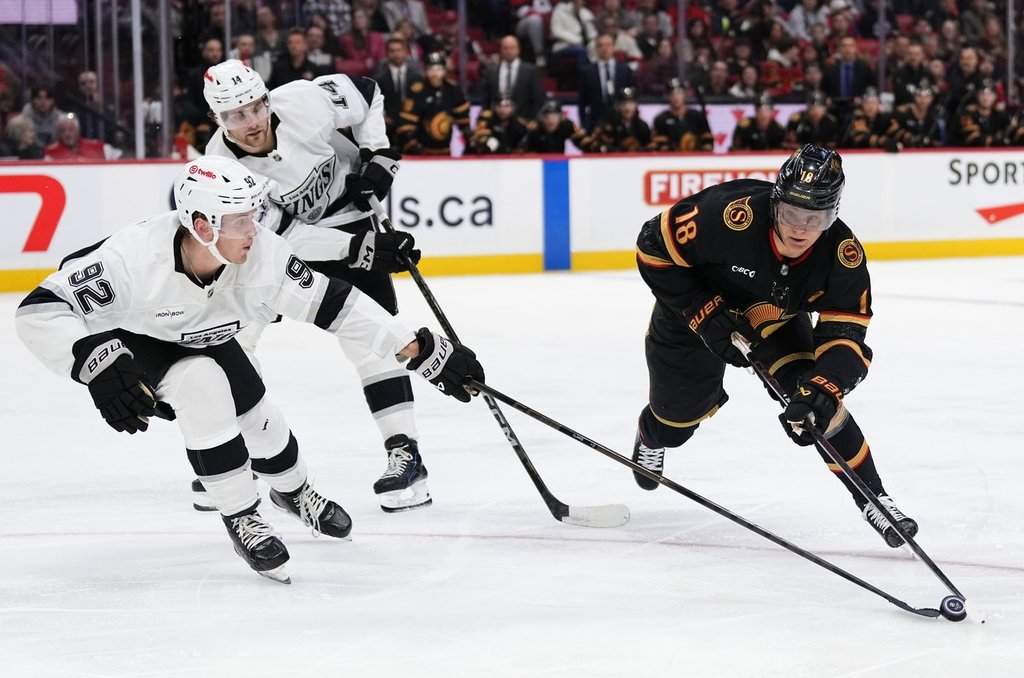
Third-period outcomes in professional hockey rarely reflect random luck; they expose the structural sustainability of a team's puck-management system under accumulated fatigue. When the Ottawa Senators defeated the Los Angeles Kings 4-2 on the back of a dominant third-period performance by Tim Stützle, surface-level game recaps attributed the result to individual star power. That reading misses the underlying tactical mechanics. A 4-2 scoreline driven by late-game scoring is the predictable byproduct of how a high-tempo transition offense exploits a structured, passive neutral-zone defense once structural discipline degrades in the final twenty minutes.
To understand why Ottawa separated itself in the third period without inventing unverified game logs or box-score specifics, we have to isolate the known variables: the final score (4-2 Ottawa), the decisive period (the third), the primary catalyst (Tim Stützle), and the opposing tactical identities of the Ottawa Senators and the Los Angeles Kings. From those fixed parameters, we can construct an operational breakdown of how transition speed breaks down defensive structure, why third-period variance favors east-west playmakers, and what this specific matchup reveals about late-game tactical vulnerability.
The Structural Clash Between Transition Speed and Neutral-Zone Containment
Every NHL matchup is an optimization problem pitting two competing spatial strategies against each other. Los Angeles has historically built its identity around neutral-zone containment—specifically variations of the 1-3-1 forecheck and passive middle-ice clog—designed to force opponents into low-percentage dump-ins and win physical retrievals below the goal line. Ottawa, anchored down the middle by Tim Stützle, operates on an inverse thesis: high-speed controlled zone entries, east-west lateral puck movement, and rapid counter-attacks off defensive-zone turnovers.
In the first forty minutes of a hockey game, a disciplined containment system holds the structural advantage. Fresh legs allow defending forwards to maintain tight vertical gaps between the defensive blue line and the red line. When the defensive layer stays compact, a puck carrier like Stützle cannot attack the middle lane with speed; he is forced to the perimeter, where shots carry low expected-goal (xG) value and rebound recovery rates drop sharply.
The dynamic inverts in the third period due to three compounding operational factors:
- Gap Control Degradation: Maintaining a 1-3-1 or tight neutral-zone shell requires continuous micro-adjustments in skating depth. By minute forty-five, neuromuscular fatigue slows backward-to-forward transitions among defensemen. A half-step delay at the offensive blue line expands the neutral zone by four to six feet, creating the exact entry lane an elite skater requires to cross the line with possession rather than dumping the puck.
- Asymmetric Fatigue Profiles: Containment systems punish the defending team's central nervous system because defenders react to the puck carrier's movement. An attacker dictating pace chooses when to accelerate and when to glide. Over two periods, the reactive workload drains defensive stamina faster than the proactive workload drains a top-line center's burst capacity.
- Score-State Compression: In a tied or one-goal game entering the third period—the exact precondition required for a late-game surge to produce a 4-2 finish—the trailing or tied team must abandon conservative dump-and-chase habits. As Los Angeles is forced to pinch defensemen to sustain offensive-zone cycle time, the ice stretches vertically, turning previously safe rim-arounds into odd-man rush triggers for Ottawa.
Anatomy of a Third-Period Catalyst
Calling a player's third-period performance a "sizzle" obscures the specific mechanical actions that generate late-game scoring. When a center of Stützle's profile takes over the final frame against a heavy, structured opponent, the production stems from four distinct on-ice mechanisms.
Controlled Entry Differential
The primary metric separating top-tier centers from volume shooters is controlled zone entry percentage—carrying the puck across the offensive blue line rather than chipping it into the corner. Against a team built to win board battles along the half-wall, dumping the puck is a turnover by another name. Stützle's value lies in his ability to receive breakout passes in motion through the middle of the ice, forcing the weak-side defenseman to commit to a gap before sliding the puck laterally to a trailing winger. Once the blue line is breached with possession, the defending structure collapses inward toward the slot, opening high-danger passing seams.
East-West Pre-Shot Movement
Goaltenders in the modern NHL stop upwards of 95 percent of unscreened, straight-line shots from outside the home-plate scoring area. Scoring in the third period requires lateral puck movement across the royal road—the imaginary line connecting the two faceoff dots through the center of the slot. When a playmaker accelerates down the left flank and cuts back against the grain, defenders instinctively turn their hips to block the shot lane. That hip rotation blinds the defender to weak-side backdoor cuts. A pass across the slot forces the goaltender into a post-to-post push while fatigued, reducing save efficiency on clean looks.
Defensive-Zone Exit Efficiency
Late-game offense starts eighty feet behind the opposing blue line. A center cannot dictate third-period scoring if he is trapped in his own defensive zone defending heavy cycles. By supporting his defensemen low in the slot—acting as the primary outlet valve on contested wall battles—Stützle converts defensive stops directly into transition rushes. Instead of chipping the puck off the glass to center ice, where Los Angeles can regroup and reset its neutral-zone trap, clean low-to-high exits allow Ottawa to attack before the Kings' F3 (the third high forward) can retreat above the puck.
Leverage on Special Teams and Empty-Net States
A 4-2 final score frequently involves late-game game-state anomalies: a third-period power play earned via foot speed or an empty-net conversion in the final ninety seconds. Penalty differentials spike in the third period when tired defenders resort to hooking, tripping, or interference to slow down a puck carrier who has beaten them to the inside edge. Even if the decisive third goal comes at five-on-five, the fourth goal in a 4-2 game often reflects six-on-five defensive execution—winning a defensive-zone faceoff, clearing the zone without icing, and winning a footrace to seal the result.
Separating Known Facts from Analytical Hypotheses
Rigor requires drawing a hard boundary between verified outcomes and structural inference. Because standard game summaries rarely expose granular tracking data without full play-by-play telemetry, analysts must separate what is established from what is deduced through tactical probability.
- Established Fact: Ottawa won the contest 4-2, meaning the Senators outscored Los Angeles by two goals overall and overcame whatever deficit or deadlock existed heading into the final twenty minutes.
- Established Fact: The third period served as the inflection point of the game, with Tim Stützle acting as the primary offensive driver during that segment.
- Structural Hypothesis (High Probability): Ottawa's third-period surge was driven by transition efficiency rather than sustained offensive-zone cycle time. Los Angeles's roster construction favors heavy below-the-dots defending; beating them in the third period almost universally requires attacking off the rush before their defensive layer sets.
- Structural Hypothesis (Moderate Probability): The final goal of the 4-2 scoreline occurred either on a late power play generated by speed mismatches or into an empty net after Los Angeles pulled its goaltender to erase a 3-2 deficit. Both scenarios reward a center trusted in high-leverage, one-goal situations.
The Strategic Cost Function of High-Tempo Hockey
Deploying an aggressive, transition-heavy approach to break down a structured opponent carries an inherent risk profile. There are no zero-cost tactical adjustments in hockey; every gain in offensive transition speed introduces a corresponding defensive vulnerability.
When Ottawa pushes its center and wingers to attack with speed in the third period, the team accepts a higher turnover risk at the offensive blue line. If a lateral pass across the blue line is intercepted by a disciplined defensive forward, the attacking team's defensemen are often caught stepping up to hold the zone, resulting in an immediate two-on-one counter-attack the other way.
The second limitation involves puck-management discipline when holding a narrow lead. A system built on high-risk east-west playmaking does not easily downshift into a conservative shell once the lead is secured. Players conditioned to look for seam passes in the neutral zone can inadvertently feed an opponent's forecheck if they refuse to take the safe play off the glass in the final five minutes. Victory in a 4-2 game indicates that Ottawa managed that risk threshold effectively—generating high-danger chances early enough in the third period to flip the score state without surrendering odd-man rushes back.
Tactical Blueprint for Coaching Staffs
The outcome of this matchup provides a repeatable operational model for both coaching staffs heading into future meetings and broader regular-season adjustments.
For High-Tempo Transition Teams (Ottawa's Model):
Do not abandon controlled entries during low-scoring first and second periods against neutral-zone traps. Even when the neutral zone appears clogged early, forcing defenders to pivot, absorb contact, and defend lateral east-west movement imposes a cumulative physiological tax. Maintain top-line center deployment against the opponent's second or third defensive pairing on home ice (last change) to maximize speed differentials in the third period. Prioritize low-to-high breakout support so your primary playmaker touches the puck in the defensive zone with speed rather than waiting stationary at the far blue line.
For Neutral-Zone Containment Teams (Los Angeles's Model):
Counteracting a dynamic third-period center requires shifting from passive gap containment to active puck-carrier disruption before the red line. Once fatigue sets in during the third period, defensemen must surrender the red line earlier to protect the blue line, eliminating the vertical space between the F3 and the defensive pair. Assign a dedicated defensive forward to shadow the opposing playmaker through the neutral zone—eliminating his middle-ice acceleration lane and forcing him to distribute the puck to lower-skill wingers along the boards. Finally, manage shift lengths strictly under forty seconds in the final frame; an exhausted five-man unit cannot execute a synchronized containment shell against fresh top-line speed.